


Krishna Aragam: An African Ancestry–Specific CD36 Variant Raises DCM Risk
Krishna Aragam, Director of Cardiovascular Genomics at Cleveland Clinic, posted on LinkedIn:
”Why are dilated cardiomyopathy (DCM) and heart failure about twice as common in individuals of self-identified Black race?
This risk difference has long been recognized but not fully explained by traditional risk factors or social determinants.
Our new paper in Nature Genetics identifies a key contributor: ”A common loss-of-function variant in the gene CD36, specific to individuals of African ancestry, that increases risk of DCM.”
In the VA Million Veteran Program, we found that:
• 1 in 6 of African ancestry carries one copy → ~33% higher DCM risk
• 1 in 100 of African ancestry carries two copies → ~3× higher risk
• Variant is virtually absent in other populations
This single CD36 variant explains 8% of DCM in African ancestry populations — a greater impact on DCM than diabetes or chronic kidney disease — and accounts for 20% of the excess DCM risk compared with European ancestry individuals.
Mechanistically, CD36 encodes the transporter responsible for moving long-chain fatty acids (the heart’s main fuel) into cardiomyocytes. We found that loss of CD36 impairs fuel uptake, mitochondrial energy production, and contractility — revealing a myocardial energetic pathway to heart failure.
The variant’s higher frequency likely reflects positive selection in sub-Saharan Africa, where CD36 deficiency may have conferred protection against severe malaria.
This represents a new paradigm linking ancestry, metabolism, and heart failure.
Grateful to an extraordinary team across institutions, especially Jennifer Huffman, Liam Gaziano, and Zeina Al Sayed for leading this work, and Patrick Ellinor, Jacob Joseph, and Yan Sun for key support.
And most importantly, to all Veterans in the U.S. Department of Veterans Affairs Million Veteran Program, without whom this discovery would not have been possible.
Looking forward to extending this work across Cleveland Clinic, Mass General Brigham, the Broad Institute of MIT and Harvard, and other collaborating institutions to better understand the biology, refine early risk prediction, and explore how insights into myocardial energetics may guide new strategies for heart failure prevention and therapy.”
Read the full article here.
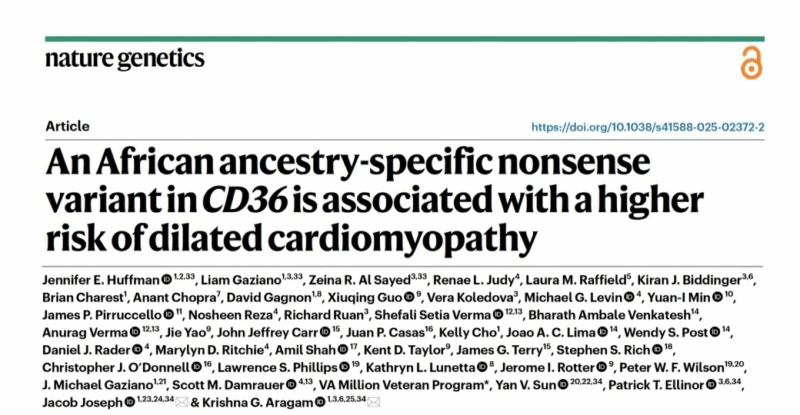
Article: An African ancestry-specific nonsense variant in CD36 is associated with a higher risk of dilated cardiomyopathy
Authors: Jennifer E. Huffman, Liam Gaziano, Zeina R. Al Sayed, Renae L. Judy, Laura M. Raffield, Kiran J. Biddinger, Brian Charest, Anant Chopra, David Gagnon, Xiuqing Guo, Vera Koledova, Michael G. Levin, Yuan-I Min, James P. Pirruccello, Nosheen Reza, Richard Ruan, Shefali Setia Verma, Bharath Ambale Venkatesh, Anurag Verma, Jie Yao, John Jeffrey Carr, Juan P. Casas, Kelly Cho, Joao A. C. Lima, Wendy S. Post, Daniel J. Rader, Marylyn D. Ritchie, Amil Shah, Kent D. Taylor, James G. Terry, Stephen S. Rich, Christopher J. O’Donnell, Lawrence S. Phillips, Kathryn L. Lunetta, Jerome I. Rotter, Peter W. F. Wilson, J. Michael Gaziano, Scott M. Damrauer, VA Million Veteran Program, Yan V. Sun, Patrick T. Ellinor, Jacob Joseph, Krishna G. Aragam
Stay updated on all scientific advances with Hemostasis Today.
-
Oct 10, 2026, 10:07Maha Othman: Look Forward to an Amazing ISTH 2027 in Vancouver!
-
Oct 10, 2026, 10:02Rucha Patil: National Convening Highlights Opportunities for Equitable Hemophilia Care Across India
-
Oct 10, 2026, 09:52Yuria Ito: Should Ferritin Testing Become a Routine Part of Prenatal Care in Japan?
-
Oct 10, 2026, 09:48Ahmed Alotaibi: Can We “Remove” the ABO Problem from Group O Platelets?
-
Oct 10, 2026, 09:31Help Shape the New ASH Iron Deficiency Guidelines – American Society of Hematology
-
Oct 10, 2026, 09:05Wolfgang Miesbach: Moving from Bleed Control to Comprehensive Joint Health
-
Oct 10, 2026, 07:59Leila Caroline Souza Reis: Enoxaparin Dosing for VTE Prevention in Adults With Obesity
-
Oct 10, 2026, 07:41Adeeb Bazuhair: New Evidence for Catheter Directed Thrombolysis in Acute PE
-
Oct 10, 2026, 07:22Poppy Clarke: Turning Steps Into Support for Thrombosis Awareness