


Marek Trojanowicz: New Real-World Evidence Strengthens the Case for BrainScan in Acute Stroke Care
Marek Trojanowicz, Co-Founder and Member of the Supervisory Board at BrainScan.AI, shared on LinkedIn about a recent article by Eray Halil et al, published in Neurology International, adding:
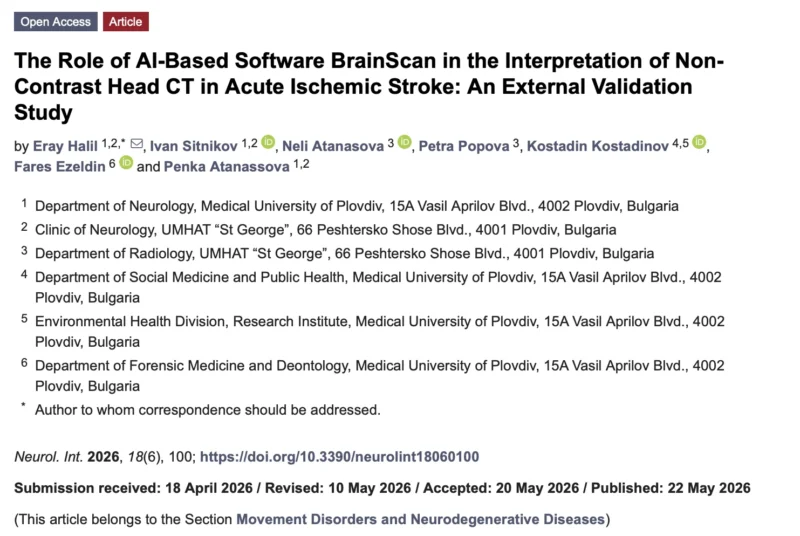
”The Role of AI-Based Software BrainScan in the Interpretation of Non-Contrast Head CT in Acute Ischemic Stroke: An External Validation Study
Independent validation matters.
A newly published peer reviewed study externally validated BrainScan in a real-world acute stroke workflow using 1,419 non-contrast head CT examinations from 1,260 consecutive patients.
Key findings:
- AUC 0.930 for acute ischemic stroke detection
- 99.8% specificity for ischemic stroke identification
- 96.7% sensitivity for intracranial hemorrhage detection
- AUC 0.983 for hemorrhage detection
- Performance independently evaluated by investigators outside the software developer organization
The study highlights what matters most in emergency neuroimaging: rapid identification of critical findings and support for clinical decision-making when every minute counts.
BrainScan continues to demonstrate how AI can help radiologists and stroke teams prioritize urgent cases, accelerate workflows, and improve access to expert-level neuroimaging support. We are proud to see BrainScan evaluated in independent clinical research and contributing to the growing body of evidence supporting AI in stroke care.
Congratulations to the authors for this important contribution to the field of AI-powered stroke imaging: Eray Halil, Ivan Sitnikov, Neli Atanasova, Petra Popova, Kostadin Kostadinov, Fares Ezeldin and Penka Atanassova.”
Title: The Role of AI-Based Software BrainScan in the Interpretation of Non-Contrast Head CT in Acute Ischemic Stroke: An External Validation Study
Authors: Eray Halil, Ivan Sitnikov, Neli Atanasova, Petra Popova, Kostadin Kostadinov, Fares Ezeldin, Penka Atanass
Stay updated on all scientific advances with Hemostasis Today.
-
Nov 9, 2026, 10:32Natalie Arnold: The Lp(a) Puzzle – Why Lower Levels May Not Tell the Whole Story
-
Nov 9, 2026, 10:22ISBT Opens Applications for the I TRY IT Programme 2027
-
Nov 9, 2026, 10:08Ibrahim Mansoor: Rare Tests, Common Diseases – Rethinking Autoimmune Diagnostics
-
Nov 9, 2026, 09:29Veronica Sanchez: A Framework for Woman’s Health
-
Nov 8, 2026, 19:31Anna Kajaste-Rudnitski: Presenting AAV-Induced p53 Signalling in Human CNS Cells at ESGCT 26
-
Nov 8, 2026, 19:29David McIntosh: Cybersecurity Matters, but Blood Availability Remains the Bigger Challenge
-
Nov 8, 2026, 19:26Wenxue Ma: An Integrative Framework for Macrophage-Mediated Therapeutic Resistance in Cancer
-
Nov 8, 2026, 19:25Yildiz Yigit: Presenting a Polycythemia Vera Case at the MPN Subcommittee Session
-
Nov 8, 2026, 18:56Denis Oduor: Strengthening the Regulation and Delivery of Blood Transfusion and Transplantation Services