


Maria Cherska: Beyond LDL – Remnant Cholesterol and Stroke Prognosis
Maria Cherska, The Head of Cardiology Department at The State Institution V.P. Komisarenko Institute of Endocrinology and Metabolism, shared a post on LinkedIn about a recent article by Changhong Yuan et al., published in Lipids in Health and Disease, adding:
“Could remnant cholesterol help identify patients at risk of poorer recovery after ischaemic stroke?
A new article in Lipids in Health and Disease explores the relationship between remnant cholesterol, carotid plaque burden and early outcomes after acute ischaemic stroke.
In a retrospective cohort of 623 patients, higher remnant cholesterol was associated with both early neurological deterioration and poor functional outcome at three months.
Key findings
Compared with the lowest remnant cholesterol quartile, patients in the highest quartile had:
- 3.47-fold higher adjusted odds of early neurological deterioration.
- 2.85-fold higher adjusted odds of poor functional outcome at three months.
Exploratory analyses also suggested that maximum carotid plaque thickness may partly mediate these associations, offering a potential link between circulating atherogenic lipoproteins, plaque burden and stroke prognosis.
Why does this matter?
The findings support further investigation of remnant cholesterol alongside vascular imaging to better understand risk after stroke.
However, this was a single-centre observational study that excluded patients receiving thrombolysis or endovascular treatment. It does not establish causality or demonstrate that lowering remnant cholesterol improves recovery.
Prospective validation and intervention trials are needed.
An interesting contribution to the discussion of lipid-related risk beyond LDL cholesterol – and the relationship between biomarkers and vascular disease.”
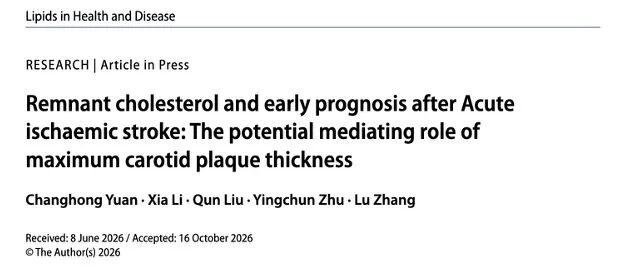
Title: Remnant cholesterol and early prognosis after Acute ischaemic stroke: The potential mediating role of maximum carotid plaque thickness
Authors: Changhong Yuan, Xia Li, Qun Liu, Yingchun Zhu, Lu Zhang
Other posts featuring Maria Cherska on Hemostasis Today.
-
Nov 3, 2026, 22:00Ravi C Dara: What’s New in ASFA’s 10th Edition – Practical Updates for the Apheresis Clinician
-
Nov 3, 2026, 21:46Cedric Hermans: Treatment Differentiators for Shared Decision-Making in Haemophilia in 2026
-
Nov 3, 2026, 21:38Arwa Z. Al-Riyami: AI Opportunities and Future Directions in Transfusion Medicine
-
Nov 3, 2026, 21:11Yazan Abou-Ismail: Presenting at American College of Emergency Physicians and MWTCC in the Same Week
-
Nov 3, 2026, 21:05Anirban Sen Gupta: Escalating-Dose Lyophilized SynthoPlate for Emergency Trauma Mitigation
-
Nov 3, 2026, 20:50Mostafa Faisal Mohammed Saleh: Targeting Plasma Cells to Control Persistent ADAMTS13 Autoantibodies in iTTP
-
Nov 3, 2026, 16:57Ahmed Alotaibi: Which Macrophage Receptor ‘eats’ anti-E and Anti-K Coated RBCs?
-
Nov 3, 2026, 16:53Jan Sloves: Key Factors for Achieving Durable Patency in Advanced Venous Stenting
-
Nov 3, 2026, 16:45Nina Weber: Review on Kidney Injury After Stem Cell Transplantation