


Martin Haluzík Analyzes the Overall Accuracy of Current Available Smartwatches in Identifying AF
Martin Haluzík, Professor of Medicine at Institute for Clinical and Experimental Medicine, shared on LinkedIn about a recent article by Nelson Barrera et al, published in JACC:
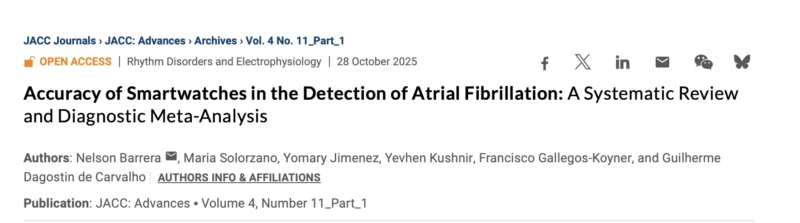
”Accuracy of Smartwatches in the Detection of Atrial Fibrillation: A Systematic Review and Diagnostic Meta-Analysis
Very interesting paper recently published in JACC: Advances by Nelson Barrera and colleagues.
Atrial fibrillation (AF) is the most prevalent arrhythmia and a significant risk factor for stroke and heart disease, making early diagnosis crucial for prevention. Although several smartwatches can detect AF, their accuracy varies, and there is limited information regarding their effectiveness.
The purpose of this study was to analyze the overall accuracy of current available smartwatches in identifying AF.
A comprehensive systematic literature search was performed across major databases for articles published until January 2025.
The specificity, sensitivity, and area under the curve (AUC). Statistical analysis was conducted using R software.
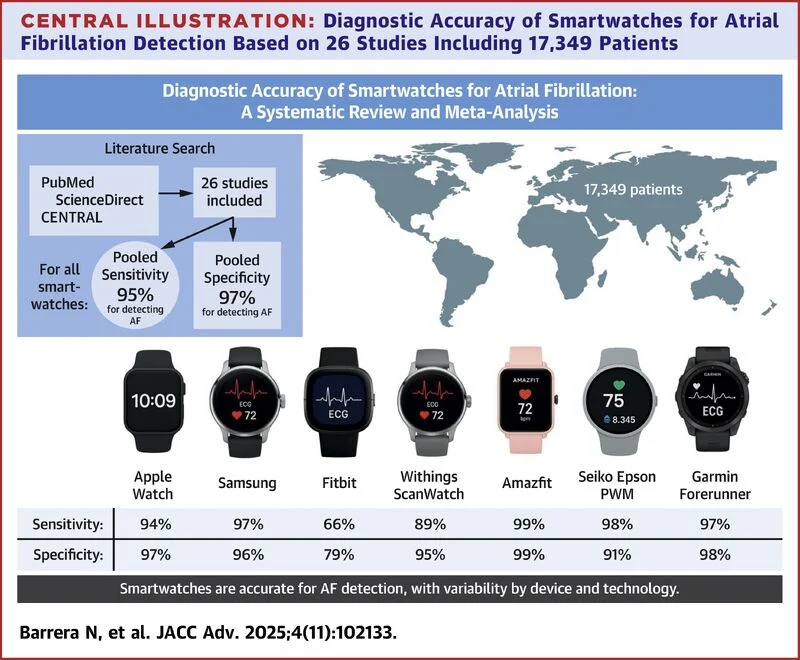
Twenty-six studies were included in the study, including 17,349 patients. Overall sensitivity was 95% (95% CI: 92%-97%; I2 = 95%) and specificity 97% (95% CI: 94%-98%; I2 = 99%), with a pooled AUC of 0.97 (95% CI: 0.96%-0.99%).
Device performance varied, with the Apple Watch achieving 94% sensitivity (95% CI: 89%-96%; I2 = 71%) and 97% specificity (95% CI: 93%-99%; I2 = 87%), Samsung devices yielding 97% sensitivity (95% CI: 92%-99%; I2 = 92%) and 96% specificity (95% CI: 91%-98%; I2 = 92%), and the Withings Scan Watch showing 89% sensitivity (95% CI: 75%-96%; I2 = 94%) and 95% specificity (95% CI: 88%-99%; I2 = 93%).
Accuracy was comparable between photoplethysmography and electrocardiogram-based models.
Smartwatches possess excellent diagnostic accuracy for AF detection and may, therefore, represent a suitable and fitting option for patients.
- Very interesting data
- Overall, impressive specificity and sensitivity.
- Now, the question is, should all patients with high risk of AF wear these devices to detect and treat early?
- I would bet that not only money but also couple of lifes could be saved by this approach
Excellent paper! Congratulations to the authors!”
Title: Accuracy of Smartwatches in the Detection of Atrial Fibrillation: A Systematic Review and Diagnostic Meta-Analysis
Authors: Nelson Barrera, Maria Solorzano, Yomary Jimenez, Yevhen Kushnir, Francisco Gallegos-Koyner, Guilherme Dagostin de Carvalho
Read the Full Article on JACC
Stay updated on all scientific advances with Hemostasis Today.
-
Sep 20, 2026, 13:29Factor XI Deficiency and the Challenge of Unpredictable Bleeding – EHC
-
Sep 20, 2026, 13:18Cindy Howry: FDA Approves First Treatment for Ataxia-Telangiectasia
-
Sep 20, 2026, 13:08Mohammad Salar Amoli: When Routine Coagulation Tests Miss von Willebrand Disease
-
Sep 20, 2026, 12:55Stelios Andreadis։ Human Salivary Gland Organoids Offer New Potential for Regenerative Medicine
-
Sep 20, 2026, 12:43Obi Light Ogbonnia: The Power of Lived Experience in Sickle Cell Care
-
Sep 20, 2026, 12:34Sabrine Mekni: Advancing HSCT for Children With Fanconi Anemia
-
Sep 20, 2026, 12:11Giacomo Buso: Silent Atherosclerosis Begins Earlier Than Expected
-
Sep 20, 2026, 12:0310 Posts Not to Miss This Week
-
Sep 20, 2026, 11:27Edward Lee Carter: Prasugrel Dosing Matters in P2Y12 Inhibitor Comparisons After PCI