


Short and Informative About Myocardial Infarction by Nassim Emteir: What is It and What to Do
Nassim Emteir, Consultant in internal medicine and emergency at Gesundheitszentrum Fricktal AG, shared a post on LinkedIn:
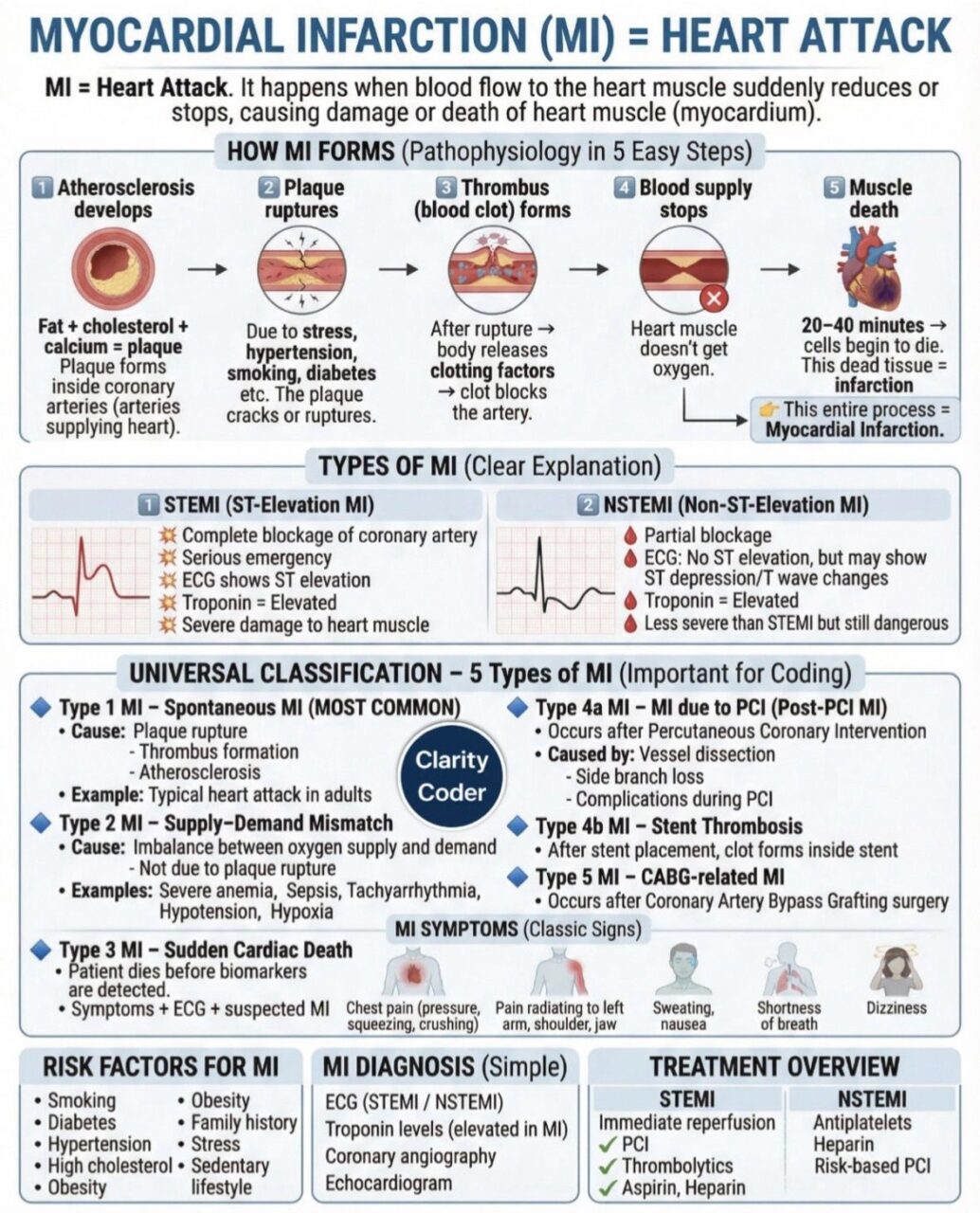
“What is MI (Myocardial Infarction)?
MI = Heart Attack.
It happens when blood flow to the heart muscle suddenly reduces or stops, causing damage or death of heart muscle (myocardium).
How MI Forms (Pathophysiology in 5 Easy Steps)
- Atherosclerosis develops
Fat + cholesterol + calcium = plaque
This plaque forms inside coronary arteries (arteries supplying heart). - Plaque ruptures
Due to stress, hypertension, smoking, diabetes etc.
The plaque cracks or ruptures. - Thrombus (blood clot) forms
After rupture → body releases clotting factors → clot blocks the artery. - Blood supply stops
Heart muscle doesn’t get oxygen. - Muscle death
20–40 minutes → cells begin to die.
This dead tissue = infarction.
This entire process = Myocardial Infarction.
Types of MI (Clear Explanation)
- STEMI (ST-Elevation MI)
Complete blockage of coronary artery
Serious emergency
ECG shows ST elevation
Troponin = Elevated
Severe damage to heart muscle - NSTEMI (Non-ST-Elevation MI)
Partial blockage
ECG: No ST elevation, but may show ST depression/T wave changes
Troponin = Elevated
Less severe than STEMI but still dangerous
Universal Classification – 5 Types of MI (Important for Coding)
Type 1 MI – Spontaneous MI (MOST COMMON)
Cause:
Plaque rupture
Thrombus formation
Atherosclerosis
Example: Typical heart attack in adults.
Type 2 MI – Supply–Demand Mismatch
Cause: Imbalance between oxygen supply and demand
Not due to plaque rupture.
Examples:
Severe anemia
Sepsis
Tachyarrhythmia
Hypotension
Hypoxia
Type 3 MI – Sudden Cardiac Death
Patient dies before biomarkers are detected.
Symptoms + ECG + suspected MI.
Type 4a MI – MI due to PCI (Post-PCI MI)
Occurs after Percutaneous Coronary Intervention.
Caused by:
Vessel dissection
Side branch loss
Complications during PCI
Type 4b MI – Stent Thrombosis
After stent placement, clot forms inside stent.
Type 5 MI – CABG-related MI
Occurs after Coronary Artery Bypass Grafting surgery.
MI Symptoms (Classic Signs)
Chest pain (pressure, squeezing, crushing)
Pain radiating to left arm, shoulder, jaw
Sweating, nausea
Shortness of breath
Dizziness
Risk Factors for MI
Smoking
Diabetes
Hypertension
High cholesterol
Obesity
Family history
Stress
Sedentary lifestyle
MI Diagnosis (Simple)
ECG (STEMI / NSTEMI)
Troponin levels (elevated in MI)
Coronary angiography
Echocardiogram
Treatment Overview
STEMI
Immediate reperfusion
- PCI
- Thrombolytics
- Aspirin, Heparin
NSTEMI
Antiplatelets
Heparin
Risk-based PCI”
Follow the latest in Hemostasis Today.
-
Sep 29, 2026, 14:43Mary Cushman: Apply to Shape Scientific Publishing as ISTH Associate Editor
-
Sep 29, 2026, 14:32Honoring Women Leaders Advancing Research, Care, and Innovation in Thrombosis and Hemostasis – Seminars in Thrombosis and Hemostasis
-
Sep 29, 2026, 14:20Nathan Connell: Key Takeaways from the 8th Aland Island Meeting on von Willebrand Disease
-
Sep 29, 2026, 14:09Mariusz Ratajczak: Are We Inadvertently Destroying the True Regenerative Power of PRP by Discarding the Plasma?
-
Sep 29, 2026, 14:00Nithin M: Proximal Splenic Artery Embolization Prior to Shunt-Directed Variceal Therapy
-
Sep 29, 2026, 13:12Wolfgang Miesbach: Teclistamab Targets the Source of Pathogenic Autoantibodies
-
Sep 29, 2026, 12:37Dan Milikovsky: Uncovering Cerebrovascular Injury in Sickle Cell Disease
-
Sep 29, 2026, 12:02Hajra Malik: Bridging Language Gaps in Hematology With AI
-
Sep 29, 2026, 11:57Joan Montaner: Can Blood Test Identify Intracerebral Hemorrhage Within Minutes?