


Paris Margaritis: Native Cellular Biology and the Future of Durable Hemophilia A Gene Therapy
Paris Margaritis, Chief Scientific Officer at GeneVentiv Therapeutics, Inc, shared on LinkedIn about a recent article by Paige E. Severeid et al, published in Blood Advances, adding:
”A newly published study in Blood Advances provides important insight into one of the key challenges facing current FVIII gene therapies for hemophilia A.
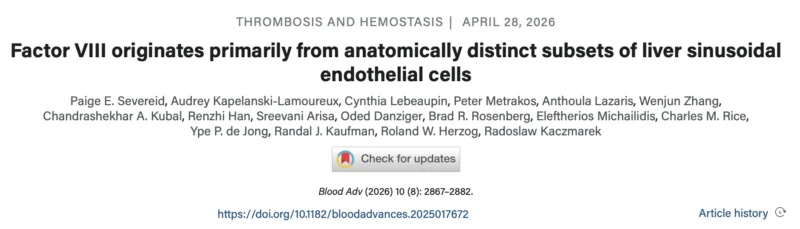
The paper further demonstrates that endogenous FVIII is produced primarily by liver sinusoidal endothelial cells (LSECs), not hepatocytes, and highlights that ‘discordance between natural FVIII biosynthesis sites and cellular targets of adeno-associated viral vectors has been implicated in efficacy limitations of current gene therapies for HA.’
The paper further reinforces the importance of aligning gene therapy design with endogenous cellular biology, an increasingly important consideration for durable expression in hemophilia gene therapy.
This is equally interesting and important work for the field and congratulations to all the authors and Roland W Herzog and Radoslaw (Radek) Kaczmarek.
Why this is important:
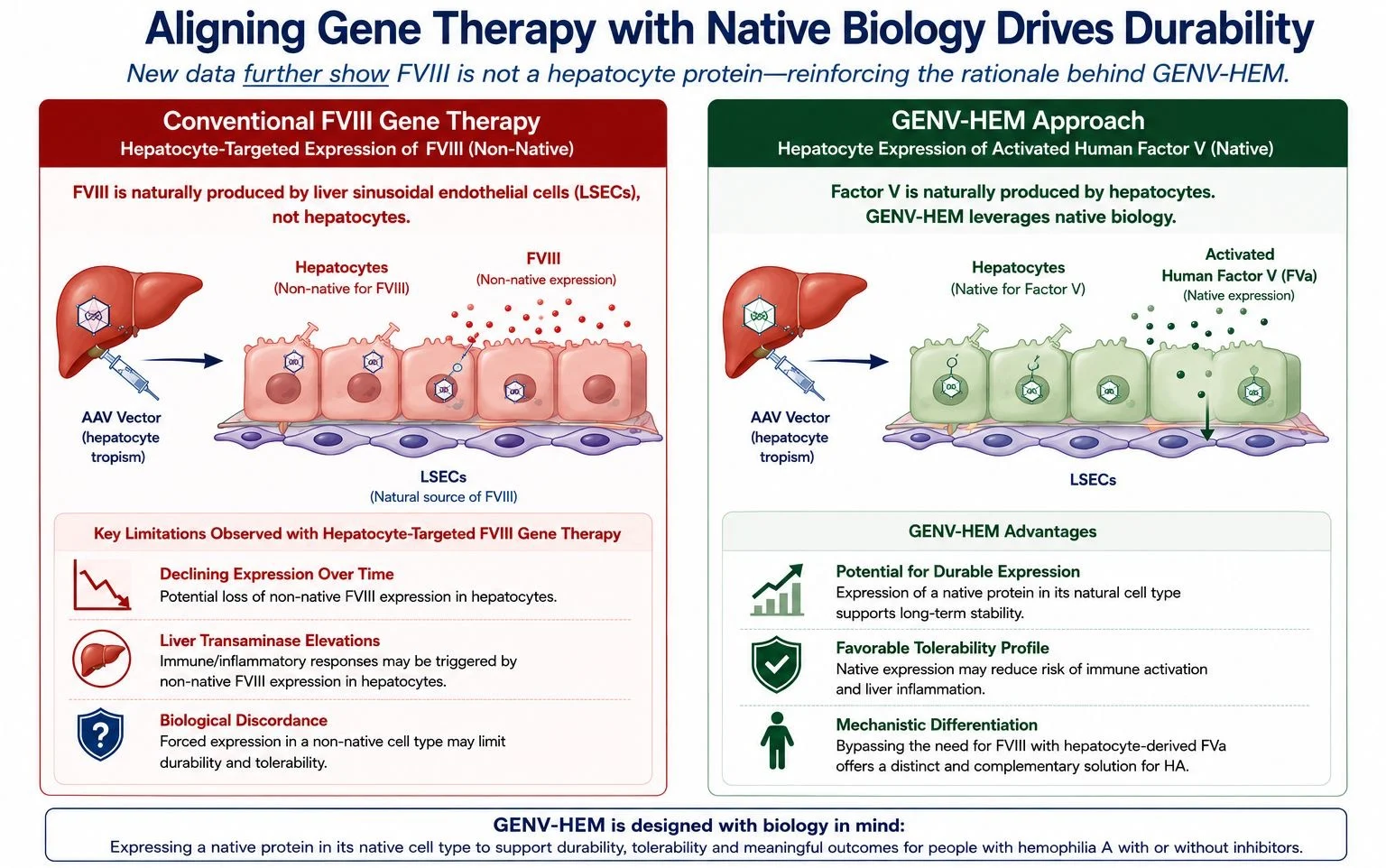
This work is highly relevant for hemophilia A gene therapies given the declining or variable expression observed with hepatocyte-targeted FVIII gene therapies such as valoctocogene roxaparvovec (Roctavian).
GeneVentiv’s GENV-HEM was designed to treat hemophilia A, regardless of inhibitors, from a fundamentally different biological premise.
Rather than forcing non-native FVIII expression in hepatocytes, GENV-HEM expresses activated human Factor V (FVa) in hepatocytes, the natural cellular site for Factor V synthesis.
This native-expression approach is intended to leverage the liver’s intrinsic biology, potentially supporting improved tolerability and long-term durability, including in patients with inhibitors.
Preclinical mouse data indeed support both such durability and efficacy and clinically relevant evaluation in hemophilia A dogs is currently ongoing.”
Title: Factor VIII originates primarily from anatomically distinct subsets of liver sinusoidal endothelial cells
Authors: Paige E. Severeid, Audrey Kapelanski-Lamoureux, Cynthia Lebeaupin, Peter Metrakos, Anthoula Lazaris, Wenjun Zhang, Chandrashekhar A. Kubal, Renzhi Han, Sreevani Arisa, Oded Danziger, Brad R. Rosenberg, Eleftherios Michailidis, Charles M. Rice, Ype P. de Jong, Randal J. Kaufman, Roland W. Herzog, Radoslaw Kaczmarek
Stay updated on all scientific advances with Hemostasis Today.
-
Oct 13, 2026, 21:05Francisco Chacón-Lozsán: Heparin-Induced Thrombocytopenia – When an Anticoagulant Triggers Thrombosis
-
Oct 13, 2026, 21:04Aref Zribi: Isolated Tumor Thrombus and the Role of Prophylactic Anticoagulation
-
Oct 13, 2026, 21:01Alex Larson: Why Normal Bloodwork Does Not Always Tell the Whole Story
-
Oct 13, 2026, 20:58Juan Jauregui-Lozano: How Replication Stress Impairs Red Blood Cell Maturation
-
Oct 13, 2026, 20:55Caitlin Raymond: Understanding Platelet Refractoriness Before Ordering More Platelets
-
Oct 13, 2026, 20:54Sanja Seratlic: How Cow Feeding Systems Influence the Anti-Platelet Properties of Cheddar Cheese
-
Oct 13, 2026, 20:50Ruchika Goel: Cord Blood Red Blood Cells as a Physiologically Aligned Transfusion Strategy
-
Oct 13, 2026, 20:47Sophia Delicou: Strengthening Transfusion Safety Through Advanced Screening and Haemovigilance
-
Oct 13, 2026, 20:45Lydia Pecker: Alloimmunization and Transfusion Indications in Sickle Cell Disease Pregnancy