


Perioperative Bleeding Management: What 1,030+ U.S. Anesthesiologists Think About Current Challenges
Wolfgang Miesbach, Professor of Medicine at Frankfurt University Hospital, shared on LinkedIn:
”Perioperative Bleeding Management: What 1,030+ U.S. Anesthesiologists Think About Current Challenges
50.6% practiced primarily at academic medical centers, while 42.3% worked in community hospitals, with additional representation from military/VA hospitals (3.7%). Nearly half (48.4%) worked at Level I trauma centers
The Progress
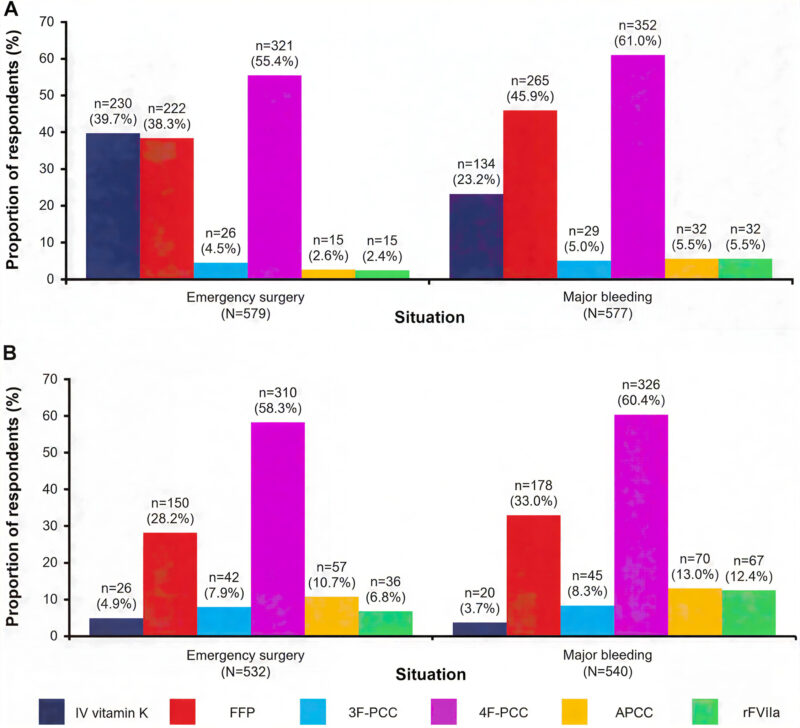
Prothrombin complex concentrates (PCCs) have become the dominant choice for managing anticoagulated patients in emergency settings. For warfarin reversal, 4-factor PCCs jumped from 30% adoption in 2019 to 55.4% in 2023. Similarly, PCCs are now chosen by 76.9% of clinicians for direct oral anticoagulant (DOAC) reversal before emergency surgery, up from 44% just four years earlier.
Fresh frozen plasma (FFP) – once the default choice – has dramatically declined in use from 75% to just 38.3% for warfarin reversal, replaced by more targeted, efficient interventions.
The Challenges That Remain
Access and Approval Remain Fragmented: Despite clear guidelines, 19.3% of respondents lack access to PCCs entirely, while 18.9% face approval requirements that could delay life-saving interventions.
Inconsistent Institutional Protocols: For DOAC management, only 33.8% of clinicians have formal institutional protocols in place, while 44% didn’t even know if their hospital had one.
Resource Limitations for Advanced Testing: Just 36.2% of hospitals can access drug-specific anti-FXa level testing for apixaban or rivaroxaban—essential data for informed decision-making in urgent scenarios.
The DOAC Reversal Agent Gap: While specific DOAC reversal agents exist—idarucizumab for dabigatran and andexanet alfa for apixaban/rivaroxaban – the survey revealed a notable limitation: their usage patterns weren’t assessed. However, the recent ANNEXA-I trial showed that 85.5% of patients in the standard care group received PCCs, highlighting their continued prominence despite available specific antidotes.
Fibrinogen Concentrate: While fibrinogen concentrate (FIBRYGA®) recently received FDA approval for acquired fibrinogen deficiency based on the FIBRES trial demonstrating non-inferiority to cryoprecipitate, uptake remains remarkably low at just 5.5%, with cryoprecipitate dominating at 65.9%.
Massive Transfusion Protocols (MTPs): While 92.9% of respondents reported having an MTP at their hospital, there’s striking heterogeneity in fibrinogen replacement strategies: 44.3% use cryoprecipitate exclusively, 24.5% use either product based on availability, but 26.3% don’t include fibrinogen replacement at all in their protocols.
For severe acquired factor deficiencies during cardiac surgery(60.0%), liver surgery (66.9%), and postpartum hemorrhage (71.3%), FFP remains the first-line choice – despite its limitations, including volume overload and delayed onset.
Journal of Thrombosis and Haemostasis (JTH) International Society on Thrombosis and Haemostasis (ISTH)
Link here.”
Title: Perioperative use of factor concentrates and blood products—a survey of clinical practices in the United States: communication from the ISTH Subcommittee on Perioperative and Critical Care
Authors: Jerrold H. Levy, Joseph R. Shaw, Kamrouz Ghadimi, Cheryl L. Maier, James Douketis, Keyvan Karkouti, Michael Mazzeffi, Alex C. Spyropoulos, Kenichi A. Tanaka, Jean M. Connors, Roman M. Sniecinski
Stay updated with Hemostasis Today.
-
Oct 16, 2026, 16:48Abdul Rahman: Reticulocyte Count and Bone Marrow Activity
-
Oct 16, 2026, 16:44DOAC Adherence in Stroke Patients With Atrial Fibrillation – International Journal of Stroke
-
Oct 16, 2026, 16:22Shannon Farmer: Driving Patient Blood Management Forward in Australia and New Zealand
-
Oct 16, 2026, 16:01Obi Light Ogbonnia: The Greatest Reward Is Changing Lives, Not Winning Awards
-
Oct 16, 2026, 15:18Carmine Liberatore: Limited Accuracy of VTE Risk Scores in Multiple Myeloma
-
Oct 16, 2026, 14:55Alex Borstein and the Bleeding Phenotype of Hemophilia A Carriers
-
Oct 16, 2026, 13:59Aya Akmal Amin: Antiphospholipid Syndrome Management and Risk Stratification
-
Oct 16, 2026, 13:10Emanuel Sueldo: CAHT 2026 Celebrates Scientific Progress and Team Achievements
-
Oct 16, 2026, 13:05Maha Othman: Queen’s Health Sciences Advances CAT Risk Models and Pediatric ISTH-BAT Cut-Offs