


Reza Hosseini Ghomi: A New Tool Predicts The Onset of Dementia After Stroke
Reza Hosseini Ghomi, Chief Executive Officer of MedFlow, shared on LinkedIn:
”Had a stroke? Your dementia risk just tripled.
New tool predicts exactly when.
International Stroke Conference this week:
45,000 stroke patients tracked 8.4 years
New prediction model
Better accuracy than existing tools
Why matters:
1 in 4 stroke survivors develops dementia
Most within 5 years
Early intervention works
Nobody’s screening
The tool:
Models for ischemic stroke, hemorrhagic stroke, TIA
Predicts risk at 1, 3, 5, 10 years
Inputs: Age, stroke type, severity, vascular risks, recurrent strokes
Output: Individual risk percentage, risk category, timeline
Why stroke causes dementia:
Direct brain damage, vascular cascade, inflammation spreads.
Most survivors don’t know this risk.
Current care after stroke:
- Physical therapy: Yes
- Speech therapy: Yes
- Cardiac risk reduction: Yes
- Cognitive screening: Rarely
- Dementia prevention: Almost never
The gap:
Patients focus on physical recovery. Doctors focus on preventing second stroke.
Nobody focuses on brain health.
Meanwhile: Dementia risk climbing, intervention window closing, prevention possible but not offered.
What tool enables:
Identify highest-risk patients, enroll in prevention trials, aggressive vascular management, early cognitive interventions.
Real application:
73-year-old, moderate ischemic stroke. Risk score: 45% dementia within 5 years.
Interventions: Intensive BP control (<120/80), cognitive rehabilitation, Mediterranean diet, social engagement, monthly monitoring.
3 years later: No cognitive decline, risk reduced to 15%.
Prevention worked because we predicted and intervened.
Why most don’t get this:
- Tool for research, not clinical use yet
- No reimbursement for prevention
- Not in guidelines
- Most neurologists don’t think about it
The disconnect:
- Cardiologists prevent second heart attack
- Neurologists prevent second stroke
- Nobody prevents the dementia
What stroke survivors should demand:
Baseline cognitive testing, risk stratification, prevention plan, regular monitoring.
Not “wait and see.” Act before symptoms.
What reduces risk:
Aggressive BP: 30-50% reduction
Cholesterol management: Significant
Physical activity: 35% reduction
Cognitive stimulation: Maintains reserve
Social engagement: 60% benefit
Mediterranean diet: Established
All modifiable. All underused.
Current approach: “Glad you survived the stroke.”
Better approach: “Now let’s prevent the dementia.”
Clinical trial opportunity:
Tool identifies perfect candidates, test prevention strategies, measure outcomes systematically.
Current state:
We’ve quantified risk, built prediction tool, know interventions.
Just not implementing.
Classic healthcare problem.
Know someone who’s had a stroke?
Repost if prevention should follow prediction
Follow me (Reza Hosseini Ghomi, MD, MSE) for practical neurology
Citation: Joundi RA, et al. Novel clinical risk prediction tool for dementia after transient ischemic attack and stroke. Presented at: International Stroke Conference 2026”
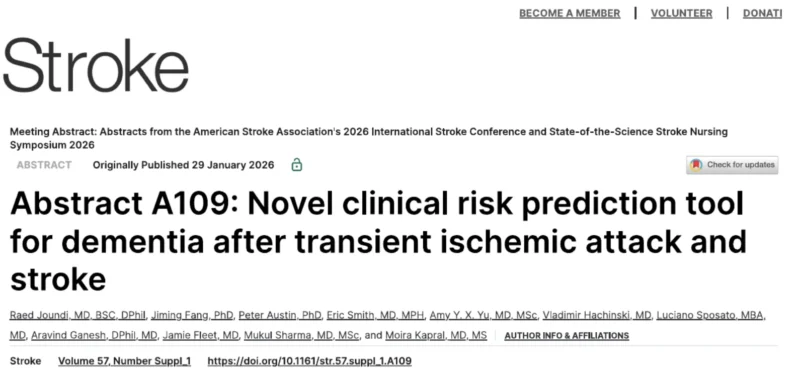
Title: Abstract A109: Novel clinical risk prediction tool for dementia after transient ischemic attack and stroke
Authors: Raed Joundi, Jiefeng Fang, Peter Austin, Eric Smith
Read the Full Article on Stroke/ResearchGate
Stay updated on all scientific advances with Hemostasis Today.
-
Oct 4, 2026, 15:06Vasiliki Gkalea: Journal of Clinical Medicine Launches Special Issue on Hematologic Thrombosis and Bleeding
-
Oct 4, 2026, 14:55Quentin Brebant: What Defines a High-Quality Red Blood Cell Concentrate?
-
Oct 4, 2026, 14:47Rana Al-Hrout: Recognizing Non-Anemic Iron Deficiency – Why Iron Matters Beyond Hemoglobin
-
Oct 4, 2026, 14:41David McIntosh: International Plasma Awareness Week 2026 – Closing the Global Plasma Gap
-
Oct 4, 2026, 14:33Pete Stibbs: CleanerVac Real-World Study Presented at VIVA and The VEINS 2026
-
Oct 4, 2026, 13:56Maria Elisa Mancuso: EHC 2026 Highlights the Unmet Needs of Women with Bleeding Disorders
-
Oct 4, 2026, 13:53Nirmal Shaji George: Individualizing Anticoagulation in Complex APS and Thrombocytopenia
-
Oct 4, 2026, 13:5210 Posts Not to Miss This Week
-
Oct 4, 2026, 13:45Suswapna Singh Rawat: The Clinical Significance of Coronary Plaque Stability