


Roberta Gualtierotti: How Do Sex and Gender Influence VTE in Patients with Cancer?
Roberta Gualtierotti, Associate Professor of Internal Medicine at the University of Milan, posted on LinkedIn about a recent article she and her colleagues co-authored, adding:
”Cancer-associated thrombosis (CAT) remains one of the leading causes of morbidity and mortality in oncology.
Yet one important dimension of risk is still insufficiently explored: sex and gender differences.
How do sex and gender influence venous thromboembolism (VTE) in patients with cancer?
Men generally show a higher overall incidence of cancer-associated VTE.
- Women may experience earlier thrombotic events, often related to anticancer therapies.
- Biological differences in coagulation and inflammation may contribute to these patterns, although the underlying mechanisms are still not fully understood.
- Sex-related disparities also appear in treatment complications, including bleeding risk and abnormal uterine bleeding in anticoagulated women of reproductive age.
- In hematologic malignancies, evidence on sex differences in thrombosis remains limited and inconsistent.
In addition, gender-related inequalities in clinical trial participation still affect the interpretation of available data.
Overall, current evidence supports sex as a clinically relevant modifier of cancer-associated thrombosis risk.
Advancing research that systematically integrates sex- and gender-informed analyses and sex-stratified reporting will be essential to improve mechanistic understanding and support precision medicine in thrombosis and oncology.”
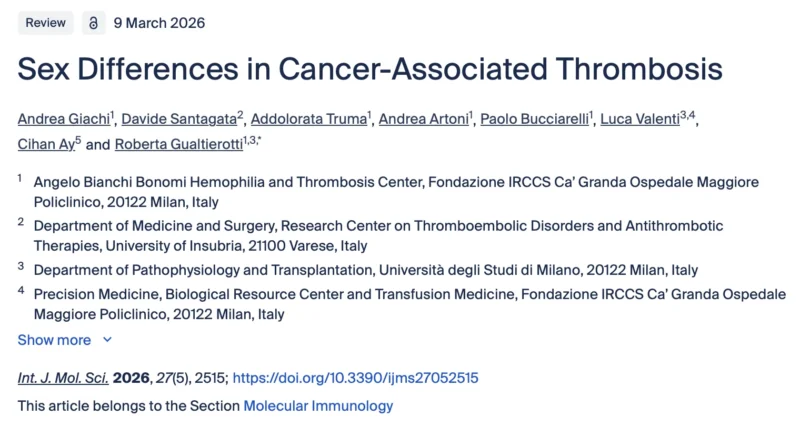
Title: Sex Differences in Cancer-Associated Thrombosis
Authors: Andrea Giachi, Davide Santagata, Addolorata Truma, Andrea Artoni, Paolo Bucciarelli, Luca Valenti, Cihan Ay, Roberta Gualtierotti
Read the Full Article on International Journal of Molecular Sciences
Stay updated on all scientific advances with Hemostasis Today.
-
Sep 11, 2026, 17:41Khaled Musallam: Earlier Recognition, Better Outcomes in NTDT
-
Sep 11, 2026, 17:29Reyhan Kose Cobanoglu: APS ACTION Registry Study Published in Lupus
-
Sep 11, 2026, 17:14Obi Light Ogbonnia: From Kenya to Global Sickle Cell Advocacy
-
Sep 11, 2026, 17:01EAHAD 2027 Marks 20 Years
-
Sep 11, 2026, 16:54Denise Braendgaard: Reimagining Health Systems Through Collective Action
-
Sep 11, 2026, 16:47Jehad Khamaysa: Budd-Chiari Syndrome as the Initial Presentation of Behçet’s Disease in a 16-Year-Old
-
Sep 11, 2026, 16:44Mostafa Faisal Mohammed Saleh: From HLA Biology to Curative Therapy
-
Sep 11, 2026, 16:38Jim Kaveney: Class I, Level A – Lifestyle is Now the Official Standard in AFib Care
-
Sep 11, 2026, 16:31George Touma: Do We Really Need to Implant Metal in Every High-Bleeding-Risk Patient?