


Salvatore Massimo Petrina – Smart D-Dimer Use: A 3-Step Pathway to Better Diagnosis
Salvatore Massimo Petrina, Hospital Physician Cardiology ASP Ragusa, shared on LinkedIn:
“Smart D-Dimer Use: A 3-Step Pathway to Better Diagnosis
Navigating D-dimer results can be tricky. Its high sensitivity but low specificity means it’s a powerful tool if used correctly. Overuse can lead to unnecessary anxiety and imaging, while underuse can miss critical diagnoses like PE or DVT.
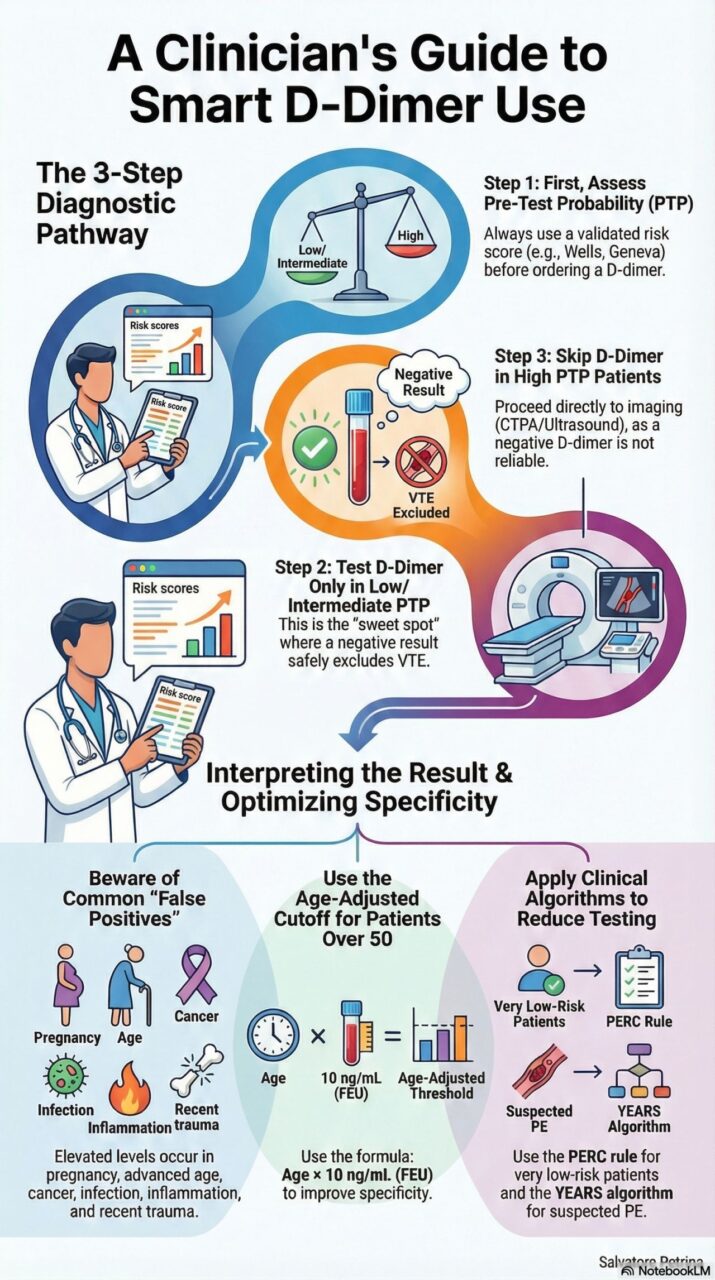
Based on the clinician’s guide, here’s a simple 3-step pathway to optimize D-dimer use in your practice:
Step 1: Assess Pre-Test Probability (PTP)
Never order a D-dimer in a vacuum. Start by assessing the clinical likelihood of Venous Thromboembolism (VTE) using a validated risk score (e.g., Wells’ score). This is the most critical step.
Step 2: D-Dimer for Low/Medium PTP
If the PTP is low or intermediate, a D-dimer test is appropriate. A negative result can effectively rule out VTE, avoiding the need for further imaging.
Step 3: Imaging for High PTP
If the PTP is high, proceed directly to diagnostic imaging (e.g., CT pulmonary angiography). A D-dimer test in this scenario is often a detour that delays definitive treatment.
Optimizing Specificity and Avoiding Pitfalls:
Beware of False Positives: Remember that factors like pregnancy, malignancy, Aortic dissection and inflammation can elevate D-dimer levels.
Use Age-Adjusted Cutoffs: For patients over 50, use an age-adjusted cutoff (Age x 10 ng/mL) to improve specificity and reduce false positives.
Consider Clinical Algorithms: Tools like the PERC and YEARS rules can further streamline decision-making in the emergency department.
Using a structured approach ensures we leverage the D-dimer’s strengths while minimizing its weaknesses, leading to better patient outcomes.”
Explore more posts for deeper insights into hemostasis with Hemostasis Today.
-
Oct 17, 2026, 02:36Archil Jaliashvili: Oxygen Transport in Capillaries
-
Oct 17, 2026, 02:35Carly Newton: Understanding Access to Red Blood Cell Exchange for People Living With SCD
-
Oct 17, 2026, 02:34Raising Awareness of Blood Clots During and After Pregnancy – Thrombosis UK
-
Oct 17, 2026, 02:33Alaa Salamat: Our Research Accepted for Publication at ASH 2026
-
Oct 17, 2026, 02:32Mohammed Al Sharif: Discussing Factor XIII Testing and Its Clinical Significance
-
Oct 17, 2026, 02:31Joanna Popiolek-Kalisz: Talking about Novel Pharmacotherapy for Hypertension at CV Prevention and Intervention
-
Oct 17, 2026, 02:00How Antiphospholipid Syndrome Can Affect the Adrenal Glands – APS Foundation of America
-
Oct 17, 2026, 01:59Liza-Marie Johnson: How Far Should Clinicians Go to Influence Parents’ Decisions?
-
Oct 17, 2026, 01:54Jim Hoffman: The Importance of Self-Advocacy and Understanding Autoimmune Mechanisms