


Sandeep De: Long COVID and the Microvascular Obstruction with Amyloid-Like Microclots
Sandeep De, Former Senior Manager at OpenText, shared on LinkedIn about a recent article by Douglas B. Kell et al, published in Cardiovascular Science, adding:
”Persistent amyloid-like microclots physically obstruct human capillaries to drive systemic inflammatory diseases like Long COVID.
The human body enters a permanent state of vascular decay when anomalous protein formations jam the microcirculation system and starve surrounding tissues of oxygen.
The mechanical reality of microscopic obstruction:
Capillaries measure less than one hundred micrometers across.
Fibrinaloid microclots emerge as anomalous protein structures ranging from two to two hundred micrometers in diameter.
These massive amyloid-like formations actively resist natural fibrinolysis and physically jam the smallest vessels of the circulatory system.
The resulting physical blockages force the microcirculation system to an absolute standstill and deprive surrounding tissues of oxygen.
Functional observation of systemic failure:
Mainstream diagnostics historically treat elevated blood pressure as an isolated vascular disease.
Real-time monitoring with laser speckle imaging reveals a completely different mechanical reality by tracking the scattering of light from moving red blood cells.
Massive drops in capillary flow directly coincide with severe spikes in systemic blood pressure.
The blockages increase peripheral resistance so drastically that the macrovascular system must increase pressure to maintain basic circulation.
Hypertension operates as the inevitable mathematical result of massive capillary death.
The common infrastructure of chronic illness:
Widespread capillary obstruction operates as the underlying architecture for multiple systemic failures.
Patients with Long COVID, sepsis, ischemic stroke, and type 2 diabetes all demonstrate the exact same persistent microvascular thrombosis.
The induced cellular hypoxia triggers a continuous loop of severe oxidative stress and systemic inflammation.
Advanced laser Doppler imaging confirms identical blood stasis patterns across these supposedly distinct diagnostic categories.
Administrators categorize a singular vascular catastrophe into dozens of isolated billing codes.
The medical industry treats chronic cellular hypoxia as a psychiatric failure to cope with modern life.
Profit margins on fatigue management require a deliberate refusal to examine actual capillary perfusion rates.”
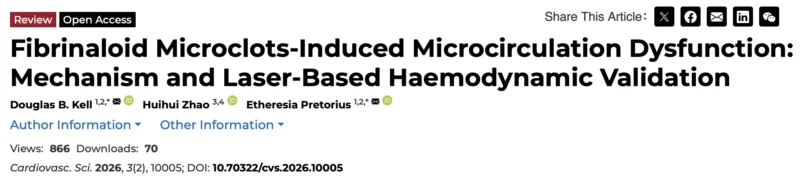
Title: Fibrinaloid Microclots-Induced Microcirculation Dysfunction: Mechanism and Laser-Based Haemodynamic Validation
Authors: Douglas B. Kell, Huihui Zhao, Etheresia Pretorius
Stay updated on all scientific advances with Hemostasis Today.
-
Oct 3, 2026, 00:25Antiplatelets May Be a Strong Option After Ischemic Stroke in Active Cancer – International Journal of Stroke
-
Oct 3, 2026, 00:24Mavis Agnes Kisakye: Honored to Join UNHLS Leadership in Advancing HIV Diagnostics in Uganda
-
Oct 3, 2026, 00:23Phil Spinella: Blood is for Bleeding, Salt Water is for Cooking pasta, Keeping it simple
-
Oct 3, 2026, 00:21Pablo Corral: The ANGPTL Axis in Dyslipidemia and Cardiovascular Risk
-
Oct 3, 2026, 00:20Raghavendra Rao: The Link Between Chronic Venous Disease and VTE May Be Less Robust Than Previously Thought
-
Oct 3, 2026, 00:19Nicolas Hubacz: Immune Cells in the Embryo
-
Oct 3, 2026, 00:18Kalpana Gupta Shekhawat: Reading Beyond the Numbers – A Deeper Look at Routine Blood Reports
-
Oct 3, 2026, 00:17Paulus Kirchhof: Aortic stiffness – A Consequence of High Blood Pressure, or a Driver, or Both?
-
Oct 3, 2026, 00:17Konstantin Yenkoyan: When Science Steps Outside the Laboratory – ERNA 2026