


Sandeep De: Omicron Infection Confirmed to Raise Blood Clot Risk for 6 Months
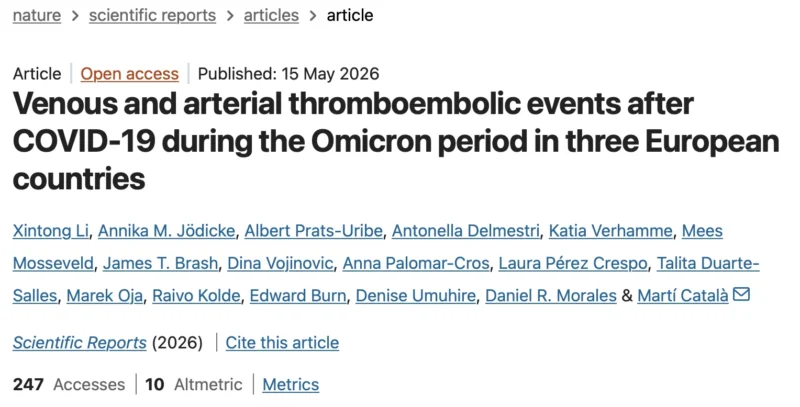
Sandeep De, Former Senior Manager at OpenText, shared on LinkedIn about a recent article by Xintong Li et al, published in Nature, adding:
”Omicron infection raises blood clot risk for six months, three-country European study confirms
Peer-reviewed analysis of 8.4 million electronic health records across the UK, Netherlands, and Spain finds COVID-19 during the Omicron period drives venous and arterial thromboembolic events well above pre-pandemic baselines, with the steepest spike in the first 30 days.
Study design and scale:
The DARWIN EU network pulled primary care records from CPRD GOLD in the UK, IPCI in the Netherlands, and SIDIAP in Spain, comparing 7.6 million people from 2017 to 2019 against 780,000 individuals diagnosed with COVID-19 from 1 December 2021 onward, when Omicron dominated.
The European Medicines Agency funded the work.
Clotting elevation:
Standardized incidence ratios for venous thromboembolism reached 3.61 in CPRD GOLD and 4.10 in SIDIAP within 30 days of infection, roughly three to four times pre-pandemic rates.
By 180 days the ratios eased to 1.88 and 2.37 but remained statistically elevated. Pulmonary embolism, heart failure, and stroke also rose.
Among UK adults aged 55 to 64, VTE incidence hit 717 per 100,000 person-years within a month.
Vulnerable groups:
The signal ran strongest among immunocompromised people and those infected for the first time.
Prior infection appeared to offer some protection against post-COVID thrombosis, consistent with earlier work on healthcare workers showing layered immunity from infection plus vaccination.
Vaccinated individuals showed lower clotting rates than the unvaccinated.
Mechanism and continuity:
COVID-19 coagulopathy involves cytokine surges, platelet activation, endothelial dysfunction, and immune crosstalk with fibrinolytic pathways.
Earlier studies covering 48 million adults in England and Wales, plus Swedish national registries, recorded the same clotting signal during pre-Omicron waves.
The current findings extend it through the variant most often described in public messaging as mild.
The variant marketed as mild keeps producing pulmonary emboli at triple the baseline rate, six months after the test result.”
Title: Venous and arterial thromboembolic events after COVID-19 during the Omicron period in three European countries
Authors: Xintong Li, Annika M. Jödicke, Albert Prats-Uribe, Antonella Delmestri, Katia Verhamme, Mees Mosseveld, James T. Brash, Dina Vojinovic, Anna Palomar-Cros, Laura Pérez Crespo, Talita Duarte-Salles, Marek Oja, Raivo Kolde, Edward Burn, Denise Umuhire, Daniel R. Morales, Martí Català
Stay updated on all scientific advances with Hemostasis Today.
-
Sep 30, 2026, 13:03Amira Mohy: Diagnostic Flow Cytometry Panels for Hematological Malignancies
-
Sep 30, 2026, 12:52Paul Watton: Could Repetitive Head Impacts Leave a Molecular Memory?
-
Sep 30, 2026, 12:41The Journey to ISTH 2027 Starts in Vancouver
-
Sep 30, 2026, 11:36Basit Ali: A Closer Look at CT Venography
-
Sep 30, 2026, 11:16Christina Pohlman: Could aPL Levels Help Predict Stroke Recurrence?
-
Sep 30, 2026, 10:55Rana Al Hrout: Diagnostic Approach to Hypochromic Microcytic Anemia
-
Sep 30, 2026, 01:52Javed Anees: DADA2 – When a Young Stroke Is More Than a Stroke
-
Sep 30, 2026, 01:51How a Venous Thrombus Becomes Revascularized – ISTH
-
Sep 29, 2026, 22:45Victor Agunyego: Paracetamol – The Most Common Drug We Underestimate