


Sara Ng: Predicting Contraceptive VTE Risk Years Before Market
Sara Ng, Staff Specialist Haematologist at South Western Sydney Local Health District, shared a post on LinkedIn:
“Predicting Contraceptive Safety Years in Advance
Link to full article
Title: Predicting venous thromboembolism risk from ETP-based nAPCsr assay: toward early assessment of combined oral contraceptives.
Authors: Laure Morimont, Mitchell D. Creinin, Ulysse Gaspard, Jean-Michel Foidart, Jonathan Douxfils
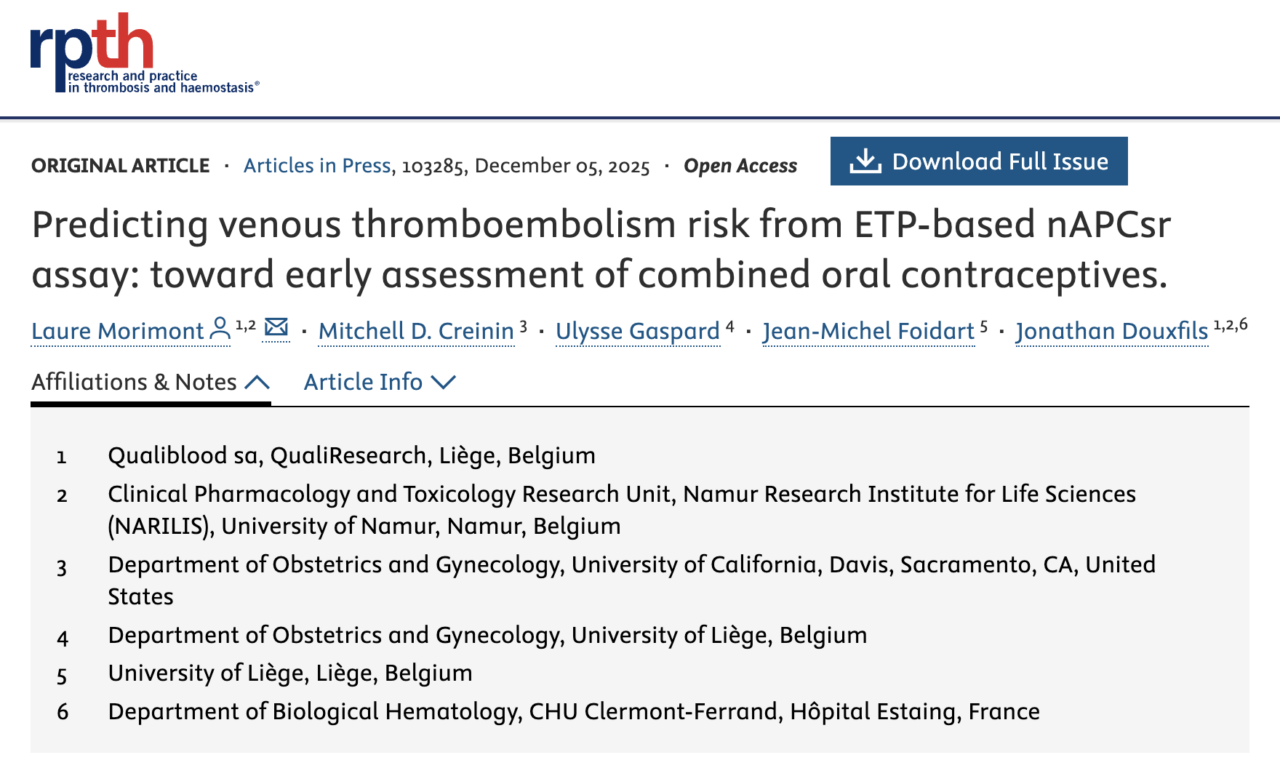
A new RPTH Journal study by introduces a breakthrough computational model that predicts venous thromboembolism (VTE) risk for oral contraceptives with 96% accuracy (R^2=0.96).
How it works:
Instead of waiting for decade-long epidemiological studies, researchers used the nAPCsr biomarker to correlate clotting sensitivity in plasma samples directly with known population risks.
Key Findings:
* High Accuracy: The model successfully replicated known risk hierarchies.
* Safety Profile: Contraceptives with bioidentical estrogens (E2 and E4) showed the lowest APC resistance (nAPCsr < 3.0), suggesting a superior safety profile compared to synthetic options.
The Impact:
Regulators and pharma companies could now assess VTE risk as early as Phase II or III clinical trials, speeding up access to safer hormonal therapies.”
Quoting Jonathan Douxfils’s post:
“Can we estimate the VTE risk of a pill before a million women use it?
Today, the venous thromboembolism (VTE) risk of a new combined oral contraceptive (COC) is usually quantified years after launch, through large post-authorization safety studies. In the meantime, clinicians and women must decide with incomplete information.
In our new article in RPTH Journal, we propose a different path: using a standardized biomarker – the normalized activated protein C sensitivity ratio (nAPCsr) – to predict population-based VTE risk for a given COC formulation.
Using >450 plasma samples from non-users and users of nine different COCs, we:
measured nAPCsr with a fully validated ETP-based APC resistance assay (ISO 17025, European Medicines Agency-endorsed for steroidal contraceptives), linked mean nAPCsr values to established VTE relative risks from de Bastos et al.’s network meta-analysis, built an exponential in silico model with R² = 0.96 and Spearman Rs = 1, accurately reproducing the known VTE risk hierarchy of EE/LNG, EE/“third-generation” progestins, and anti-androgenic combinations.
We then used this model to estimate VTE risk for COCs lacking mature epidemiology data in the de Bastos et al’s NMA, including EE30/DNG, EE20/DRSP, E2/NOMAC and E4/DRSP. The predicted risks for E2- and E4-based pills fall closer to non-users and are consistent with emerging epidemiological data, supporting the concept that bioidentical estrogens may offer a safer hemostatic profile.
Why is this important?
– It shows that a harmonized biomarker (nAPCsr) can serve as a quantitative bridge between phase II–III trials and real-world VTE risk.
– It opens the door to earlier, more transparent risk categorization of new contraceptives, instead of waiting nearly a decade for PASS data.
– It offers regulators, companies and clinicians a common metric to compare the thrombotic profile of different pills beyond crude pharmacovigilance reporting.
Our hope is that this work will stimulate integration of validated coagulation biomarkers into regulatory decision-making, so that women and prescribers can discuss not only efficacy and cycle control, but also a more reliable, biomarker-informed estimate of VTE risk for each pill.
Read the full article here or print.
Congratulations to Laure Morimont for crowning achievement of this work and thank you to all the collaborators around this project and the co-authors of this paper, Mitchell Creinin, Ulysse Gapsard and Jean-Michel Foidart.”
Explore more posts for deeper insights into hemostasis with Hemostasis Today.
-
Oct 7, 2026, 16:44Amor Salah: 2026 NCS/SCCM Guidelines for Managing Antithrombotic-Associated ICH
-
Oct 7, 2026, 16:04NETs in Thrombosis: From Mechanism to Therapeutic Target
-
Oct 7, 2026, 15:28Amir Samimi: Prognostic Value of Platelet Count in Resected HNSCC
-
Oct 7, 2026, 15:21Eloïse Laouenan: Bridging Immunity and Thrombosis in MVTE
-
Oct 7, 2026, 15:10Uthra Sundaram: Honouring Donors During International Plasma Awareness Week
-
Oct 7, 2026, 15:04Daniel Victor Ortigoza: Should Frail Older Patients With AF Switch From VKA to DOACs?
-
Oct 7, 2026, 14:53Susan Noone: Donor Turned Recipient Shares Lifesaving Transfusion Story
-
Oct 7, 2026, 14:49Aimee Burtenshaw: The Impact of the Infected Blood Inquiry on Hospital Transfusion Laboratories
-
Oct 7, 2026, 14:41Vikash Jaiswal: Does Timing Matter for Calcium in Pre-Eclampsia Prevention?