


Tareq Abadl: Bleeding Time (BT) and Clotting Time (CT) Comparison
Tareq Abadl, Medical Laboratory Specialist and Director of the Blood Bank at Dr. Abdelkader Al-Mutawakkil Hospital, shared a post on LinkedIn:
“Bleeding Time (BT) and Clotting Time (CT)
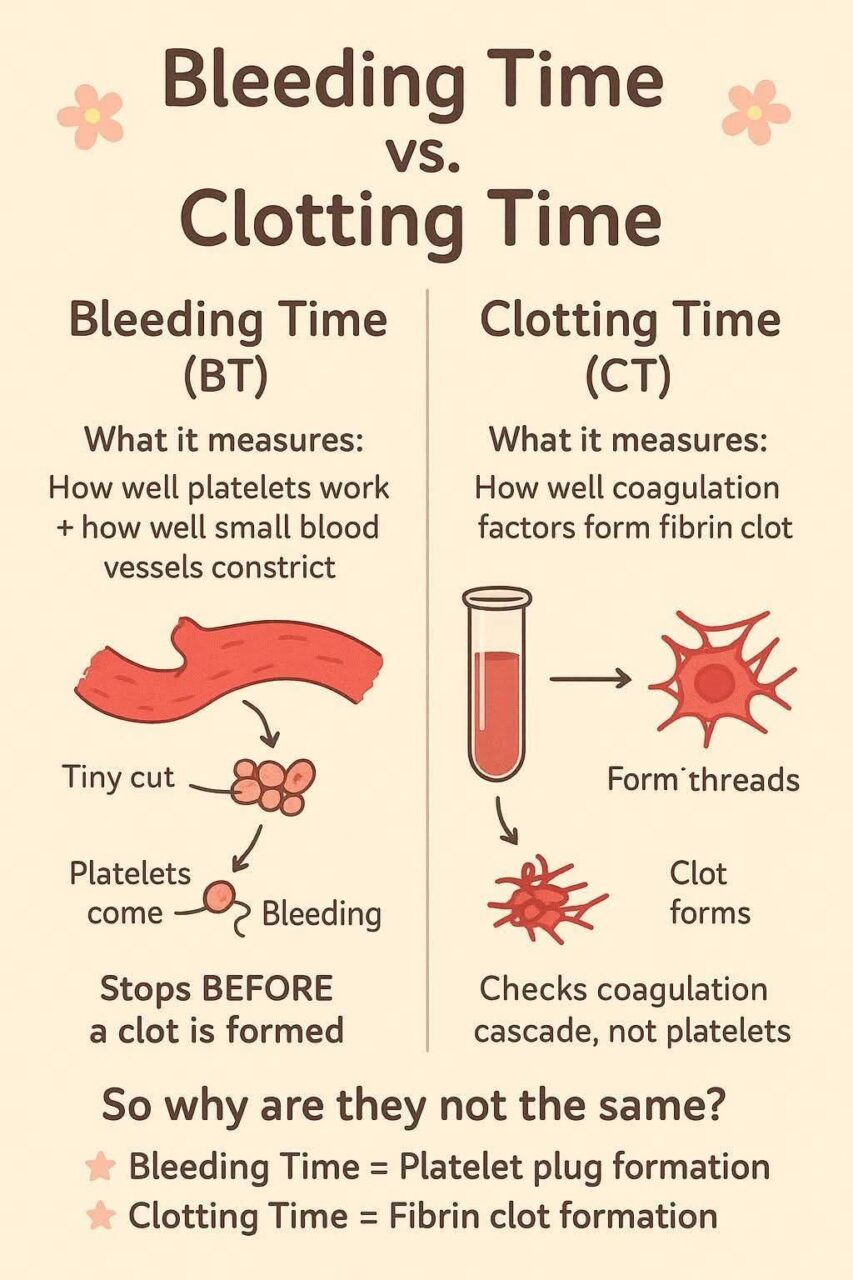
Bleeding Time (BT)
Purpose:
Used to assess platelet function and capillary integrity.
- Ivy Method (Standard Method)
Principle:
Measures the time required for bleeding to stop after a standardized skin incision under controlled pressure.
Procedure:
- Apply a blood pressure cuff to the upper arm and inflate to 40 mmHg.
- Clean the volar surface of the forearm with antiseptic and allow to dry.
- Make a standardized incision (approximately 5 mm long and 1 mm deep).
- Start the stopwatch immediately.
- Blot the blood gently every 30 seconds using filter paper without touching the wound.
- Stop timing when bleeding has completely stopped.
Normal Range:
2–7 minutes
- Duke Method (Older Method)
Principle:
Measures bleeding time after a simple skin puncture.
Procedure:
- Prick the earlobe or fingertip with a sterile lancet.
- Start timing immediately.
- Blot the blood every 30 seconds.
- Stop timing once bleeding stops.
Normal Range:
1–3 minutes
This method is less accurate due to poor standardization.
Clotting Time (CT)
Purpose:
Evaluates the intrinsic coagulation pathway and clotting factors.
- Capillary Tube Method
Principle:
Determines the time taken for blood to clot inside a capillary tube.
Procedure:
- Prick the fingertip using a sterile lancet.
- Fill a clean, dry capillary tube with blood.
- Start the stopwatch immediately.
- Break a small piece of the tube every 30 seconds.
- Stop timing when a fibrin thread is observed between the broken ends.
Normal Range:
3–8 minutes
- Lee–White Method (Venous Blood)
Principle:
Measures clotting time using venous blood in glass tubes.
Procedure:
- Collect venous blood into clean, dry glass tubes.
- Start timing immediately after collection.
- Gently tilt the tubes every 30–60 seconds.
- Stop timing when the blood no longer flows upon tilting.
Normal Range:
5–15 minutes
Important Notes
Bleeding Time assesses platelet function, not coagulation factors.
Clotting Time assesses coagulation factors, not platelet function.
Both tests are screening tests and have limited clinical use today.”
Explore hematology with Tareq Abadl on Hemostasis Today.
-
Sep 30, 2026, 01:52Javed Anees: DADA2 – When a Young Stroke Is More Than a Stroke
-
Sep 30, 2026, 01:51How a Venous Thrombus Becomes Revascularized – ISTH
-
Sep 29, 2026, 22:45Victor Agunyego: Paracetamol – The Most Common Drug We Underestimate
-
Sep 29, 2026, 22:42Nova Sinclair: Advancing the Future of Hematology – Meet Our 2027 Organizing Committee
-
Sep 29, 2026, 22:41Lorenz Räber: Intracoronary Imaging in PCI – Why, When, How, and Which Modality?
-
Sep 29, 2026, 22:31Selma Turkovic: Pleased to Deliver the Opening Presentation at Kingston Hospital
-
Sep 29, 2026, 22:31Miguel Teran: Ultrasound and Simulation in Arterial Blood Sampling
-
Sep 29, 2026, 22:28Mohammad Refaei: Navigating Your Career in Hematology From Training to Practice
-
Sep 29, 2026, 22:27Matteo Foschi: 10 Clinical Pearls for Antithrombotic Therapy in Secondary Stroke Prevention