


Tatevik Hovakimyan: Proud to Be Part of This Important Health Economic Project
Tatevik Hovakimyan, Co-Founder and CEO at CardioLab Medical Center, reposted Philippe Timmermans’s post on LinkedIn:
“Proud to be part of this important health economic project.”
Quoting Philippe Timmermans’s post:
“If you would build your health care system from the ground up, where would you start? Which interventions would you prioritize? Or, if health care expenditure is limited, which interventions would you prefer above others?
The ESC guidelines provide us invaluable insights for clinical practice, but lack a health economical perspective. Formal health technological assessments can provide insights in cost-effectiveness of a certain intervention, but is not available for every treatment modality, is country/health care system specific and comes with an intrinsic financial cost.
Therefore, we developed a novel framework that acts as a ‘go between’, assessing both clinical impact, complexity of implementation and quantification of clinical endpoints at a fixed time interval – irrespective of health care system. Dedicated visualization of the paramaters was developed, based on the current layout of the ESC guidelines but integrating both the novel qualitative and quantitative parameters. The 2021/2023 ESC heart failure guidelines were used to deploy this novel framework. The paper of this pilot project, supported by the ESC, is published in the European Heart Journal Quality of Care and Clinical Outcomes – check it out here.
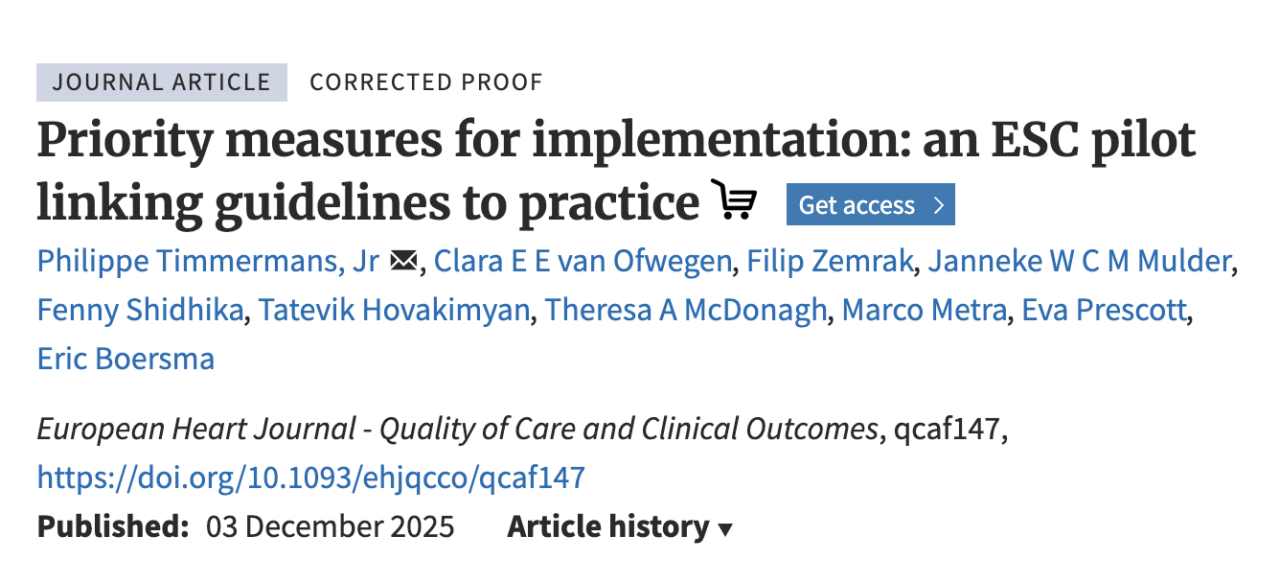
Title: Priority measures for implementation: an ESC pilot linking guidelines to practice
Authors: Philippe Timmermans, Jr, Clara E E van Ofwegen, Filip Zemrak, Janneke W C M Mulder, Fenny Shidhika, Tatevik Hovakimyan, Theresa A McDonagh, Marco Metra, Eva Prescott, Eric Boersma
It is aimed at facilitating interaction between health care professionals and health policy stakeholders. As this framework is the product of many brainstorm sessions, statistical analysis, writing and rewriting, the authors are eager to hear feedback from our peers in both the clinical, health economical and health policy field. Please do share your thoughts, comments, criticism and suggestions to further improve this new framework, which we believe can be the first step in a further integration between clinical research and health economics.
I would like to thank all co-authors for the collaboration, inspiration and opportunities to work on this seminal paper.”
Explore more posts for deeper insights into hemostasis with Hemostasis Today.
-
Oct 2, 2026, 18:34Kamini Khillan: Massive Transfusion Protocol for PPH Management
-
Oct 2, 2026, 18:24Garima Sharma։ GLP-1 Receptor Agonists Across the Reproductive Life Course
-
Oct 2, 2026, 18:13Priya Sriskandarajah: Roginolisib Plus JAK Inhibitors in Myelofibrosis
-
Oct 2, 2026, 17:40Chokri Ben Lamine: A Two-Day Journey Through Modern Hematology at KFSHRC
-
Oct 2, 2026, 17:27Reza Shojaei: The Invisible Crisis, Part 1- Donor Deferral in Whole Blood
-
Oct 2, 2026, 16:02Advancing Antithrombotic Stewardship to Optimise Care – American Heart Association
-
Oct 2, 2026, 15:37Pall T. Onundarson: Monitoring Warfarin Beyond Factor VII
-
Oct 2, 2026, 15:26Nicola Carter: World Thrombosis Day Highlights Gender Specific Risks and Prevention
-
Oct 2, 2026, 14:56Wolfgang Miesbach: Direct Comparison Reveals Distinct Mechanisms Among FVIIIa Mimetics