

Sep 22, 2025, 06:33
Antiphospholipid Syndrome (APS) in Pregnancy – Key Takeaways
Dr. Mukesh, Assistant Professor of Clinical Immunology and Rheumatology at King George’s Medical University (KGMU), posted on X:
”Antiphospholipid Syndrome (APS) in Pregnancy – Key Takeaways
- APS affects 0.5% of the population but is a major cause of recurrent pregnancy loss (RPL), preeclampsia and FGR.
- Pathogenesis: “Two-hit model” → aPL antibodies trigger endothelial/placental dysfunction → thrombosis + insufficiency.
- Lupus anticoagulant (LA) = strongest predictor of poor outcomes.
- Standard of care: Low-dose aspirin (LDA) + LMWH → boosts live birth rates.
- Hydroxychloroquine (HCQ) reduces preterm birth and improves placental health in high-risk cases.
- Refractory APS? → Novel options: TNF-α inhibitors, complement blockers (eculizumab), nitric oxide modulators, statins.
- APS + SLE overlap = compounded risks → needs aggressive, multidisciplinary management.
- CAPS (catastrophic APS) = rare but lethal; pregnancy can trigger it (mortality ~36%).
- New 2023 ACR/EULAR criteria improve APS classification and risk stratification in pregnancy.
Bottom line: Early diagnosis, tailored therapy, and multidisciplinary care = better outcomes for mom and baby.”
Read the full review here.
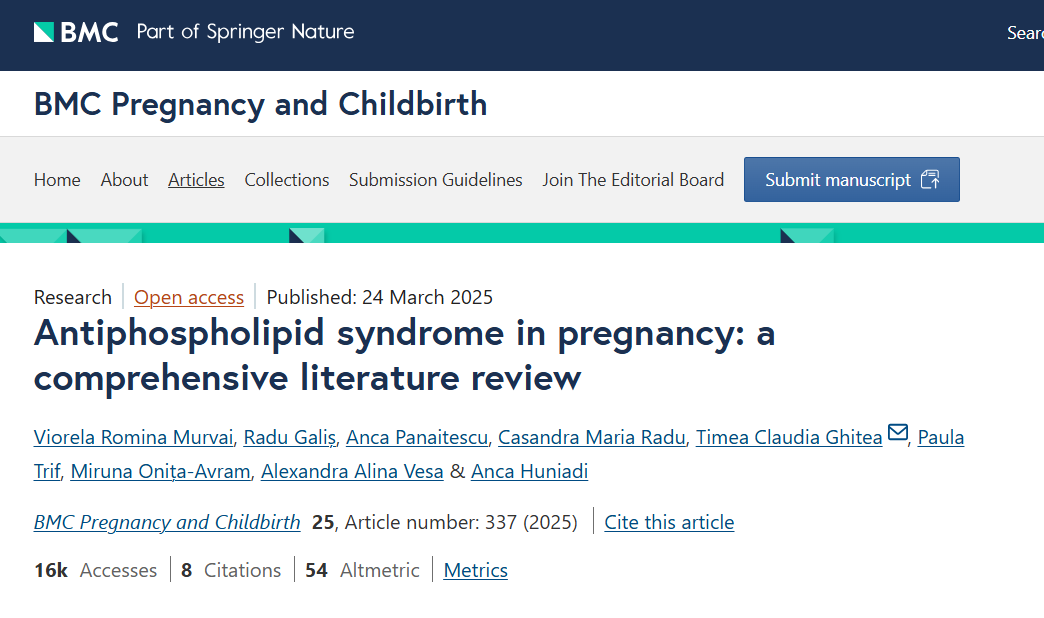
Title: Antiphospholipid syndrome in pregnancy: a comprehensive literature review
Authors: Viorela Romina Murvai, Radu Galiș, Anca Panaitescu, Casandra Maria Radu, Timea Claudia Ghitea, Paula Trif, Miruna Onița-Avram, Alexandra Alina Vesa, Anca Huniadi
Stay updated with Hemostasis Today.
Alexandra Alina Vesa
Anca Huniadi
Anca Panaitescu
Antiphospholipid Syndrome
APS
Aspirin
BioMed Central
BMC
Casandra Maria Radu
Catastrophic APS
Health
Hematology
Hemostasis
Hemostasis Today
Heparin
Hydroxychloroquine
Immunology
in Pregnancy
King George's Medical University (KGMU)
LMWH
Low-Molecular-Weight Heparin
Lupus anticoagulant (LA)
Medicine
Miruna Onița-Avram
Mukesh
Paula Trif
Pregnancy
Radu Galiș
Recurrent Pregnancy Loss (RPL)
Rheumatology
thrombosis
Timea Claudia Ghitea
Viorela Romina Murvai
-
Oct 16, 2026, 16:22Shannon Farmer: Driving Patient Blood Management Forward in Australia and New Zealand
-
Oct 16, 2026, 16:01Obi Light Ogbonnia: The Greatest Reward Is Changing Lives, Not Winning Awards
-
Oct 16, 2026, 15:18Carmine Liberatore: Limited Accuracy of VTE Risk Scores in Multiple Myeloma
-
Oct 16, 2026, 14:55Alex Borstein and the Bleeding Phenotype of Hemophilia A Carriers
-
Oct 16, 2026, 13:59Aya Akmal Amin: Antiphospholipid Syndrome Management and Risk Stratification
-
Oct 16, 2026, 13:10Emanuel Sueldo: CAHT 2026 Celebrates Scientific Progress and Team Achievements
-
Oct 16, 2026, 13:05Maha Othman: Queen’s Health Sciences Advances CAT Risk Models and Pediatric ISTH-BAT Cut-Offs
-
Oct 16, 2026, 13:03Thrombosis Awareness Must Lead to Timely Action – Roche
-
Oct 16, 2026, 12:49Wolfgang Miesbach: 5-Year CBDR Data Confirms Emicizumab Safety and Efficacy in Hemophilia A