


Katja van den Hurk: Using Mean Hemoglobin to Improve Donor Eligibility
Katja van den Hurk, Head of Donor Studies at Sanquin, reposted from Amber Meulenbeld on LinkedIn:
”Excited to share our latest work on an alternative deferral algorithm based on mean haemoglobin (Hb) levels), a first step toward a more comprehensive and data-driven assessment of donor eligibility.
Our findings suggest that using historical mean Hb to guide donor deferral decisions could reduce Hb deferral rates and may also help to prevent donations from donors with consistently low Hb levels.
However, this is only the beginning: Further studies are crucial to understand whether donors identified by this algorithm can indeed donate safely under these circumstances. Future work will refine the model, integrate data on iron stores and recovery as well as donor characteristics, and evaluate long-term donor health outcomes.
I am proud to contribute to this international collaborative effort, very efficiently done by Amber Meulenbeld, in memory of Mart Janssen, aimed at enhancing both donor safety and blood supply sustainability.”
Quoting Amber Meulenbeld‘s post:
”If Hb deferral rates are a challenge in your blood establishment, our new study offers a promising new approach! Just published open access in Vox Sanguinis.
By using historical mean Hb levels to assess donor eligibility, we found that deferral rates could drop by up to 70%.
This method also flags donors with consistently low Hb levels who currently pass eligibility due to one-off high readings. That’s a potential safety issue we should start addressing.
This is an early but important step toward incorporating individual histories in donor screening, and I’m curious to see how this develops further!
Another fruitful collaboration of the SanguinStats group, with special thanks to Claire Styles, Glen Shuttleworth, Supun Manathunga, Hans Van Remoortel, Lucile Malard, Tinus Brits, Ronel Swanevelder, José Antonio García Erce, Iris Garcia-Martínez, Surendra Karki (PhD, Epidemiology), Marijke Welvaert, Alton Russell, PhD, Mikko Arvas, Katja van den Hurk, Mart Pothast, and Mart Janssen.”
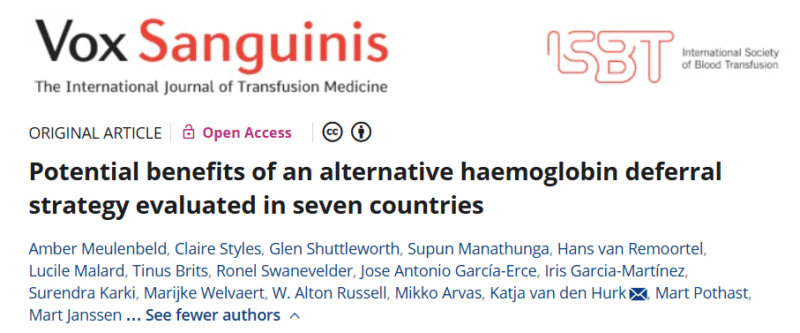
Title: Potential benefits of an alternative haemoglobin deferral strategy evaluated in seven countries
Authors: Amber Meulenbeld, Claire Styles, Glen Shuttleworth, Supun Manathunga, Hans van Remoortel, Lucile Malard, Tinus Brits, Ronel Swanevelder, Jose Antonio García-Erce, Iris Garcia-Martínez, Surendra Karki, Marijke Welvaert, W. Alton Russell, Mikko Arvas, Katja van den Hurk, Mart Pothast, Mart Janssen
Read the full article here.
Stay updated with Hemostasis Today.
-
Sep 23, 2026, 16:04Monia Ezzalfani: Advancing Patient-Centered Care in Hemophilia A and B
-
Sep 23, 2026, 15:49Bilge Başak: How Activated PRP Modulates Osteoarthritic Chondrocyte Function
-
Sep 23, 2026, 14:50Mbonjo Bitsie Dora: Strengthening Sickle Cell Care Through Education, Awareness and Innovation
-
Sep 23, 2026, 13:58The New B12 Diagnostic Algorithm: From Serum Cobalamin to Functional Deficiency
-
Sep 23, 2026, 13:56Noha Soror: Preparing for Hematology and Medical Oncology Board Certification
-
Sep 23, 2026, 13:46Ugochi Ogu: What Can Platelet Proteomics Reveal about Pain and Neurocognitive Vulnerability in Sickle Cell Disease?
-
Sep 23, 2026, 13:42Melissa Hollo: Connecting Obesity and Anemia for Earlier Maternal Risk Intervention
-
Sep 23, 2026, 13:16Beverley Hunt: Advances in Haemostatic Management of Postpartum Haemorrhage
-
Sep 23, 2026, 13:13Ioanna Mela: Recruiting a Research Associate on DNA nanotechnology