


Lucas de Vries Defends His PHD Combining Physics, Deep Learning and Medical Imaging
Lucas de Vries, PhD Candidate Deep Learning for Neuroradiology at Amsterdam UMC, shared on LinkedIn:
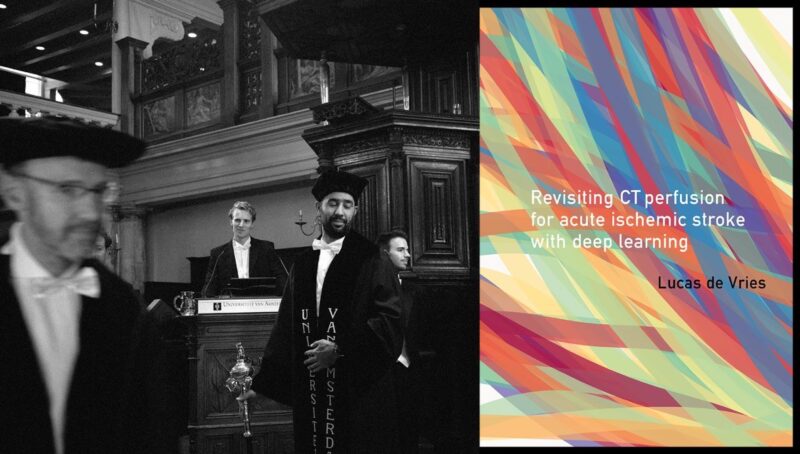
”On October 1st, I defended my PhD thesis, ‘Revisiting CT perfusion for acute ischemic stroke with deep learning’.
I’m happy to share that I have now officially obtained my PhD.
In my thesis, I explored how we can combine physics, deep learning, and medical imaging.
Specifically, I investigated how physics-informed deep learning can improve the analysis of dynamic CT perfusion imaging for acute ischemic stroke.
The full thesis is available online (see the comments below) and is based on the following five publications:
– PerfU-Net: Baseline infarct estimation from CT perfusion source data for acute ischemic stroke (Medical Image Analysis)
– Spatio-temporal physics-informed learning: A novel approach to CT perfusion analysis in acute ischemic stroke (Medical Image Analysis)
– Accelerating physics-informed neural fields for fast CT perfusion analysis in acute ischemic stroke (MIDL)
– Neural fields for tissue attenuation curve reconstruction in sparsely sampled time-resolved CT (MIDL)
– Automated collateral assessment restricted to the hypoperfused area for distal vessel occlusions in ischemic stroke (European Radiology)
A big thanks to my team, Efstratios Gavves, Henk Marquering, Charles Majoie, and Bart Emmer, for their guidance over the past few years, to all my co-authors, and to my paranimfs Julius de Vries and Roel van Herten for their endless support.
With this chapter coming to an end, I will soon be moving to Paris to start a new adventure.
If you are based in Paris or have connections there, I would appreciate any recommendations or introductions, whether related to housing, research, machine learning, or just meeting new people.
Always happy to grab a coffee and connect!”
Read the full article here.
Article: Revisiting CT perfusion for acute ischemic stroke with deep learning
Authors: Lucas de Vries
Stay updated with Hemostasis Today.
-
Sep 24, 2026, 08:55Andres Gudino: Clot Characterization Through Hounsfield Units in Ischemic Stroke
-
Sep 24, 2026, 06:52Gina Sado: Screening-Detected Atrial Fibrillation Carries High Risk of Heart Failure
-
Sep 24, 2026, 06:33Benjamin Vipler: Optimal Oral Anticoagulation Choice in Atrial Fibrillation and Advanced CKD
-
Sep 24, 2026, 06:08Christopher Salerno: AI-Powered At-Home Anemia Screening Advances Telehealth Access
-
Sep 24, 2026, 05:38Aya Qattan: When a Normal CBC Does Not Mean Normal Iron Status
-
Sep 24, 2026, 05:11Mastering Warm Autoimmune Hemolytic Anemia Diagnosis and Practice – ASH Education
-
Sep 23, 2026, 16:04Monia Ezzalfani: Advancing Patient-Centered Care in Hemophilia A and B
-
Sep 23, 2026, 15:49Bilge Başak: How Activated PRP Modulates Osteoarthritic Chondrocyte Function
-
Sep 23, 2026, 14:50Mbonjo Bitsie Dora: Strengthening Sickle Cell Care Through Education, Awareness and Innovation