

Dr Abdul Mannan: THE “HUNGRY” LEUKAEMIA
Dr Abdul Mannan, Consultant Haematologist at Betsi Cadwaladr University Health Board, posted on LinkedIn:
“THE ‘HUNGRY’ LEUKAEMIA
When the Guardian walks out, the factory goes rogue.
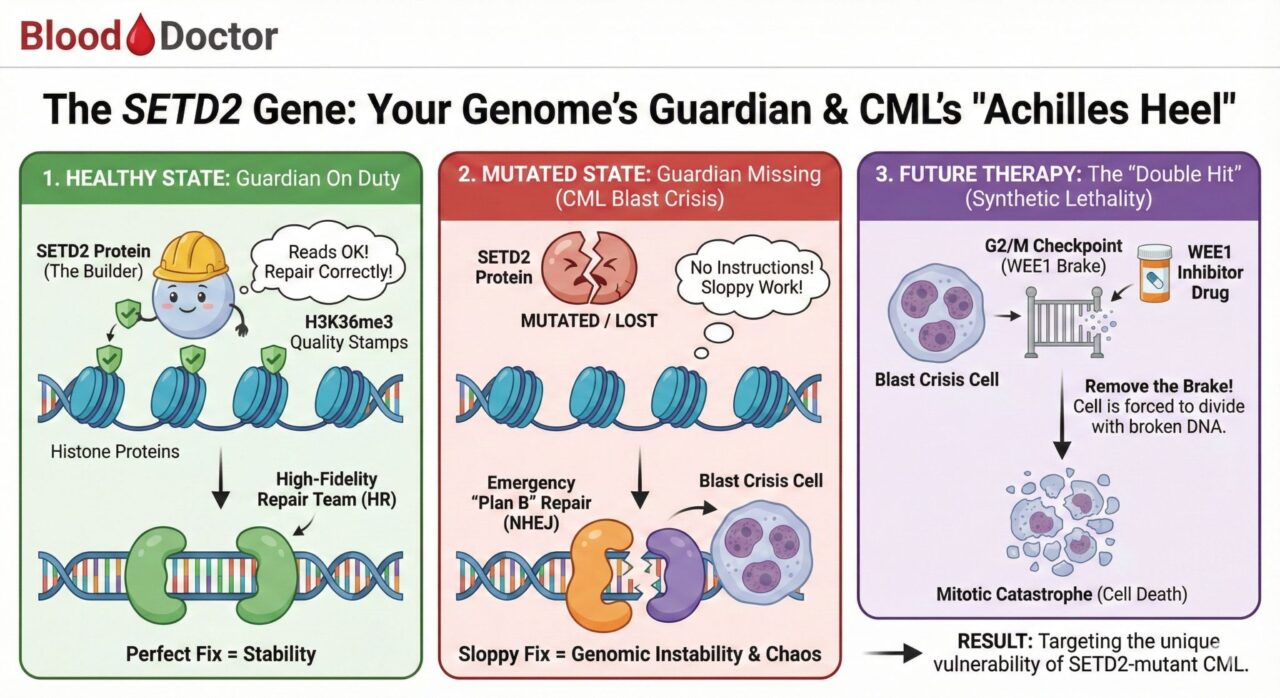
As per the recent data, SETD2 is a quiet, behind-the-scenes protector:
the enzyme that places H3K36me3, keeps transcription tidy, and makes sure DNA repair actually repairs instead of improvises.
But in CML, especially as it tips toward Blast Crisis, SETD2 does a lot more than guard the blueprint.
It controls the energy supply.
What happens when SETD2 disappears?
The cell doesn’t just become unstable.
It becomes hungry.
And like any stressed factory, it stops using the clean power grid (oxidative phosphorylation) and flips on the dirty emergency generator — aerobic glycolysis.
This is the Warburg shift.
Fast, inefficient, but perfect for uncontrolled growth.
What the data actually show
When SETD2 is lost in CML models:
HK2 shoots up
PDK1 ramps up
LDHA goes into overdrive
All the enzymes that push glucose down the ‘burn-fast, grow-fast’ glycolytic pathway.
It’s not random.
Mass spectrometry shows SETD2 was normally working with:
Cell cycle regulators: CDK1, p38
DNA repair machinery: MSH2, MSH6
Metabolic enzymes: LDHA
So when SETD2 quits, all three systems fall out of sync — repair, cell cycle, and energy.
The optimistic bit
Put SETD2 back into CML CD34+ cells and something striking happens:
The metabolic shift reverses
The blast-like behaviour calms down
Colony growth drops by more than 50%
It’s like plugging the factory back into the main power grid and shutting off the emergency generator.
My understanding
Don’t just stare at the mutations.
Ask what the cell is running on.
Blast Crisis isn’t only about DNA going wrong —
it’s about metabolism going wild.
The future of treating advanced CML may lie not just in fixing the genome,
but starving the rogue factory until it behaves again.”
Stay updated with Hemostasis Today.
-
Sep 17, 2026, 20:38Konstantinos Bistas: Reduced Circulating Tregs in Pediatric Chronic Neutropenia
-
Sep 17, 2026, 15:33Gopal Patidar: Honoured to Contribute to the ASFA 2026 Guidelines for Therapeutic Apheresis
-
Sep 17, 2026, 20:36Cosima C. Hoch: Developing a 3D Organotypic Co-Culture Model for Pleomorphic Adenoma
-
Sep 17, 2026, 20:19Riten Kumar: Boston Children’s Hospital Ranked No. 1 in Seven Pediatric Specialties
-
Sep 17, 2026, 20:17Katrina Snow: Whole Blood or Component Therapy – Which Would You Choose?
-
Sep 17, 2026, 16:30Daria Camilli: Empowering Bleeding Disorder Advocacy Through Health Economics
-
Sep 17, 2026, 16:17Mehran Ghasemzadeh: Platelet NK Cell Crosstalk in Advanced Coronary Artery Disease
-
Sep 17, 2026, 16:16Barbara Adams Krolak: Do GLP-1s Affect Blood Clot Risk?
-
Sep 17, 2026, 15:46Heghine Khachatryan: Clinical Context at the Core of Thrombosis and Thrombophilia Management