


Pradeep Natarajan Shared New Article: Comparison Between Milvexian, Abelacimab and Enoxaparin
Pradeep Natarajan, Director, Preventive Cardiology at Massachusetts General Hospital, shared on LinkedIn:
“Milvexian (oral FXIa inhibitor bid) and Abelacimab (FXI mAb x1) both have been shown to ↓knee arthroplasty postop VTE vs enoxaparin (sc FXa & thrombin inhibitor).
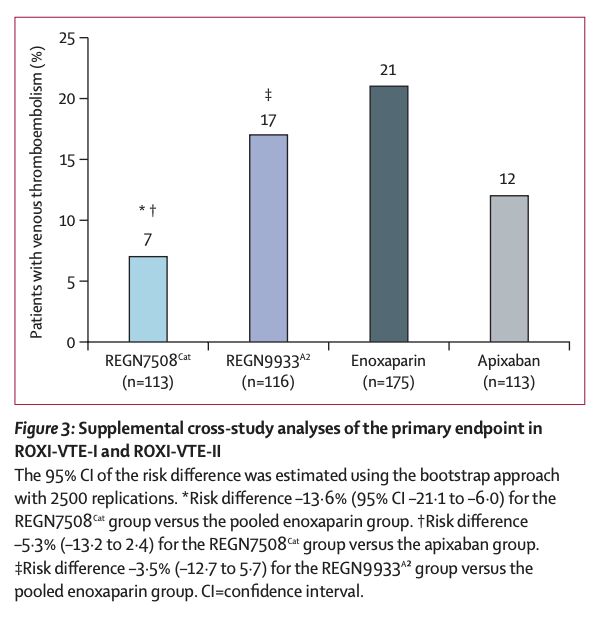
In new RCT in same context, REGN7508Cat x1 was superior to enoxaparin sc daily but REGN9933A2 x1 was non-inferior. Bleeding rates were similar but postop anemia less common for both vs enopaxarin.
– REGN7508Cat blocks the catalytic domain of FXI, so it blocks FXIa activity & FXI activation by FXIIa *and* thrombin. This is generally similar to Abelacimab, which locks FXI in its inactive state.
– REGN9933A2 blocks the apple 2 domain of FXI, blocking FXIIa-mediated activation but permits thrombin-mediated activation. So it’s primarily a contact pathway FXI inhibitor.
The effect estimate for reduced VTE with REGN7508Cat vs enoxaparin seems similar for Abelacimab at the higher doses in ANT-005 TKA.
Milvexian BID had lower VTE rates relative to enoxaparin only at the highest studied dose of AXIOMATIC-TKR with similar bleeding rates.
The data continue to show that the deepest inhibition of FXI (Abelacimab, now REGN7508Cat) is most favorable for postop VTE prevention after knee arthroplasty.
This study effectively demonstrates that FXI activation by both FXIIa *and* thrombin play a role in postop VTE.
In exploratory analyses, REGN7508Cat had lower VTE rates vs apixaban (oral FXa inhibitor), which is exciting to see. Such a comparison was not performed in the Milvexian and Abelacimab postop VTE trials.”
Title: Efficacy and safety of REGN9933A2 and REGN7508Cat for preventing postoperative venous thromboembolism (ROXI-VTE-I and ROXI-VTE-II): two randomised, open-label, phase 2 trials
Authors: Jeffrey I Weitz, Aaron P Kithcart, Meagan P O’Brien, Oren Levy, Ethan Marin, Margaret Onisko, Kusha A Mohammadi, Dateng Li, Karoline A Meagher, Hannah H Chang, Benjamin A Olenchock, David E Gutstein, Annelise Segers, Robin S Roberts, Marc P Bonaca, Gary E Raskob
Read full paper here.
Stay informed with Hemostasis Today.
-
Nov 8, 2026, 17:57Dhiren Patel: PLD1-Derived Phospholipids Regulate NAD Kinase and ROS Production in Neutrophils
-
Nov 8, 2026, 17:48Andra T.: What Causes Antiphospholipid Syndrome? – Four Steps, not One Cause
-
Nov 8, 2026, 17:38Nasrin Samadi: Can a Normal Clotting Test Be Misleading?
-
Nov 8, 2026, 17:36Paschalis Evangelidis: The Multifactorial Nature of Cardiovascular Risk in People With Hemophilia
-
Nov 8, 2026, 17:32Evangelos Panagiotopoulos: Apixaban Reduces Stroke and Major Bleeding Risk in Secondary Stroke Prevention
-
Nov 8, 2026, 17:27Danny Gaskin: Applications Open for the BBTS Specialist Certificate in Clinical Transfusion Practice
-
Nov 8, 2026, 16:54James P. Crowley: DOAC Testing Under 50 ng/mL Safely Expedites Urgent Hip Fracture Surgery
-
Nov 8, 2026, 16:21Alessandra Bosch: Women and Girls With Bleeding Disorders and the DACH Registries at HHS 2026
-
Nov 8, 2026, 15:0310 Posts Not to Miss This Week