


Wolfgang Miesbach: New FVIII‑QQ Gene Therapy Aims for “Less is More” – Durable Expression with Enhanced Potency
Wolfgang Miesbach, Professor of Medicine at Frankfurt University Hospital, shared on LinkedIn:
“Less is more: How enhanced‑function FVIII‑QQ can optimize a low‑dose gene therapy approach for haemophilia A. Great ASH presentation by Nina Frey. SPK‑8011QQ leverages the established SPK‑8011 capsid (dirloctocogene samoparvovec), which in Phase 1/2 trials demonstrated:
- Up to 6.5 years of durable FVIII expression within the mild HA range
- No wide expression variability across time points
- No sustained or late ALT elevations
Shortened corticosteroid exposure with IVMP; return to prophylaxis in only 5 of 25 participants
Now combining this proven durability and safety profile with the enhanced functional potency of FVIII‑QQ.
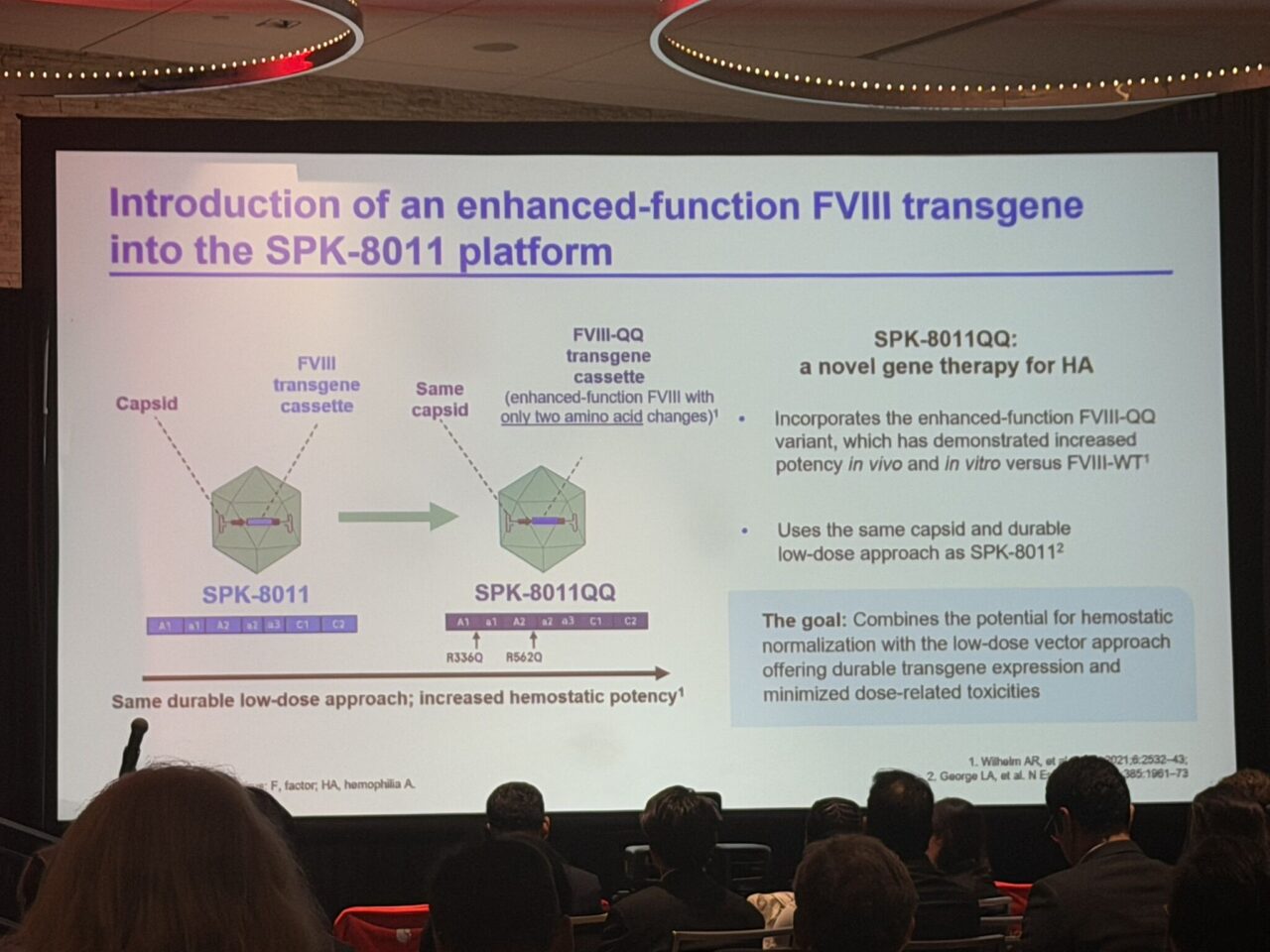
Introducing SPK‑8011QQ: This novel construct incorporates FVIII‑QQ – an enhanced‑function FVIII variant with just two amino‑acid substitutions (R336Q and R562Q) that:
- Confer resistance to activated protein C (aPC) cleavage
- Preserve physiological A2‑domain dissociation (maintaining natural control mechanisms).
Enhanced potency in the presence of aPC:
– FVIII‑QQ retained ~65% residual activity in chromogenic assays (vs. ~43% for FVIII‑WT) at 10 nM aPC
– Significantly higher residual peak thrombin across aPC concentrations in thrombin generation assays (p=0.0018 at 4 nM)
– 80–100% FVIII activity equivalent in mouse ex vivo plasma, with markedly enhanced thrombin generation vs. FVIII‑WT
Superior haemostatic control at lower FVIII activity levels:
Tail‑clip bleed model: FVIII‑QQ achieved enhanced bleed control at markedly lower FVIII levels than FVIII‑WT, with significantly reduced blood loss (p=0.0089 and p=0.0079)
Encouraging preliminary safety profile:
Ferric chloride thrombosis model: FVIII‑QQ showed a lower incidence of animals reaching the near‑occlusive zone (>85% blood flow reduction) vs. positive control
A Phase 2b study by Roche is now underway to translate these preclinical insights into meaningful clinical benefit.”
Read more from Wolfgang Miesbach on Hemostasis Today.
-
Sep 25, 2026, 09:49Haley Coleman: Volunteering to Support Hemophilia Awareness
-
Sep 25, 2026, 08:55Hitarth Mehta: BHMS Students Gain Practical Exposure to Haemophilia Diagnosis
-
Sep 25, 2026, 07:25Varun Capoor: How Therapeutic Apheresis and Transfusion Medicine Can Complement Clinical Management in SCD
-
Sep 25, 2026, 07:14Manshi Kesharwani: SAK-GQDs Modulate Thrombus Burden and Endothelial Function in Deep Vein Thrombosis
-
Sep 25, 2026, 06:20Farjah Hassan Algahtani: How Can We Better Identify Patients at Risk of Blood Clots after Metabolic and Bariatric Surgery?
-
Sep 25, 2026, 05:59Carla Lewis: Kids Conquering Sickle Disease Joins Nemours Children’s Hospital for 2nd Annual Awareness Event
-
Sep 25, 2026, 05:47Omid Seidizadeh: Evolutionary Constraint and Population Variation Across Coagulation Genes
-
Sep 25, 2026, 05:40Gerald Bertrand: Presenting UMi-NGS Non-Invasive Foetal HPA Genotyping at DGTI 2026
-
Sep 25, 2026, 05:33Urge Congress to support the Sickle Cell Disease Comprehensive Care Act – ASH