


Arun V J on The “Whole Blood” Nostalgia Trap
Arun V J, Consultant in the Department of Transfusion Medicine at Malabar Medical College, shared on LinkedIn:
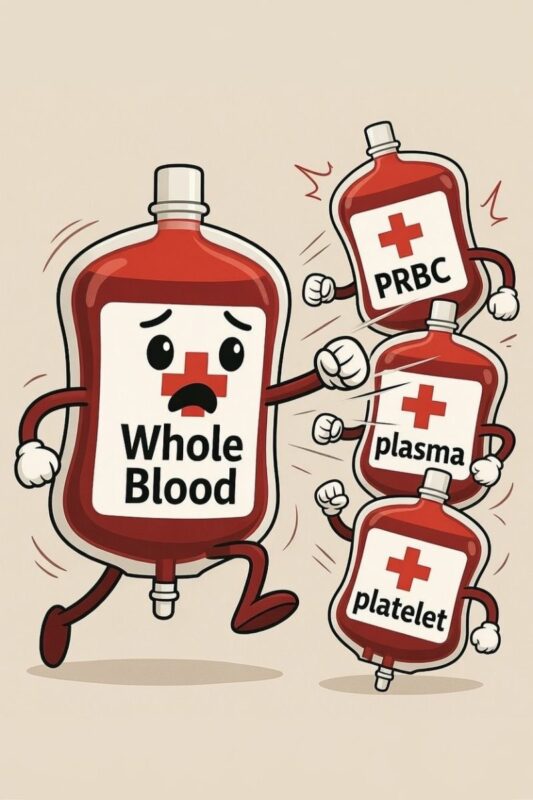
”The “Whole Blood” Nostalgia Trap: Why Modern Medicine Rips Your Donation Apart
Stop asking for Whole Blood for routine patients.
It sounds intuitive, right? “I lost blood, give me blood.” But in Transfusion Medicine, intuition is often wrong.
If you treat a non-trauma patient with Whole Blood in 2025, you aren’t practicing holistic medicine. You are practicing logistical negligence.
Here is why Component Therapy isn’t just a preference—it is the biological Gold Standard.
1. The “Storage Lesion” Reality (The Fridge War)
Blood cells are not good roommates. They hate each other’s preferred environments.
Red Cells need the fridge 2-6 degree Celsius to survive.
Platelets die in the fridge. They need room temperature 20-24 Degree Celsius.
Plasma factors degrade unless frozen solid -18 Degree Celsius.
If you keep blood “Whole” in a fridge, you are prioritizing the Red Cells and actively killing the Platelets. You are transfusing a compromised product.
2. The Sniper vs. The Shotgun
Most patients don’t need the “soup.”
Thalassemia patients need Red Cells, not Plasma volume.
Dengue patients need Platelets, not Red Cells.
Burn victims need Plasma, not Iron.
Giving Whole Blood to these patients is like using a shotgun to kill a mosquito.
It’s messy, it causes Volume Overload (TACO), and it increases reaction risks. Component therapy is the sniper shot—precise, potent, and safe.
3. The Efficiency Equation
In a world of scarcity, waste is a sin.
Whole Blood: 1 Donation = 1 Patient.
Component Therapy: 1 Donation = 3 Patients (1 Anemia + 1 Dengue + 1 Bleeding Disorder).
The Verdict:
We don’t separate blood to make it complicated. We separate it because human physiology demands it.
Unless you are dealing with a massive trauma hemorrhage, “splitting the bag” is the only responsible way to honor the donor’s gift.
Be precise. Be scientific. Choose Components.
Thoughts on this?
Are you Team Whole Blood or Team Components?
Read more.”
Stay updated with Hemostasis Today.
-
Oct 28, 2026, 23:39Paul Tortland: What a New PRP Study Really Tells Us About Knee Osteoarthritis
-
Oct 28, 2026, 23:34Jawad Derbas: Comparing Mechanical and Pharmacomechanical VTE Prophylaxis in Spine Surgery
-
Oct 28, 2026, 23:31Giulio Maria Pasinetti: Aspirin Use Linked to Lower Dementia Risk in Older Adults With Specific Genetic Characteristics
-
Oct 28, 2026, 23:27Ralf Ludwig: Targeting Neutrophil-Driven Autoimmunity Through CDK Inhibition
-
Oct 28, 2026, 23:26Houda Moustaide: Great Discussions During Our Training Day on Thrombocytopenia in Pregnancy
-
Oct 28, 2026, 23:22Keith Berelowitz: Building Better Medicines by Listening to Patients With Bleeding Disorders
-
Oct 28, 2026, 23:19Nickie Enos: Blood Clots in Arteries and Veins Differ in Symptoms and Treatment
-
Oct 28, 2026, 23:17David Rosenblum: Can Concentrated PRP Actually Cause Scar Tissue?
-
Oct 28, 2026, 23:15Shueh Hao Lim: Advancing Multidisciplinary Care for Venous Thromboembolism in Malaysia