


Jan Sloves: Pelvic Venous Disorder Is Not a Single Syndrome
Jan Sloves, President and Consultant at Vascular Imaging Professionals LLC, shared on LinkedIn:
”Pelvic venous disorder (PeVD) is not a single syndrome but a spectrum of abdominopelvic venous obstruction and reflux; labels like “pelvic congestion,” “nutcracker,” and “May–Thurner” often obscure the underlying hemodynamics.
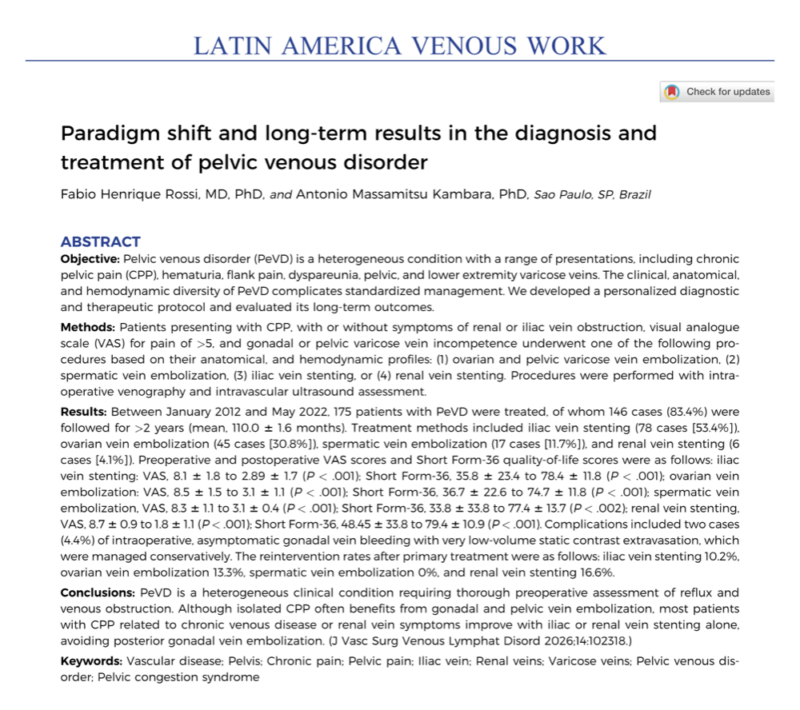
Fabio H Rossi and Antonia M. Kambara from Brazil propose a protocol that always starts with phenotype and mapping: chronic pelvic pain (CPP), C3–C6 CVD, renal‑vein symptoms, or varicocele prompt Duplex and CT venography of iliac, renal, gonadal, and internal iliac veins, with IVUS confirmation. Treatment is then tailored rather than “embolization‑by-default.”
Key insight: isolated primary gonadal reflux was uncommon (12.3%), whereas isolated iliac obstruction was seen in 36.9% and more than half the cohort had C3–C6 disease, highlighting outflow obstruction as a major driver of PeVD.
Reflecting this, 53.4% of 146 patients were ultimately treated with iliac stents, versus 30.8% with ovarian embolization, 11.7% spermatic embolization, and 4.1% renal stents.
The therapeutic algorithm is simple and provocative:
•Isolated CPP or varicocele with documented reflux → gonadal/pelvic embolization.
•CPP plus C3–C6 CVD and iliac obstruction → iliac stenting first.
•CPP plus flank pain, hematuria, or proteinuria with LRV obstruction → renal vein stenting first, without routine gonadal embolization.
Across all strategies, mean VAS scores fell from ≈8–9 to ≈2–3 and SF‑36 scores roughly doubled over a mean 110‑month follow‑up, with only two minor, asymptomatic gonadal vein bleeds and day‑case care throughout.
Reinterventions were modest (≈10–16%, 0% for varicocele), mostly within 12–18 months, and usually for residual pelvic reflux rather than stent failure.
For vascular teams, the message is clear: systematically look for PeVD in advanced CVD and atypical/recurrent varices, correct iliac or renal outflow first when those phenotypes are present, and reserve pelvic embolization for truly reflux‑dominant disease.
Subscribe to the only newsletter built for vascular pros.”
Read the full article here.
Article: Paradigm shift and long-term results in the diagnosis and treatment of pelvic venous disorder
Authors: Fabio Henrique Rossi, Antonio Massamitsu Kambara
Stay updated on all scientific advances with Hemostasis Today.
-
Sep 25, 2026, 09:49Haley Coleman: Volunteering to Support Hemophilia Awareness
-
Sep 25, 2026, 08:55Hitarth Mehta: BHMS Students Gain Practical Exposure to Haemophilia Diagnosis
-
Sep 25, 2026, 07:25Varun Capoor: How Therapeutic Apheresis and Transfusion Medicine Can Complement Clinical Management in SCD
-
Sep 25, 2026, 07:14Manshi Kesharwani: SAK-GQDs Modulate Thrombus Burden and Endothelial Function in Deep Vein Thrombosis
-
Sep 25, 2026, 06:20Farjah Hassan Algahtani: How Can We Better Identify Patients at Risk of Blood Clots after Metabolic and Bariatric Surgery?
-
Sep 25, 2026, 05:59Carla Lewis: Kids Conquering Sickle Disease Joins Nemours Children’s Hospital for 2nd Annual Awareness Event
-
Sep 25, 2026, 05:47Omid Seidizadeh: Evolutionary Constraint and Population Variation Across Coagulation Genes
-
Sep 25, 2026, 05:40Gerald Bertrand: Presenting UMi-NGS Non-Invasive Foetal HPA Genotyping at DGTI 2026
-
Sep 25, 2026, 05:33Urge Congress to support the Sickle Cell Disease Comprehensive Care Act – ASH