

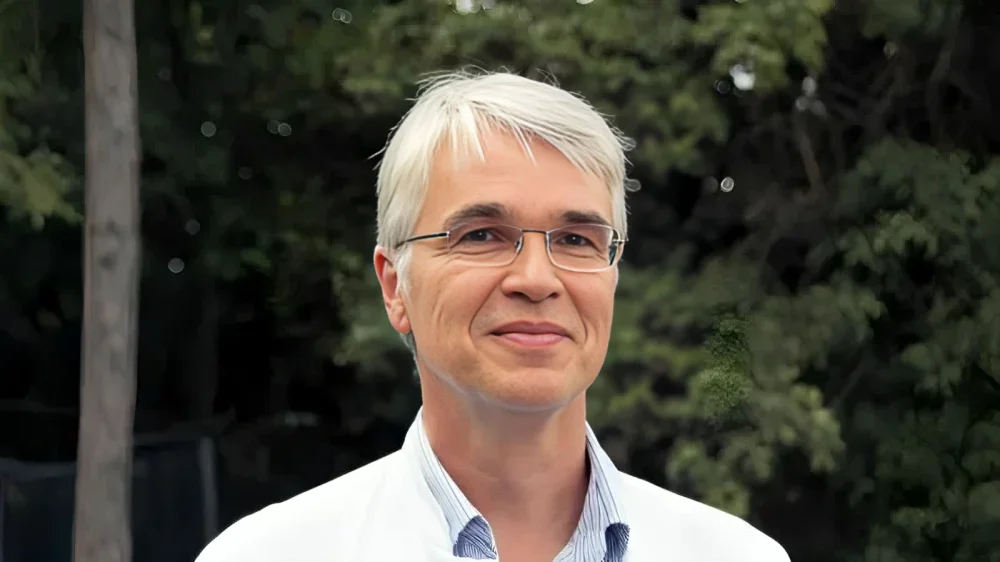
Wolfgang Miesbach on GTH Certification Program for Haemophilia Centres in German-Speaking Countries
Wolfgang Miesbach, Professor of Medicine at Frankfurt University Hospital, shared on LinkedIn:
”Quality Standards in Haemophilia Care: Five Years of Successful Center Certification
Thrilled to share our latest publication, led by Hermann Eichler, in Haemophilia Journal on the GTH certification program for haemophilia centres in German-speaking countries.
The Challenge
Specialized haemophilia centres have transformed outcomes for people with bleeding disorders, but consistent quality across centres is not a given. Building on the European EUHANET guidelines, the GTH developed its own structural and process quality guideline and launched an independent certification process in 2019.
The Methodology
Scope: Certification conceptually designed for Germany, Austria and Switzerland under the umbrella of GTH; all 23 certified centres so far are in Germany, with the first Swiss audit planned.
Centre types: Haemophilia Comprehensive Care Centres (≥40 patients with severe haemophilia A/B or vWD type 3) and Haemophilia Treatment Centres (≥10 patients).
Audit set-up: One-day on-site audit by two experienced haemophilia physicians specifically trained in quality management, supported by professional QM staff.
What was assessed: Compliance with GTH criteria on personnel, infrastructure, diagnostics, treatment (incl. surgery), registry participation and patient/relative education.
Governance: Scientific content by GTH; operational implementation and independence ensured by the accredited certification body ClarCert GmbH.
The Results
23 centres certified (2019–2024), based on 25 audits (including one repeat and one recertification).
Mean 2.8 nonconformities per audit (range 0–14), dropping to ~1.2 from 2021 onwards with better preparation and QM support.
On average 6 recommendations per centre, used to move beyond minimum standards toward continuous improvement.
Centres rated both the auditors and ClarCert as “excellent” (mean scores around 1.0–1.2 on a 1–4 scale), reflecting high trust and perceived added value rather than a purely administrative exercise.
17 Comprehensive Care Centres and 6 Treatment Centres now operate under a common, transparent quality framework.
In Germany, a valid certificate has become a prerequisite for haemophilia centres to conclude dedicated comprehensive-care contracts with health insurance bodies—linking measurable quality to funding and patient access.
The program also aligns national practice with evolving European accreditation efforts (EUHANET/European Association for Haemophilia and Allied Disorders (EAHAD)) while remaining pragmatic and scalable in daily clinical reality.”
Read the full article here.
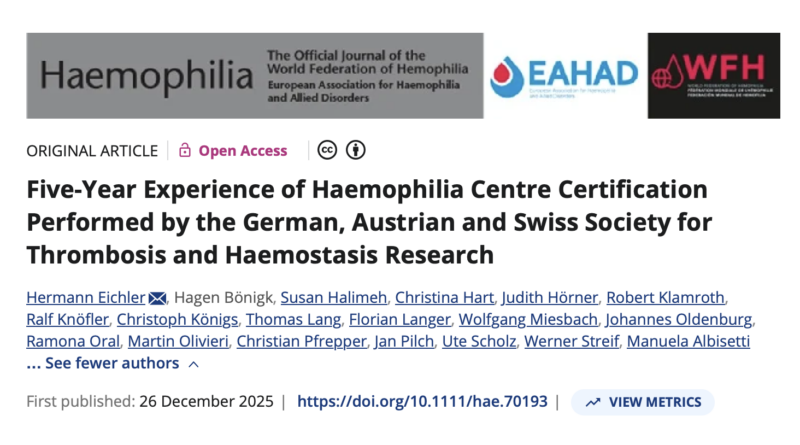
Article: Five-Year Experience of Haemophilia Centre Certification Performed by the German, Austrian and Swiss Society for Thrombosis and Haemostasis Research
Authors: Hermann Eichler, Hagen Bönigk, Susan Halimeh, Christina Hart, Judith Hörner, Robert Klamroth, Ralf Knöfler, Christoph Königs, Thomas Lang, Florian Langer, Wolfgang Miesbach, Johannes Oldenburg, Ramona Oral, Martin Olivieri, Christian Pfrepper, Jan Pilch, Ute Scholz, Werner Streif, Manuela Albisetti
Stay updated on all scientific advances with Hemostasis Today.
-
Sep 25, 2026, 07:25Varun Capoor: How Therapeutic Apheresis and Transfusion Medicine Can Complement Clinical Management in SCD
-
Sep 25, 2026, 07:14Manshi Kesharwani: SAK-GQDs Modulate Thrombus Burden and Endothelial Function in Deep Vein Thrombosis
-
Sep 25, 2026, 06:20Farjah Hassan Algahtani: How Can We Better Identify Patients at Risk of Blood Clots after Metabolic and Bariatric Surgery?
-
Sep 25, 2026, 05:59Carla Lewis: Kids Conquering Sickle Disease Joins Nemours Children’s Hospital for 2nd Annual Awareness Event
-
Sep 25, 2026, 05:47Omid Seidizadeh: Evolutionary Constraint and Population Variation Across Coagulation Genes
-
Sep 25, 2026, 05:40Gerald Bertrand: Presenting UMi-NGS Non-Invasive Foetal HPA Genotyping at DGTI 2026
-
Sep 25, 2026, 05:33Urge Congress to support the Sickle Cell Disease Comprehensive Care Act – ASH
-
Sep 25, 2026, 05:24Isabelle Mahé: Reduced-Dose Apixaban in Extended CAT Treatment
-
Sep 25, 2026, 05:15Maria Cherska: High Cholesterol Isn’t Always Diet or Lifestyle – Sometimes It’s Genetic