


Bartosz Hudzik: Extended Anticoagulation in Cancer-Associated VTE – Who Is at Higher Bleeding Risk?
Bartosz Hudzik, Editorial Consultant at JACC Case Reports, shared on LinkedIn about a recent article by Isabelle Mahé et al, published in The Lancet Haematology:
”Extended anticoagulation in cancer-associated VTE: who is at higher bleeding risk?
Extended anticoagulation with reduced-dose apixaban has been shown to be non-inferior to full-dose therapy for preventing recurrent VTE in patients with active cancer—while offering fewer clinically relevant bleeding events.
A new post-hoc analysis of the API-CAT trial takes a closer look at predictors of clinically relevant bleeding during extended therapy.
Key findings (12-month follow-up, n=1,766):
Four factors were independently associated with increased bleeding risk:
• Anaemia and/or thrombocytopenia
• Age ≥75 years
• Pulmonary embolism as the index event
• Male sex
Notably:
• Results were consistent across cancer types
• No interaction with apixaban dose was observed
Why this matters
Although API-CAT was not designed to guide anticoagulation discontinuation, these insights may help clinicians better individualize extended anticoagulation, balancing thrombotic protection against bleeding risk in patients with cancer-associated VTE.”
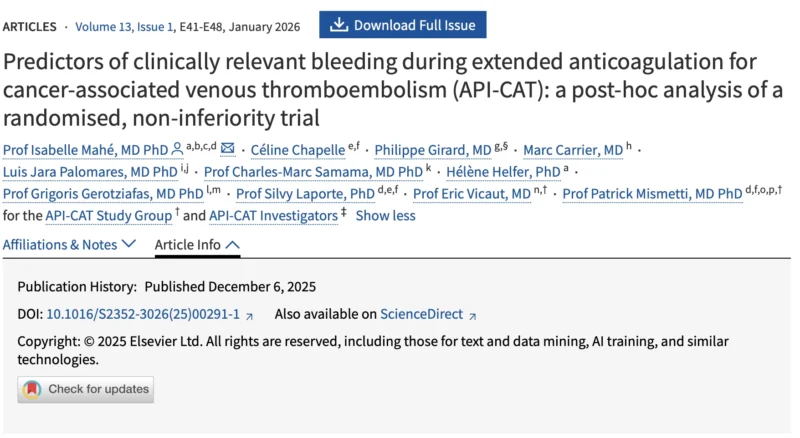
Title: Predictors of clinically relevant bleeding during extended anticoagulation for cancer-associated venous thromboembolism (API-CAT): a post-hoc analysis of a randomised, non-inferiority trial
Authors: Isabelle Mahé, Céline Chapelle, Philippe Girard, Marc Carrier, Luis Jara Palomares, Charles-Marc Samama, Hélène Helfer, Grigoris Gerotziafas, Silvy Laporte, Eric Vicaut, Patrick Mismetti for the API-CAT Study Group and API-CAT Investigators
Read the Full Article on The Lancet Haematology
Stay updated on all scientific advances with Hemostasis Today.
-
Sep 25, 2026, 09:49Haley Coleman: Volunteering to Support Hemophilia Awareness
-
Sep 25, 2026, 08:55Hitarth Mehta: BHMS Students Gain Practical Exposure to Haemophilia Diagnosis
-
Sep 25, 2026, 07:25Varun Capoor: How Therapeutic Apheresis and Transfusion Medicine Can Complement Clinical Management in SCD
-
Sep 25, 2026, 07:14Manshi Kesharwani: SAK-GQDs Modulate Thrombus Burden and Endothelial Function in Deep Vein Thrombosis
-
Sep 25, 2026, 06:20Farjah Hassan Algahtani: How Can We Better Identify Patients at Risk of Blood Clots after Metabolic and Bariatric Surgery?
-
Sep 25, 2026, 05:59Carla Lewis: Kids Conquering Sickle Disease Joins Nemours Children’s Hospital for 2nd Annual Awareness Event
-
Sep 25, 2026, 05:47Omid Seidizadeh: Evolutionary Constraint and Population Variation Across Coagulation Genes
-
Sep 25, 2026, 05:40Gerald Bertrand: Presenting UMi-NGS Non-Invasive Foetal HPA Genotyping at DGTI 2026
-
Sep 25, 2026, 05:33Urge Congress to support the Sickle Cell Disease Comprehensive Care Act – ASH