

Soroush Sohrabi: The Hidden Biology of Sclerotherapy and Mechanisms Beyond Endothelial Injury
Soroush Sohrabi, Consultant vascular and ednovascular surgeon at NMC Healthcare, shared a post on LinkedIn:
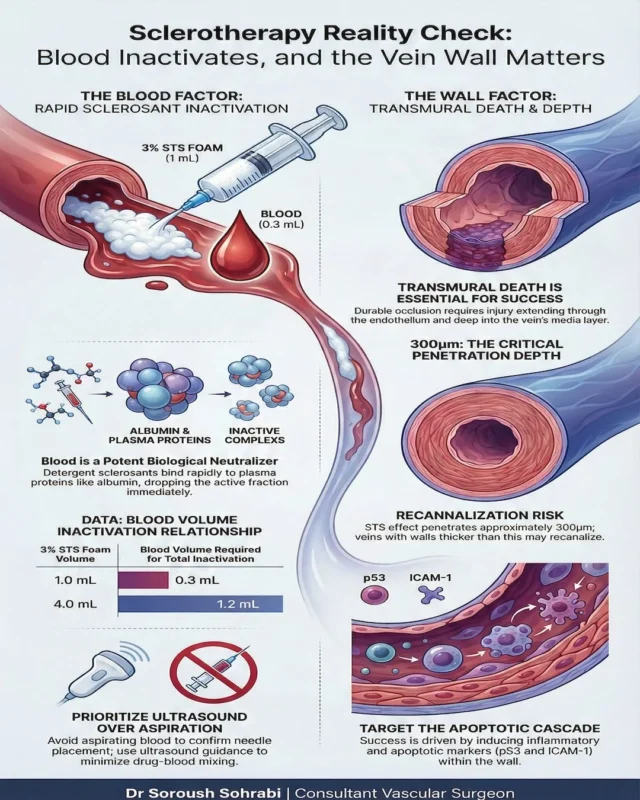
“Sclerotherapy Reality Check: Blood Inactivates — and the Vein Wall Matters
We often describe sclerotherapy in simple terms: inject the sclerosant, damage the endothelium, the vein closes.
The biology is more complex.
Two important experimental studies help clarify what is really happening:
‘Implication of foam sclerosant inactivation by human whole blood in a laboratory setting’
and
‘Media Damage Following Detergent Sclerotherapy Appears to be Secondary to the Induction of Inflammation and Apoptosis: An Immunohistochemical Study Elucidating Previous Histological Observations.’
These papers demonstrate two critical realities.
- First, blood is not passive. It actively reduces sclerosant activity. Detergent agents rapidly bind to plasma proteins such as albumin, forming inactive complexes. Even small volumes of blood can significantly decrease the active fraction available to act on the vein wall.
- Second, durable vein closure depends on more than superficial endothelial injury. Successful treatment requires deeper medial damage driven by inflammatory and apoptotic pathways. If injury remains too superficial relative to wall thickness, recanalisation becomes more likely.
In simple terms:
- Blood reduces effective drug activity
- The vein wall response determines durability
- Endothelial irritation alone is not enough
Why this matters clinically ?
These mechanistic insights help explain why outcomes vary:
- Larger veins behave differently from smaller veins
- Technique influences drug–wall contact time
- Mixing with blood reduces effective concentration
- Wall thickness influences long-term closure
- Sclerotherapy is not just a chemical injection. It is a biological interaction between sclerosant, blood, and vessel wall.
Understanding that interaction helps us refine technique, counsel patients more accurately, and improve durability of results.
What changes, if any, have these mechanisms prompted in your own approach to sclerotherapy?”
Stay updated with Hemostasis Today.
-
Aug 23, 2026, 17:51Gurpreet Kaurr: A Proud Milestone in Haematology and Oncology
-
Aug 23, 2026, 17:33Kathrine Kaspersen: How Voluntary Plasma Donors Helped Transform Denmark’s Plasma Supply
-
Aug 23, 2026, 16:51Sthanu Subramanian: Empagliflozin and a Rise in Hematocrit
-
Aug 23, 2026, 16:50Lale Tokgözoğlu: New PCSK9i Research Published in the European Heart Journal
-
Aug 23, 2026, 16:44Eric Gehrie: Your 2026 Guide to the Essentials of Transfusion Medicine
-
Aug 23, 2026, 16:35Thomas Dayspring: The Overlooked Pathway in Cholesterol Homeostasis
-
Aug 23, 2026, 16:28Evan Mapelu: The People Who Make Cancer Care Meaningful
-
Aug 23, 2026, 16:09Felice Gragnano: New Publication on Aspirin Discontinuation After PCI for Acute Coronary Syndromes
-
Aug 23, 2026, 16:06Mostafa Faisal: Donor Type and Long-Term Quality of Life After HCT for Severe Aplastic Anemia