


Radoslaw Kaczmarek: Will AAV Gene Therapy for Hemophilia Trigger Tumorigenesis?
Radoslaw Kaczmarek, Assistant Research Professor of Pediatrics at Indiana University School of Medicine, reposted from RPTH Journal on LinkedIn, adding:
”Thank you, RPTH Journal, for highlighting my latest opinion article on malignancy and AAV gene therapy.
Despite the relatively low rate of integration, AAV can and does integrate into the host genome.
The total number of vector particles in a single dose means that every recipient will have millions of integration events.
While no ‘smoking gun’ evidence of malignancy in humans has been shown, animal studies have demonstrated that AAV is mechanistically capable of triggering tumorigenesis.
The recent malignancy case in the REGENXBIO trial for mucopolysaccharidosis (MPS) is a reminder that this risk is a relevant part of the clinical conversation.
Preliminary analysis of the CNS tumor in a young participant revealed an AAV vector integration event associated with the overexpression of PLAG1, a known proto-oncogene.
While causality is still being formally investigated, this case might be the closest thing to a ‘smoking gun’ we have seen regarding AAV-mediated insertional mutagenesis in a human clinical trial.
Is it relevant for hemophilia gene therapy?
The dose, route of administration, age, vector serotype and target tissue are entirely different, which may modify the risk, but these factors are unlikely to change the implications of integration events.
The most relevant difference in this context is the strong constitutive CMV promoter, which has not been used in hemophilia gene therapy.
AAV remains a transformative tool for people with hemophilia and other rare diseases, but long-term safety must be part of a nuanced, accessible, and transparent conversation.”
Quoting RPTH Journal‘s post:
”Gene therapy for hemophilia is here, but the real safety story is just beginning.
A powerful RPTH Forum article tackles one of the field’s biggest questions:
Could AAV gene therapy cause cancer?
The answer right now is nuanced
Yes, AAV vectors can integrate into the genome at low frequency.
But across 10 reported cancer cases in gene-therapy recipients, no evidence shows that AAV integration caused the tumors.
So why the caution?
- In mice, AAV integration can trigger liver cancer under certain conditions.
- In humans, evidence varies because methods, sample quality, and analyses differ widely.
- Long-term, global surveillance is now essential.
The big message:
We must avoid both alarmism and false reassurance.
What the field needs next:
- Standardized molecular analysis of tumors
- Global registries and long-term follow-up
- Better communication of complex safety data
As gene therapy becomes mainstream, safety science must evolve just as fast as innovation.”
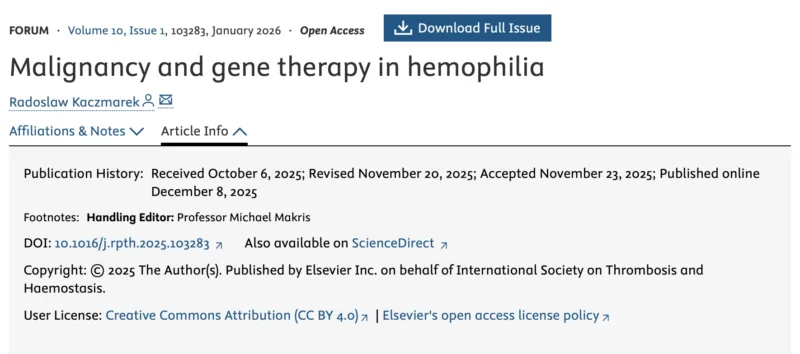
Title: Malignancy and gene therapy in hemophilia
Author: Radoslaw Kaczmarek
Read the Full Article on RPTH Journal
Stay updated on all scientific advances with Hemostasis Today.
-
Oct 16, 2026, 12:49Wolfgang Miesbach: 5-Year CBDR Data Confirms Emicizumab Safety and Efficacy in Hemophilia A
-
Oct 16, 2026, 12:40Edward Lee Carter: How Factor XI Inhibition Could Transform Anticoagulation Therapy
-
Oct 16, 2026, 12:40Marc Carrier: Looking Ahead to ISTH 2027 in Vancouver
-
Oct 16, 2026, 12:30Bob Lempke: How One Blood Donation Can Save Up to Three Lives
-
Oct 16, 2026, 12:30Why VWF Therapies Belong on the EU Critical Medicines List – EHC
-
Oct 16, 2026, 12:17Exploring Endothelial Cells, Genetic Fate Mapping, and Revascularization – ISTH
-
Oct 16, 2026, 10:07Habib Bennaceur: Building a Stronger Care Pathway for Sickle Cell Disease in India
-
Oct 16, 2026, 09:59Tareq Abadl: A Simple Guide to Blood Collection Tubes
-
Oct 16, 2026, 09:50Mona Alfaraj: Distinguishing HCL from SMZL in Bone Marrow