

Sumedha Dash: Why Whole Blood is Rarely the Answer Anymore?
Sumedha Dash, Transfusion Medicine specialist at Institute of Medical Sciences and Sum Hospital, shared a post on LinkedIn:
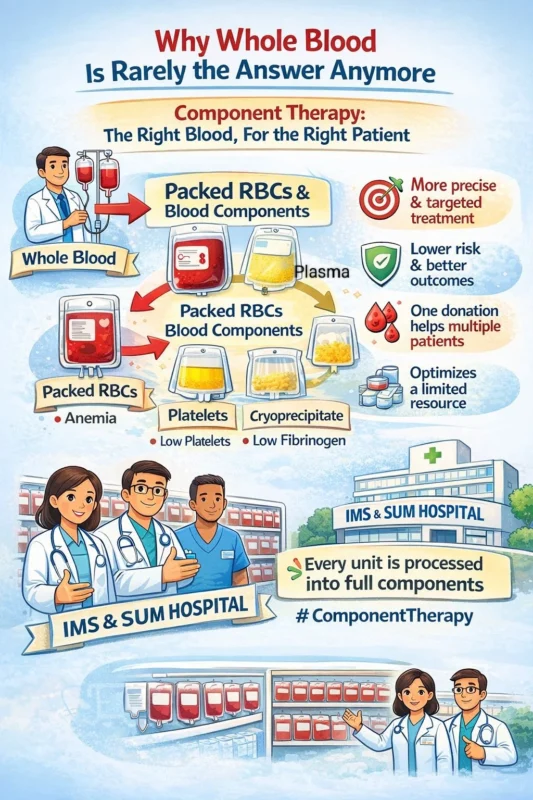
“Why Whole Blood Is Rarely the Answer Anymore?!
For decades, whole blood was the default response to anemia and blood loss. Today, transfusion medicine has moved far beyond this one size fits all approach.
Modern transfusion practice is built on component therapy. Instead of transfusing whole blood, we transfuse only what the patient actually needs.
Why component therapy makes more clinical sense:
- Packed Red Blood Cells (PRBCs) – Improve oxygen-carrying capacity in anemia
- Platelet concentrates – Prevent or control bleeding in thrombocytopenia
- Plasma – Correct coagulation factor deficiencies
- Cryoprecipitate – Target fibrinogen deficiency
Each component addresses a specific physiological problem, avoiding unnecessary volume overload and reducing transfusion-related risks.
The clinical impact:
- Better patient outcomes
- Lower risk of transfusion reactions and circulatory overload
- More rational and ethical use of a limited resource
- One donation benefits multiple patients, not just one
Good clinical practice and patient blood management (PBM)
At IMS and SUM Hospital, Bhubaneswar, Odisha, every unit collected is processed into full blood components, ensuring optimal utilization of each donation and delivering targeted, evidence-based transfusion support across all clinical specialties.
Whole blood still has select indications—such as massive hemorrhage protocols or specific trauma settings, but it is no longer the routine answer.
Despite the shift toward component therapy, whole blood still has a role in carefully selected clinical situations.
In cases of massive hemorrhage, particularly in severe trauma, battlefield injuries and uncontrolled acute blood loss, low-titer group O whole blood can provide rapid volume replacement along with red cells, plasma and platelets in a single product.
When time is critical and component therapy may delay resuscitation, whole blood can support early hemostasis and improve survival.
However, its use requires strict protocols, appropriate donor selection, and robust transfusion services and it is best viewed as a targeted tool for specific emergencies rather than routine transfusion practice.
However, these advanced component separation and transfusion facilities are still not universally available across many blood centers, particularly in resource-limited and peripheral settings.
As a result, patients may continue to receive whole blood by default rather than targeted components, not because it is ideal, but because it is the only option available.
Bridging this gap requires investment in infrastructure, trained manpower, quality systems, and policy support to ensure equitable access to safe and evidence-based transfusion care.
Transfusion medicine today is not about giving more blood, it’s about giving the right blood.”
Stay updated with Hemostasis Today.
-
Oct 17, 2026, 08:49Maria Magnusson: Karolinska Experts Explore Gene Therapy in Sickle Cell Disease and Hemophilia
-
Oct 17, 2026, 04:07Weihao Li: Global HEPATIC Registry Findings on Post-Transplant Arterial Thrombosis
-
Oct 17, 2026, 03:56Ghaith Abu-Zeinah: ASH Publishes 2026 Guidelines for Myelofibrosis Management in Blood Advances
-
Oct 17, 2026, 03:48Tristan Siokos: Why Vascular Occlusion Is More Than Just Clots – Breakdown of the 8 Pathways
-
Oct 17, 2026, 02:36Archil Jaliashvili: Oxygen Transport in Capillaries
-
Oct 17, 2026, 02:35Carly Newton: Understanding Access to Red Blood Cell Exchange for People Living With SCD
-
Oct 17, 2026, 02:34Raising Awareness of Blood Clots During and After Pregnancy – Thrombosis UK
-
Oct 17, 2026, 02:33Alaa Salamat: Our Research Accepted for Publication at ASH 2026
-
Oct 17, 2026, 02:32Mohammed Al Sharif: Discussing Factor XIII Testing and Its Clinical Significance