


Simon Senanu: Crossmatch Procedures and Advanced Troubleshooting
Simon Senanu, Medical Laboratory Scientist at Perkins Medical Centre, shared a post on LinkedIn։
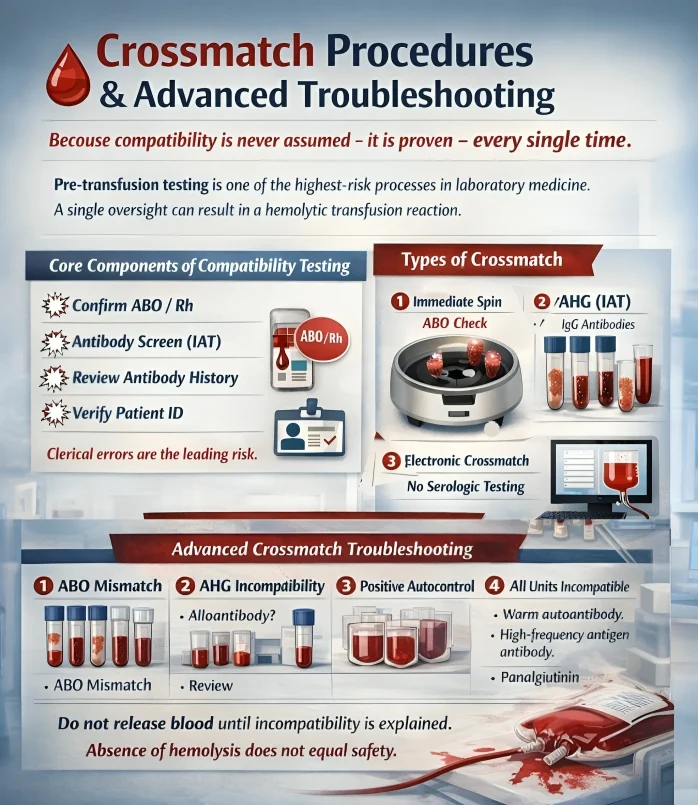
”Crossmatch Procedures and Advanced Troubleshooting
Because compatibility is never assumed, it is proven – every single time.
Pre-transfusion testing is one of the highest-risk processes in laboratory medicine.
A single oversight can result in a hemolytic transfusion reaction.
Core Components of Compatibility Testing Before crossmatching:
- Confirm patient ABO/Rh (forward and reverse grouping)
- Perform antibody screen (IAT method)
- Review history of previous antibodies
- Verify patient identification
Failure at this stage is the most common cause of fatal transfusion reactions – clerical error remains the leading risk.
Types of Crossmatch
- Immediate Spin (IS) Crossmatch
Purpose: Detect ABO incompatibility.
Principle: Patient plasma plus donor red cells, then centrifuge, and observe for macroscopic agglutination.
Detects:
- IgM antibodies (primarily ABO)
Limitations:
- Does not detect clinically significant IgG antibodies (e.g., anti-K, anti-D, anti-Fya)
Used when:
- Antibody screen is negative
- No history of clinically significant antibodies
Antiglobulin (AHG/IAT) Crossmatch
Purpose: Detect clinically significant IgG antibodies reactive at 37°C.
Procedure:
- Incubation at 37°C
- Wash to remove unbound antibodies
- Add anti-human globulin (Coombs reagent)
- Observe for agglutination
Detects:
- Alloantibodies not picked up by immediate spin
- Weak or low-titer antibodies
Required when:
- Antibody screen is positive
- Patient has historical antibodies
Electronic (Computer) Crossmatch
No serologic testing performed.
Requirements:
- Two concordant ABO/Rh typings
- Current negative antibody screen
- No history of significant antibodies
- Validated LIS safeguards
Risk reduction: Minimizes human clerical error – the most common cause of incompatible transfusion.
Advanced Crossmatch Troubleshooting
Incompatibility at Immediate Spin
Most likely cause:
- ABO mismatch
Action:
- Repeat patient and donor ABO grouping
- Verify sample labeling
- Confirm LIS entry
- Recollect sample if discrepancy persists
Never assume weak reaction is insignificant.
Incompatibility at AHG Phase
Potential causes:
- Alloantibody (most common)
- Autoantibody
- Positive DAT
- Cold-reactive antibodies
- Rouleaux formation
Systematic approach:
- Perform antibody identification panel
- Check autocontrol
- Perform DAT
- Review transfusion/pregnancy history
- Perform enzyme panel if needed
Positive Autocontrol
- Suggests autoantibody.
Next steps:
- Perform DAT
- Determine if IgG or complement coated
- Consider warm autoimmune hemolytic anemia (WAIHA)
Transfusion may require:
- Least incompatible units
- Close clinical monitoring
All Units Incompatible
Think:
- Warm autoantibody
- High-frequency antigen antibody
- Panagglutinin
Advanced workup:
- Adsorption studies
- Extended phenotype
- Referral to reference lab
Critical Bench Reminder
Do not release blood until incompatibility is explained.
The absence of hemolysis does not equal safety.”
Stay updated with Hemostasis Today.
-
Sep 30, 2026, 11:36Basit Ali: A Closer Look at CT Venography
-
Sep 30, 2026, 11:16Christina Pohlman: Could aPL Levels Help Predict Stroke Recurrence?
-
Sep 30, 2026, 10:55Rana Al Hrout: Diagnostic Approach to Hypochromic Microcytic Anemia
-
Sep 30, 2026, 01:52Javed Anees: DADA2 – When a Young Stroke Is More Than a Stroke
-
Sep 30, 2026, 01:51How a Venous Thrombus Becomes Revascularized – ISTH
-
Sep 29, 2026, 22:45Victor Agunyego: Paracetamol – The Most Common Drug We Underestimate
-
Sep 29, 2026, 22:42Nova Sinclair: Advancing the Future of Hematology – Meet Our 2027 Organizing Committee
-
Sep 29, 2026, 22:41Lorenz Räber: Intracoronary Imaging in PCI – Why, When, How, and Which Modality?
-
Sep 29, 2026, 22:31Selma Turkovic: Pleased to Deliver the Opening Presentation at Kingston Hospital