


Fayad Al-Haimus: Key Themes from the New 2026 AHA/ACC Guideline for Acute PE
Fayad Al-Haimus, Adult Thrombosis Fellow at McMaster University, shared a post on LinkedIn about a recent article by Mark Creager et al. published in AHA/ASA Journals:
“New 2026 AHA/ACC Guideline for Acute Pulmonary Embolism
A major, multidisciplinary update on how we evaluate, risk stratify, and manage PE has just been published in Circulation Journal.
After going through the document, a few themes stand out that will meaningfully impact day-to-day practice:
- A New PE Classification (A-E)
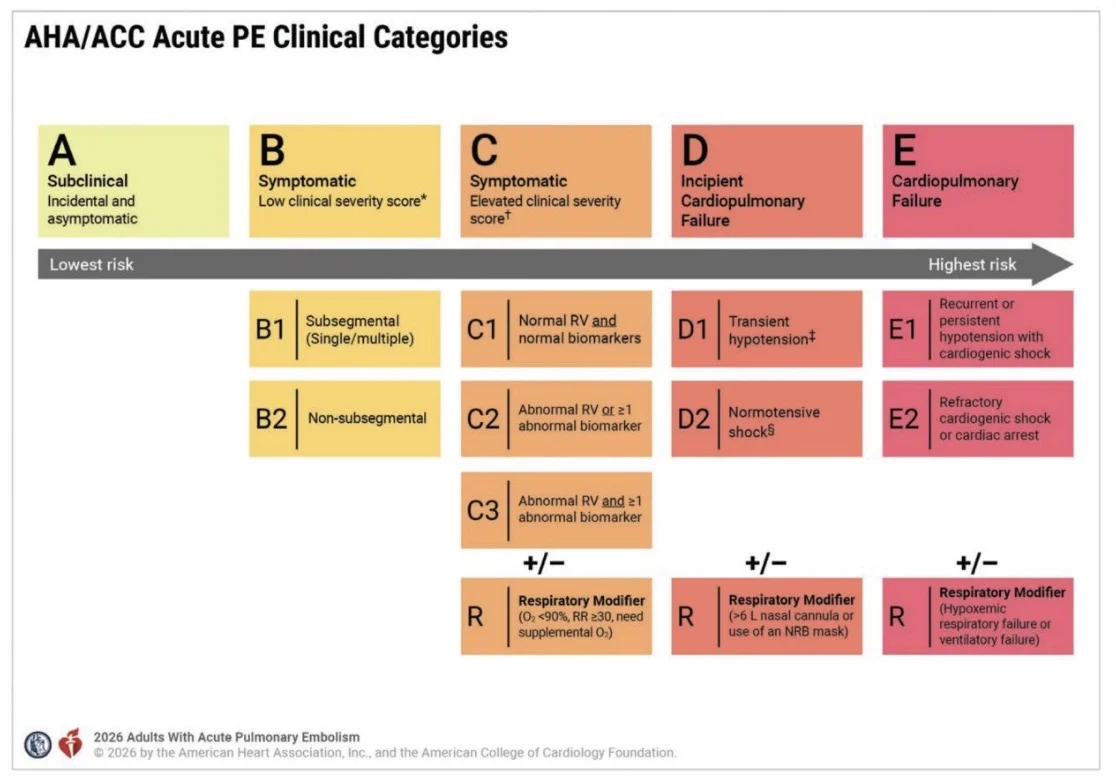
The guideline introduces an AHA/ACC Acute PE Clinical Category system (A-E), moving beyond the traditional ‘massive vs submassive’ framework. This aligns PE care with modern shock and heart failure paradigms, and importantly recognizes entities like ‘shock without hypotension’. - Smarter, More Efficient Diagnostics
Strong emphasis on Age-adjusted D-dimer and YEARS algorithm to safely avoid unnecessary imaging. - Anticoagulation Remains the Foundation
Clear recommendation: LMWH preferred over UFH when parenteral therapy is needed (unless instability or procedures expected). - PERT Becomes Central to Care
Strong recommendation for Pulmonary Embolism Response Teams (PERT). PERT activation is now recommended for Categories C-E. Think CODE PE similar to CODE STEMI. - A Paradigm Shift in Advanced Therapy
An important shift in the 2026 AHA/ACC PE guideline is how we think about advanced therapy. It’s no longer simply: ‘Remove the clot’. It’s: Preserve and recover RV function
For those of us in Emergency Medicine and Thrombosis, this will shape how we triage, treat, and follow PE patients moving forward.”
Title: 2026 AHA/ACC/ACCP/ACEP/CHEST/SCAI/SHM/SIR/SVM/SVN Guideline for the Evaluation and Management of Acute Pulmonary Embolism in Adults: A Report of the American College of Cardiology/American Heart Association Joint Committee on Clinical Practice Guidelines
Authors: Mark Creager, Geoffrey Barnes, Jay Giri, Debabrata Mukherjee, William Jones, Allison Burnett, Teresa Carman, Ana Casanegra, Lana Castellucci, Sherrell Clark, Mary Cushman, Kerstin de Wit, Jennifer Eaves, Margaret Fang, Joshua Goldberg, Stanislav Henkin, Hillary Johnston-Cox, Sabeeda Kadavath, Daniella Kadian-Dodov, William Keeling, Andrew Klein, Jun Li, Michael McDaniel, Lisa Moores, Gregory Piazza, Karen Prenger, Steven Pugliese, Mona Ranade, Rachel Rosovsky, Farla Russo, Eric Secemsky, Akhilesh Sista, Leben Tefera, Ido Weinberg, Lauren Westafer, Michael Young
Read the Full Guideline on AHA/ASA Journals․
Stay updated on all scientific advances with Hemostasis Today.
-
Oct 22, 2026, 06:43Giacomo Buso: Lifelong Carotid Risk vs. Late-Stage Trial Neutrality
-
Oct 22, 2026, 06:35Aastha Gupta: Navigating the Diagnostic Challenge of Restricted NK-Cell Repertoires in Flow Cytometry
-
Oct 22, 2026, 06:25Ahmed Alotaibi: Platelet Refractory, But HLA-negative – What Are You Missing?
-
Oct 22, 2026, 06:17Alessandra Bosch: Swiss Medical Weekly Publishes National Guidance on Desmopressin for Bleeding Disorders
-
Oct 22, 2026, 05:24Archil Jaliashvili: Hemoglobin Dose in Red Cell Transfusion
-
Oct 22, 2026, 03:40Hussein Burestom: Blood and Plasma as Strategic Resources for National Health Security
-
Oct 22, 2026, 03:28João Paulo Marochi Telles: Antibiotic Treatment in Febrile Neutropenia
-
Oct 21, 2026, 18:13Wolfgang Miesbach: Hereditary Hemorrhagic Telangiectasia Is an Overlooked Bleeding Disorder
-
Oct 21, 2026, 17:55Gayatri Kotwal։ New Review on Anemia, Pain, and Nutritional Deficiencies in Cancer Patients