

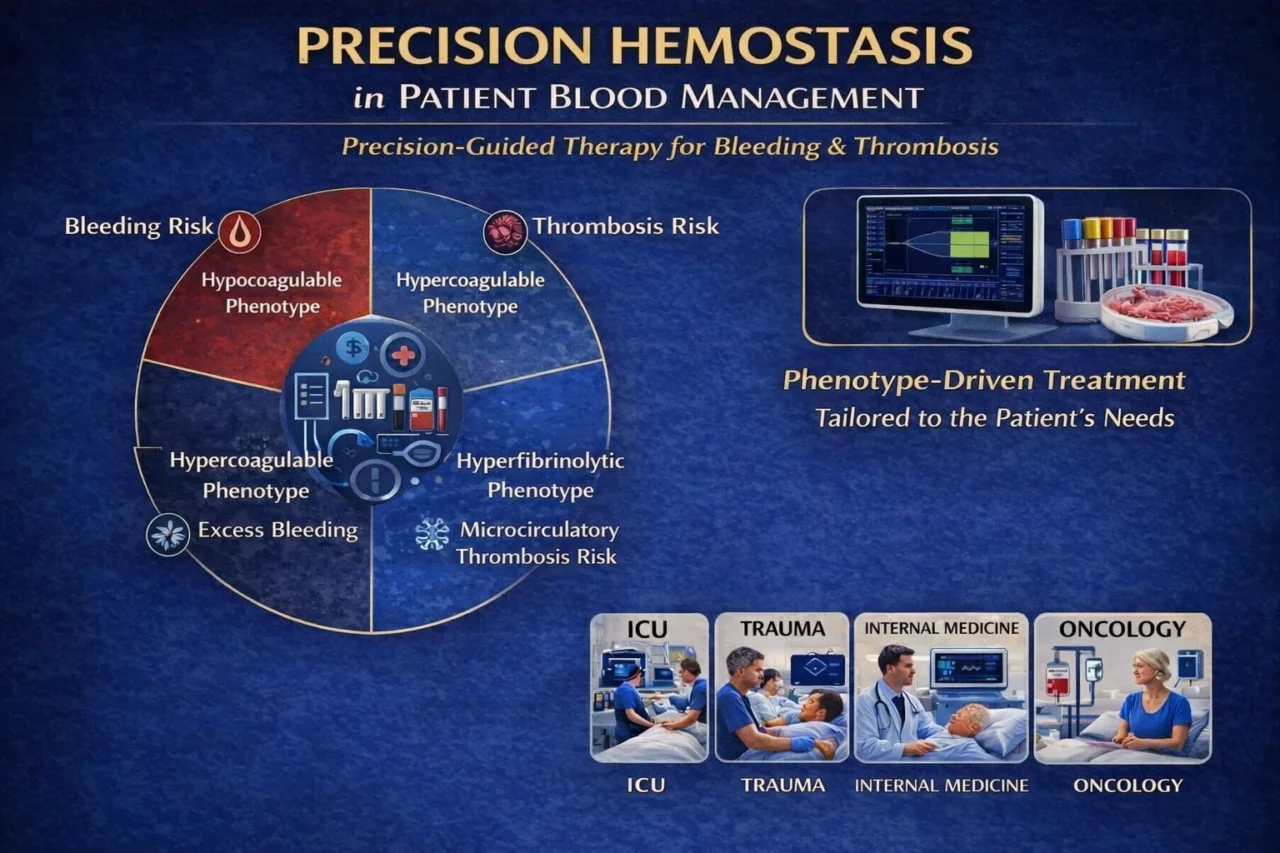
Denise M: Precision Hemostasis in Patient Blood Management
Denise M, Bloodless Medicine and Surgery Program Coordinator, shared a post on LinkedIn:
“Sometimes the best work begins with a challenge.
A few weeks ago, I posted an infographic on the value of Patient Blood Management (PBM) during a crisis.
Tomaz Crochemore, critical care physician and hemostasis expert, left a comment that stopped me.
He said the infographic was outstanding.
Then he pushed further. He wanted to see Patient Clot Management and precision hemostatic medicine explicitly woven into the PBM framework.
It was the first time I had heard of Patient Clot Management. While the physiology of bleeding and thrombosis including conditions like DIC is familiar territory in clinical practice, the term Patient Clot Management was new to me.
Crochemore’s work gave language and structure to that complexity.
I visited his profile (who is this guy?), and found his just published article in the Juntendo Medical Journal:
‘Revisiting the Concept of DIC: A Phenotype-guided Framework for Modern Hemostatic Medicine.’ That was my a-ha moment.
The dynamic balance between bleeding and thrombosis. Coagulopathy phenotyping. Individualized hemostatic therapy.
He was right. So I went to work.
What emerged is this:
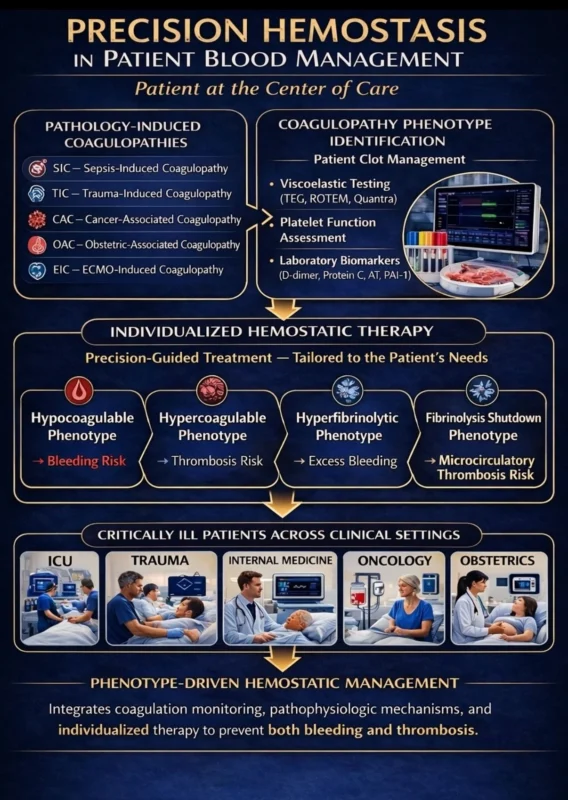
Precision Hemostasis in Patient Blood Management.
A framework that moves beyond anemia and transfusion stewardship into the full spectrum of blood health:
- Identifying coagulopathy phenotypes — sepsis, trauma, cancer, obstetric, ECMO-induced
- Matching therapy to the patient’s actual hemostatic state
- Preventing both bleeding AND thrombosis
Not one-size-fits-all. Precision-guided. Patient at the center.
For me, it expanded how I think about the PBM framework and adds another dimension to the PBM conversation
Thank you, Crochemore, for seeing further and for trusting that a PBM nurse coordinator in Brooklyn would follow you there. It was great collaborating with you.
This infographic is proof. LinkedIn made it possible. ”
Stay updated with Hemostasis Today.
-
Nov 9, 2026, 09:29Veronica Sanchez: A Framework for Woman’s Health
-
Nov 8, 2026, 19:31Anna Kajaste-Rudnitski: Presenting AAV-Induced p53 Signalling in Human CNS Cells at ESGCT 26
-
Nov 8, 2026, 19:29David McIntosh: Cybersecurity Matters, but Blood Availability Remains the Bigger Challenge
-
Nov 8, 2026, 19:26Wenxue Ma: An Integrative Framework for Macrophage-Mediated Therapeutic Resistance in Cancer
-
Nov 8, 2026, 19:25Yildiz Yigit: Presenting a Polycythemia Vera Case at the MPN Subcommittee Session
-
Nov 8, 2026, 18:56Denis Oduor: Strengthening the Regulation and Delivery of Blood Transfusion and Transplantation Services
-
Nov 8, 2026, 18:28Raghavendra Rao: A Narrative Review on Chronic Venous Disease during Pregnancy
-
Nov 8, 2026, 17:57Dhiren Patel: PLD1-Derived Phospholipids Regulate NAD Kinase and ROS Production in Neutrophils
-
Nov 8, 2026, 17:48Andra T.: What Causes Antiphospholipid Syndrome? – Four Steps, not One Cause