


Simon Senanu: D-Dimer – A Small Fragment with Big Clinical Significance
Simon Senanu, Medical Laboratory Scientist at Perkins Medical Centre, shared a post on LinkedIn:
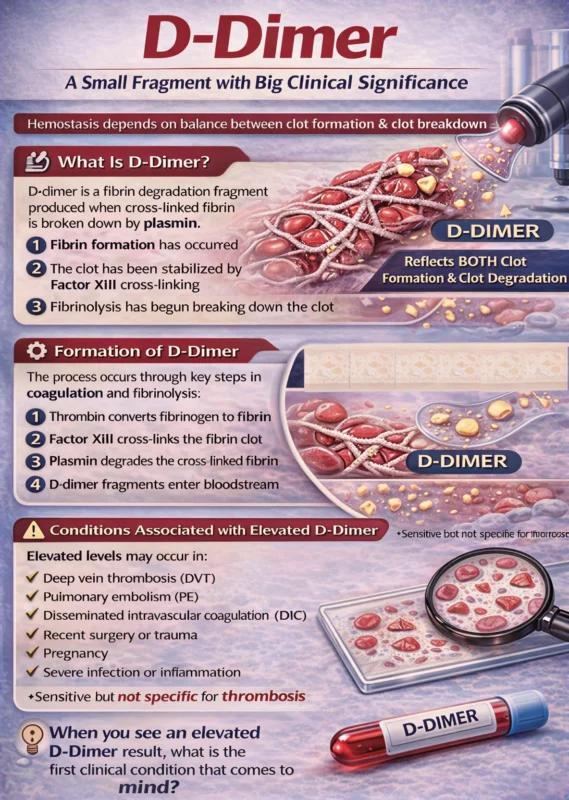
”D-Dimer – A Small Fragment with Big Clinical Significance
Hemostasis depends on a balance between clot formation and clot breakdown.
One important laboratory marker reflecting this balance is D-dimer, a fibrin degradation product that indicates active coagulation and fibrinolysis.
Despite its widespread use, D-dimer remains one of the most frequently misinterpreted tests in hemostasis.
What Is D-Dimer?
D-dimer is a protein fragment produced when cross-linked fibrin is degraded by plasmin during fibrinolysis.
Its presence in circulation indicates that:
- Fibrin formation has occurred
- The clot has been stabilized by Factor XIII cross-linking
- Fibrinolysis has begun breaking down the clot
Thus, D-dimer reflects both clot formation and clot degradation.
Formation of D-Dimer
The process occurs through key steps in coagulation and fibrinolysis:
- Thrombin converts fibrinogen to fibrin
- Factor XIII cross-links the fibrin clot
- Plasmin degrades cross-linked fibrin
- D-dimer fragments are released into circulation
This makes D-dimer a marker of cross-linked fibrin degradation rather than fibrinogen breakdown.
Conditions Associated with Elevated D-Dimer
Elevated levels may occur in:
- Deep vein thrombosis (DVT)
- Pulmonary embolism (PE)
- Disseminated intravascular coagulation (DIC)
- Recent surgery or trauma
- Pregnancy
- Malignancy
- Severe infection or inflammation
For this reason, D-dimer is highly sensitive but not specific for thrombosis.
Clinical Use
D-dimer testing is most useful for excluding thrombotic disease in low-risk patients.
When combined with clinical probability assessment, it helps determine whether imaging is required.
Common applications include:
- Excluding deep vein thrombosis
- Excluding pulmonary embolism
- Supporting evaluation of disseminated intravascular coagulation (DIC)
A normal D-dimer level has a strong negative predictive value, making thrombosis unlikely.
Limitations
- Elevated D-dimer may also occur in non-thrombotic conditions such as:
- Advanced age
- Inflammation or infection
- Pregnancy
- Liver disease
- Recent surgery or trauma
Therefore, D-dimer should not be used alone to confirm thrombosis.
Laboratory Methods
D-dimer can be measured using several techniques:
- Latex agglutination assays
- Immunoturbidimetric assays
- ELISA-based methods (high sensitivity)
Modern automated analyzers allow rapid detection, making the test valuable in emergency settings.
Laboratory Takeaway
D-dimer reflects the interaction between coagulation and fibrinolysis.
When interpreted appropriately, it helps clinicians:
- Assess thrombotic activity
- Exclude venous thromboembolism
- Support evaluation of DIC
A small fragment with major diagnostic importance in hemostasis.
When you see an elevated D-dimer result, what is the first clinical condition that comes to mind?”
Stay updated with Hemostasis Today.
-
Sep 25, 2026, 07:25Varun Capoor: How Therapeutic Apheresis and Transfusion Medicine Can Complement Clinical Management in SCD
-
Sep 25, 2026, 07:14Manshi Kesharwani: SAK-GQDs Modulate Thrombus Burden and Endothelial Function in Deep Vein Thrombosis
-
Sep 25, 2026, 06:20Farjah Hassan Algahtani: How Can We Better Identify Patients at Risk of Blood Clots after Metabolic and Bariatric Surgery?
-
Sep 25, 2026, 05:59Carla Lewis: Kids Conquering Sickle Disease Joins Nemours Children’s Hospital for 2nd Annual Awareness Event
-
Sep 25, 2026, 05:47Omid Seidizadeh: Evolutionary Constraint and Population Variation Across Coagulation Genes
-
Sep 25, 2026, 05:40Gerald Bertrand: Presenting UMi-NGS Non-Invasive Foetal HPA Genotyping at DGTI 2026
-
Sep 25, 2026, 05:33Urge Congress to support the Sickle Cell Disease Comprehensive Care Act – ASH
-
Sep 25, 2026, 05:24Isabelle Mahé: Reduced-Dose Apixaban in Extended CAT Treatment
-
Sep 25, 2026, 05:15Maria Cherska: High Cholesterol Isn’t Always Diet or Lifestyle – Sometimes It’s Genetic