


Samwel Mikaye: Blood Smear Morphology Guide
Samwel Mikaye, Medical Doctor at MSK, shared a post on LinkedIn:
“Blood Smear Morphology
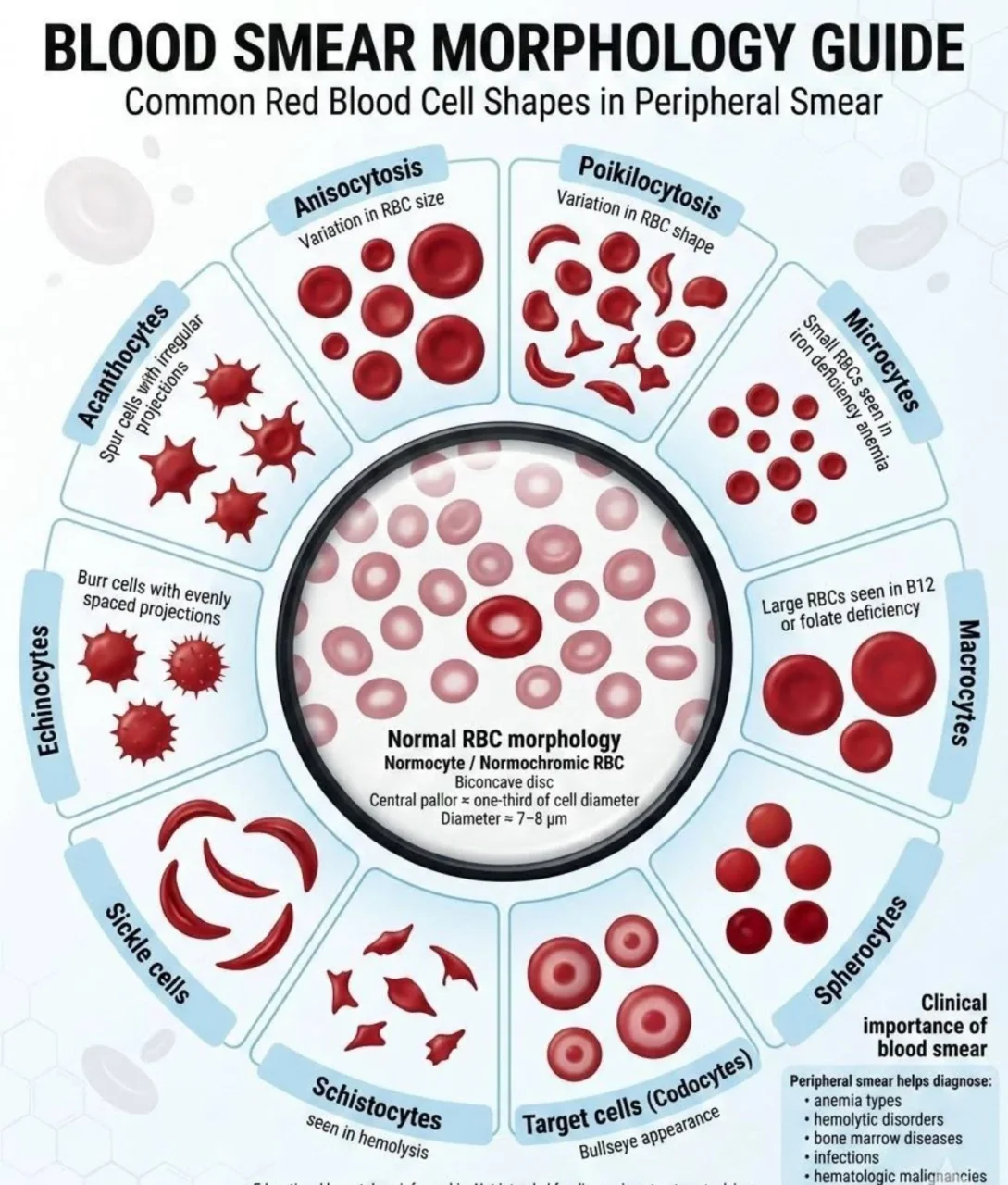
Blood smear morphology refers to the microscopic examination of red blood cells (RBCs), white blood cells (WBCs), and platelets on a stained blood film to assess their shape, size, color, and abnormalities.
It is commonly done using stains such as Wright Stain or Giemsa Stain.
1. Normal Red Blood Cell Morphology
Normal RBCs are:
- Biconcave discs
- Diameter about 7–8 µm
- Central pallor occupying about one-third of the cell
- Uniform in size and shape
2. Abnormal Red Blood Cell Shapes (Poikilocytosis)
Spherocytes
- Round RBCs without central pallor
- Seen in Hereditary Spherocytosis and Autoimmune Hemolytic Anemia
Target Cells (Codocytes)
- Bull’s-eye appearance
- Seen in Thalassemia, Liver Disease, and Iron Deficiency Anemia
Sickle Cells
- Crescent-shaped RBCs
- Seen in Sickle Cell Disease
Elliptocytes
- Oval or elongated RBCs
- Seen in Iron Deficiency Anemia and Hereditary Elliptocytosis
Schistocytes
- Fragmented RBCs
- Seen in Disseminated Intravascular Coagulation and Hemolytic Uremic Syndrome
Tear Drop Cells (Dacrocytes)
- Tear-shaped RBCs
- Seen in Myelofibrosis
3. RBC Size Variations (Anisocytosis)
Microcytes
- Small RBCs
- Seen in Iron Deficiency Anemia
Macrocytes
- Large RBCs
- Seen in Vitamin B12 Deficiency and Folate Deficiency
4. RBC Color Changes
Hypochromia
- Pale RBCs with large central pallor
- Seen in Iron Deficiency Anemia
Polychromasia
- Bluish RBCs indicating immature cells (reticulocytes)
5. RBC Inclusions
Howell-Jolly Bodies
- Nuclear remnants
- Seen after Splenectomy
Basophilic Stippling
- Small blue granules in RBCs
- Seen in Lead Poisoning
Heinz Bodies
- Denatured hemoglobin
- Seen in G6PD Deficiency
6. White Blood Cell Morphology
Abnormal WBC morphology may indicate infections or hematologic disorders such as Leukemia.
Examples:
- Increased neutrophils is associated with bacterial infection
- Increased lymphocytes is associated with viral infection
- Presence of blast cells is associated with leukemia
7. Platelet Morphology
- Normal platelets are small, round fragments.
- Reduced platelets may occur in Thrombocytopenia.
- Giant platelets may be seen in some bone marrow disorders.
Blood smear examination helps diagnose anemia, infections, blood disorders, and hemolytic diseases by evaluating the shape, size, and appearance of blood cells.”
Other posts featuring Samwel Mikaye on Hemostasis Today.
-
Sep 30, 2026, 10:55Rana Al Hrout: Diagnostic Approach to Hypochromic Microcytic Anemia
-
Sep 30, 2026, 01:52Javed Anees: DADA2 – When a Young Stroke Is More Than a Stroke
-
Sep 30, 2026, 01:51How a Venous Thrombus Becomes Revascularized – ISTH
-
Sep 29, 2026, 22:45Victor Agunyego: Paracetamol – The Most Common Drug We Underestimate
-
Sep 29, 2026, 22:42Nova Sinclair: Advancing the Future of Hematology – Meet Our 2027 Organizing Committee
-
Sep 29, 2026, 22:41Lorenz Räber: Intracoronary Imaging in PCI – Why, When, How, and Which Modality?
-
Sep 29, 2026, 22:31Selma Turkovic: Pleased to Deliver the Opening Presentation at Kingston Hospital
-
Sep 29, 2026, 22:31Miguel Teran: Ultrasound and Simulation in Arterial Blood Sampling
-
Sep 29, 2026, 22:28Mohammad Refaei: Navigating Your Career in Hematology From Training to Practice