


Asad Ikram: Headache and Visual Impairment in Idiopathic Intracranial Hypertension
Asad Ikram, Assistant Professor of Medicine at Anne Burnett Marion School of Medicine at Texas Christian University, shared a post on LinkedIn about a recent article by Gabriel Bsteh et al, published on European Journal of Neurology, adding:
“Headache and Visual Impairment in idiopathic intracranial hypertension (IIH)
The role of surgical interventions in IIH related headache vs visual impairment and what those offer: a very pragmatic look at when and in whom procedures actually help.
Across multiple tertiary centers, investigators evaluated outcomes of patients undergoing CSF shunting, venous sinus stenting, or optic nerve sheath fenestration (ONSF), with a focus on how indication for surgery (vision vs headache) influences results.
What stands out is that surgery is consistently effective for vision preservation, with most patients showing stabilization or improvement in visual function after intervention.
However, outcomes for headache control were far less predictable, with a significant proportion continuing to have persistent or recurrent symptoms despite technically successful procedures.
Complication and revision rates particularly for shunts were not negligible, reinforcing the need for careful patient selection.
From a neurovascular and stroke-adjacent perspective, this is highly relevant because we often encounter IIH in young patients presenting with headache or visual symptoms, sometimes mimicking vascular pathology and often associated with Dural Venous Sinus thrombosis needing anticoagulation.
The key takeaway is that surgical intervention should be driven primarily by visual risk rather than headache alone, and that multidisciplinary evaluation (neurology, neuro-ophthalmology, neurosurgery) is critical before committing patients to invasive therapies.”
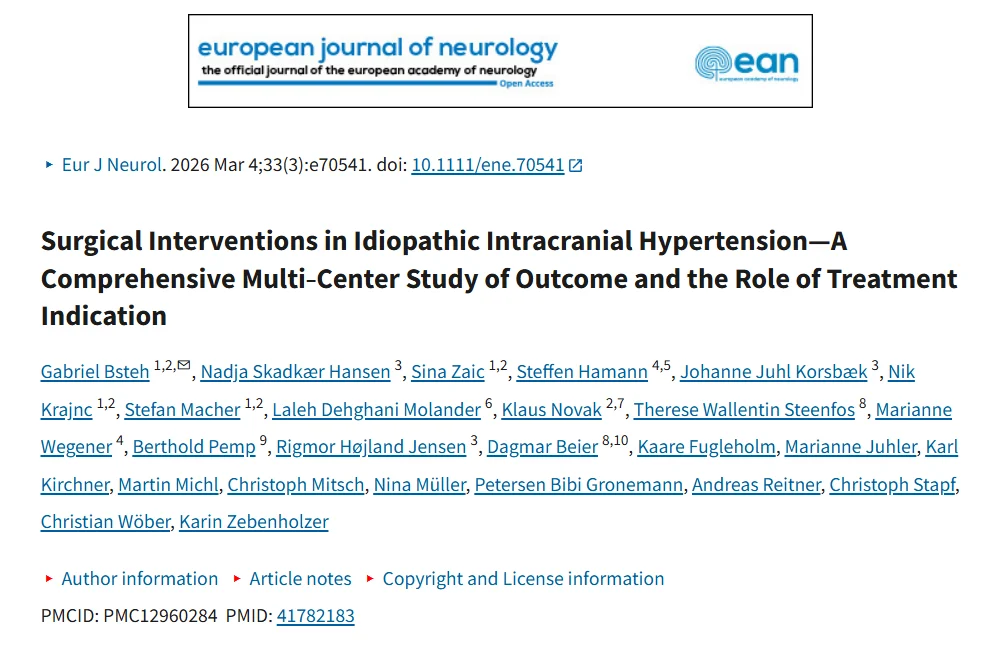
Title: Surgical Interventions in Idiopathic Intracranial Hypertension—A Comprehensive Multi‐Center Study of Outcome and the Role of Treatment Indication
Authors: Gabriel Bsteh, Nadja Skadkær Hansen, Sina Zaic, Steffen Hamann, Johanne Juhl Korsbæk, Nik Krajnc, Stefan Macher, Laleh Dehghani Molander, Klaus Novak, Therese Wallentin Steenfos, Marianne Wegener, Berthold Pemp, Rigmor Højland Jensen, Dagmar Beier, Kaare Fugleholm, Marianne Juhler, Karl Kirchner, Martin Michl, Christoph Mitsch, Nina Müller, Petersen Bibi Gronemann, Andreas Reitner, Christoph Stapf, Christian Wöber, Karin Zebenholzer
Read the Full Article on European Journal of Neurology
Stay updated with Hemostasis Today.
-
Oct 21, 2026, 03:36Steve Watson: Ligand Epitope Ratios Influence Antagonist Inhibition
-
Oct 21, 2026, 03:18Stephen D. Coombs: Superficial Venous Thrombosis in Athletes and Importance of Early Recognition and Referral
-
Oct 21, 2026, 02:52Aymar Akilimali: Bleeding During Anticoagulation as a Potential Signal of Occult Cancer
-
Oct 21, 2026, 00:58Anees Ur Rahman: Completing a Two-Week Clinical Rotation at Haemophilia Treatment Centre Rawalpindi
-
Oct 21, 2026, 00:56Caitlyn Mooney: Pulmonary Embolism in Athletes, Recognition and Return to Sport
-
Oct 21, 2026, 00:54Hani Karrar: Pleased to Share Our Review on Emicizumab in Hemophilia A Management
-
Oct 21, 2026, 00:53Akshay Sharma: HSCT Leads to Sustained Improvements in Sickle Cell Cardiomyopathy for Up to 3 Years
-
Oct 21, 2026, 00:51Prateek Meena: The F. A. T. R. N. Mnemonic for Recognizing TTP
-
Oct 20, 2026, 23:51Registration Is Open for WFH CCS 2027 – World Federation of Hemophilia