


Rare Diseases, Plasma-Derived Medicines and the Elephant in the Room – Part 3
The previous two articles in this series sketched out the order of magnitude of the challenges our world faces in this field, and the widespread unnecessary suffering and avoidable death currently being caused.
- Part 1 discussed the range of Plasma-Derived Medicines, their vital clinical importance and the gravely damaging extent of their poor global availability.
- Part 2 offered some further scoping of the problem(s), highlighting the severe global inequity in this field – with also some glimpses of rare but encouraging progress in some parts of the LMIC world.
- Part 3, here, gives Relph, our “Realism Elephant”, an opportunity to share the fruits of his long experience of the scene, and offer his own suggestions for how we might now proceed, in the best interests of patients.
This seems a particularly appropriate moment to consider Relph’s suggestions, as organisers and delegates prepare for the International Plasma Proteins Congress later this month – the premier plasma community event in the global calendar. To be held in Milan Italy, IPPC ’26 will surely provide all present with a splendid opportunity to bring the dire global plasma situation into sharper focus, and commit ourselves to improving it.
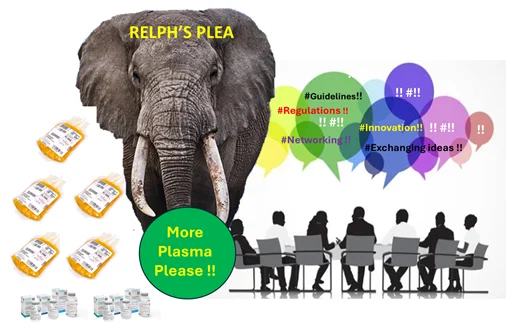
In many discussions of rare diseases, prominence is often given to the need to improve the “continuity of supply” of Plasma-Derived Medicines (PDMPs) – as if the supply were already adequate. Sadly, however, the real problem for the vast majority of sufferers globally (80%+), is not a deficiency in the continuity of supply. It is the complete absence of any supply at all. There simply are not nearly enough plasma-derived medicines to go round. Relph, as an independent observer, sees the root cause clearly. It is an inadequate global supply of human plasma for medicines production.
Throughout this Century, Relph has been witness to repetitive discussion, the practical relevance of which to his own concerns is not always clear to him. As a Realism Elephant, his focus is on patient outcomes; reductions in avoidable death and unnecessary suffering.
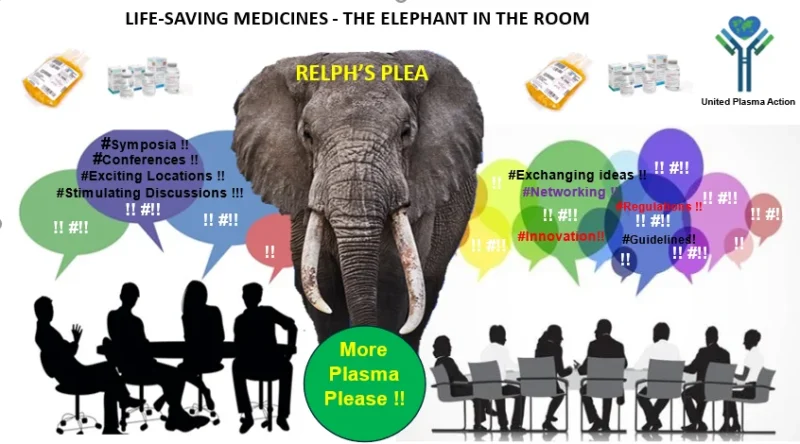
As a silent spectator at many fascinating Conferences, and many other well-intentioned, imaginative events in expensive hotels all over the World, Relph can’t help feeling disappointed at how little attention is paid to the design and implementation of actual improvements in the global plasma harvest. He knows that a dramatic increase is needed to enable the achievement of adequate plasma-derived medicines supply to meet the needs of rare disease sufferers, carers and clinicians, globally. Without that, millions of patients worldwide will continue to suffer and die unnecessarily. Relph pleads for change, genuine transformational change.
Of course, the reasons for the widespread global under-performance in plasma collection are legion. They could take up many man-years of further “exciting discussion” (as often advertised by Conference organisers) but, to Relph, it seems obvious that real progress will not come from further discussions or debates, and certainly not from further arguments. He sees real patient care success coming from the resolute simplification of the key matters at hand, and a firm commitment, not to discussing them, but to acting upon them.
Global Plasma Collection – current performance.
Analysing the sadly unsatisfactory status quo, Relph notes that plasma collection efforts globally are extremely patchy. Notably, they are most excellently successful in the United States of America – the only country in the World collecting enough plasma to meet its own patients’ needs with significant quantities to spare to help patients in other lands. (American plasma exports provide over 70% of the current total global supply.)
Collection performance is weaker, but reasonable, in some parts of Europe and also in some other rich countries. However, performance is lamentably inadequate everywhere else. The consequent patient suffering and premature mortality is shameful, especially in Low and Middle Income Countries (LMIC).
LMIC Plasma Collection – outstanding potential
There are, of course, many features that distinguish Healthcare provision in LMIC nations from what’s available, and often taken for granted, in more fortunate countries. In careful parallel with volume improvements, transformational change will also be necessary in many other aspects of the scene – notably Safety, Quality, Regulatory oversight and effective over-arching national legal frameworks. However, these will be of no benefit in the continued absence of adequate supplies of the basic sine quo non – the raw material – the donated human plasma. Relph therefore encourages us here to concentrate tightly on matters that are specifically relevant to that aspect only.
- The raw material, the plasma itself, is as plentiful in LMIC as it is anywhere. Unlike gold and other precious raw materials, plasma needs no costly prospecting or mining. It is as ubiquitous and plentiful as sunshine and raindrops. All nations need to do is to gather it in, from the arms of a few willing citizens. (Five or 6 percent of citizens will be absolutely ample.)
- The science, the technology and the systems necessary to exploit the raw material effectively and efficiently are well understood. A wealth of good advice and support is available from experienced practitioners that have long track records of outstanding performance – with many millions of donors contributing and many millions of patients benefiting. No new discoveries are necessary to allow matters to proceed.
- The basic skills and a good deal of the advanced knowledge and experience necessary to establish and maintain effective plasma collection and processing systems already exists in many LMICs. Any gaps there may be can be filled relatively easily, if necessary, with outside assistance, to help prime the pumps.
- The necessary investment is not mind-boggling. When compared with the benefits to be gained, the costs are relatively small, and very good value for money – in Health and Social benefits and also in terms of Economic Development.
So – What’s the Problem?
What is preventing the majority of LMIC nations from following the excellent example of the best performing nations in the World? Why do the LMIC parts of the World tend to be so far behind? The answer to that question is of course fundamental to the future of the whole enterprise – and the lives of more than 200 million rare disease sufferers globally who do not yet have access to the treatments they need. In accordance with normal change management practice, Relph encourages us to look at this issue from two main perspectives.
1. The potential change enablers
1.1. The principal of these are, of course, the Governments, Healthcare Authorities and other relevant bodies in the LMIC nations themselves. Committed support and encouragement from them will have the power to achieve transformational change. The work being done by dedicated LMIC professionals, commercial partners, patient representatives and others is already beginning to melt the glacier in some parts of the World. Further such work will surely bear more fruit as time goes by – provided that National and Local Authorities deploy the necessary willpower, commitment, and investment.
1.2 A second element with potential to help generate significant forward momentum is of course the community of highly efficient commercial players already well established in the field. Operating mainly in the High Income world but already providing some 90% of the current global supply of plasma-derived medicines, these companies have proven themselves ready and willing to invest and operate in LMIC environments when the circumstances allow. The recent visit to India by representatives of the international Plasma Protein Therapeutics Association (PPTA), and that organisation’s confirmation of its extended mission to LMIC plasma communities, are further encouraging signs of the potentially pivotal role of the international commercial plasma community in future LMIC development.
One recent initiative worthy of particular note is the Egyptian Government’s Source Plasma collection and contract processing initiative, in close collaboration with Spanish company, Grifols, SA. There are other promising examples to draw on, but such initiatives are, as yet, still very few and far between. Relph believes that their encouragement and expansion will be a key element of progress in the days ahead. There can surely be no doubt that Public/Private Partnerships of this kind have enormous positive potential – provided that the Public Sector injects the appropriate level of commitment, enthusiasm and financial investment, and provided also that the Private Sector is allowed a viable commercial context in which to operate.
The Private Sector in this context of course, importantly, includes members of the small but expanding commercial plasma sector based in the LMIC nations themselves. They are, on the whole, as yet, less well established globally than their HIC counterparts, but, in the LMIC context, they have the advantage of closeness to market and potentially lower costs also in both collection and processing. This sector is already well established in India, in South Korea and a small number of other countries. It has enormous potential to expand rapidly and effectively, with the right encouragement.
1.3 Lastly, in the enabling context, we have the World Health Organisation and other relevant International bodies, both in Healthcare and in Finance and Economics. Their encouragement and support can also play a hugely important role, if they weigh in with enthusiasm. The United Nations Institute for Training and Research (UNITAR) has made an enormously encouraging start in this area with their Plasma4.Life programme. Instituted first in Argentina and Malaysia, with generous Takeda sponsorship, the programme has recently been extended to include India. Originally championed by the United Plasma Action organisation and now funded by generous sponsorship from Intas Pharmaceuticals and the PPTA, this programme extension initiative has great potential to help transform the Indian scene. Though the UNITAR Plasma4.Life programme is aimed, long-term, at global relevance throughout the LMIC world, it operates in individual countries on the basis of local priority setting and programme design – aiming everything at local participation and local results for local patients, carers and clinicians. Relph highly commends this approach and has high hopes for its fruitfulness in India – and, in due course, beyond.
2. Potential Change Inhibitors
2.1. Unfortunately these are legion. Not least among them of course, is shortage of finance, an almost universal LMIC Healthcare problem. However, in the plasma case, there are unique financial and economic benefits to be reaped from a successful approach. Relph suggests that Financial and Economic aspects can in fact be turned from inhibitors into enablers, if properly assessed and managed.
The raw plasma is ubiquitous and plentiful. Collecting it is neither overly complicated nor unduly expensive. It’s rich multi-component content allows for the production of a wide range of vital plasma-derived medicines. The $37 billion that the USA earns annually from its plasma exports sets an interesting benchmark in this context. In addition to the export dollars, the economic impact on local communities, in terms of staff employment, donor compensation, and all the secondary associated economic activity, is known to be highly positive.
Relph is clear in his own mind that LMIC nations will do well to look upon plasma collection as an Economic Development activity as well as a patient lifesaver. In most cases, early Economic benefits will be mostly internal, with only a small positive element of import substitution; but in due course, the LMIC front runners are likely to reap significant export benefits also.
2.2 Secondly, directly in terms of Healthcare costs, the situation requires a broad-horizon Health Economics analysis to see the cost/benefit equations in the right perspective. The medicines may seem expensive to many, but the absence of medicines, and the prolonged and repeated suffering caused to rare disease patients, can involve significantly higher Healthcare costs over time.
Also, the lost potential of rare disease sufferers who struggle through life untreated and die young, is a significant Economic factor to be taken into account. Many rare disease sufferers live fruitful economically active lives, when properly treated with the plasma-derived medicines they need – contributing to the Economy and the life of the community in ways that make the cost of their treatment exceedingly good value for money.
2.3 Another significant inhibitor that Relph has found it hard to ignore is an apparent lack of awareness and a notable lack of reforming zeal on the part of relevant influencers and decision-makers – not only in LMIC, but also among members of the international plasma community and other important influencers. The historic and continuing mode in many areas is one of celebration about how valuable PDMPs are to patients, carers and clinicians, when they are available – with scant attention being paid to how seriously damaging it is when they are not available. There seems to be a notable lack of emphasis, or even recognition, of the fact that 80% of sufferers globally aren’t in fact receiving these medicines at all.
2.4 A seriously important part of this “all’s well with the World” progress inhibitor is the widespread advocacy of what its supporters call “altruistic donation”. This is widely preached, not as a plasma collection enhancer (which it demonstrably is not), but as if it were a valuable social phenomenon in its own right. Many benefits are claimed for the practice of Voluntary Uncompensated Donation (VUCD) as if the very doing of it were an enhancement to the Human condition. The quantity and volume of this extraordinary advocacy seems to have almost completely drowned out the key fact – the fact that ought to be the key message – that we do not donate for our own satisfaction, or for the satisfaction of others – we donate for the benefit of patients.
Yes, banal as it may sound, after years of careful observation, Relph feels that he has a duty to remind us that we donate our plasma for the benefit of patients, and only for the benefit of patients. All the rest is either a welcome by-product or an unnecessary distraction, nothing more. To lose sight of that fact and insist on worshipping a collection method, rather than the desired life-saving outcome, is to enter into a realm not only of self-indulgent fantasy, but shameful dereliction of duty to patients.
Unfortunately, a number of otherwise laudable and helpful organisations have fallen into this bizarre pseudo-ethical trap – among them, the World Health Organisation, the International Plasma and Fractionation Association and the European Blood Alliance. Their preachings against the provision of financial compensation or reward for plasma donors is one of the greatest inhibitors to patient-centred progress,, globally. As a result of this extreme prejudice, many nations still prohibit donor compensation. Many others so deeply disapprove of it that its deployment is unthinkable. It is severally and variously described as immoral, exploitative, unsafe for donors, unsafe for patients … anything derogatory that might help put everyone off the practice …. and all hopelessly misguided and unfounded …. helping patients not at all.
2.5 And here’s the key point that our friendly Elephant in the Room would particularly like to draw to our attention in this context – 90% of the current global supply of PDMPs; the supplies that ease suffering and save lives daily, all over the World – are made possible by the deployment of financial compensation for donors. All countries everywhere in the World that have any PDMPs at all to treat their rare disease sufferers are relying to a greater or lesser extent on Voluntary Reasonably Compensated Donation (VRCD).
Relph doesn’t assert that starting to deploy VRCD in the LMIC nations would create ample plasma harvests immediately. These things take time. However, from experience and observation, he’s confident in stating that no country anywhere has ever managed to gather an adequate plasma harvest without deploying VRCD.
This is not to assert, nor even to imply, that VUCD might not be capable some day of collecting an adequate plasma supply for some nation, somewhere. Relph’s observation is that all the evidence points to VRCD being the best and quickest way to make progress – and that with the relevant global mortality rate being horrifically high, on a daily basis, there really is no time to waste on speculation about what may or may not be possible in the long term. He urges action without delay – swift, purposeful action – deploying, in all LMIC nations, the proven tools already known to others to deliver safe, swift and cost-effective results.
You, dear reader, will no doubt come to your own conclusions. All that Relph asks of us is that we please don’t ignore him any longer; that we please take advantage of his observations of the scene over many years and judge them entirely on the evidence; not on the basis of misty abstract ideas or beliefs, however deeply held. He urges us to focus our efforts entirely on the millions of sufferers globally who so badly need our help.
Written by David McIntosh, Founder and Chair at United Plasma Action.
-
Oct 6, 2026, 22:43Alessandra Bosch: Pediatric GTH Opens with Regional Experts Convening on Pediatric Hemostasis and Thrombosis
-
Oct 6, 2026, 22:39Managing Thrombotic Risk in Pregnancy – How the Lab May Help – Sysmex Europe
-
Oct 6, 2026, 22:33Ahmet Davut Aksu: A Multi-Objective Approach to Enhance Fibrinolysis, Selectivity, and Inhibition Resistance
-
Oct 6, 2026, 22:29Muhammad Abubakar: New Study on Iron Biology to Be Presented at ASH 2026 and Published in Blood
-
Oct 6, 2026, 22:24David McIntosh: Calling On Decision-Makers to Prioritize Donors and Clinical Access During IPAW 2026
-
Oct 6, 2026, 22:21Zoltan Nagy: With All Eyes on Optogenetics Today, What Can It Do in Megakaryocytes and Platelets?
-
Oct 6, 2026, 22:13Khalid A. Fakhro: Sidra Medicine Hosts RAPID 2026 Advancing Diagnostics and Treatments for Inborn Errors of Immunity
-
Oct 6, 2026, 22:04Denis Oduor: Preparedness for Postpartum Haemorrhage Must Include Preparedness for Blood
-
Oct 6, 2026, 21:57Farhad Moradpour: Health Equity and Public Health – What Drives Anemia Disparities in Ethnic Minority Populations?