


Arun V J: The Nation Inside the Human Body and Blood Function
Arun V J, The Leader of Transfusion Medicine at Malabar Medical College, shared a post on LinkedIn:
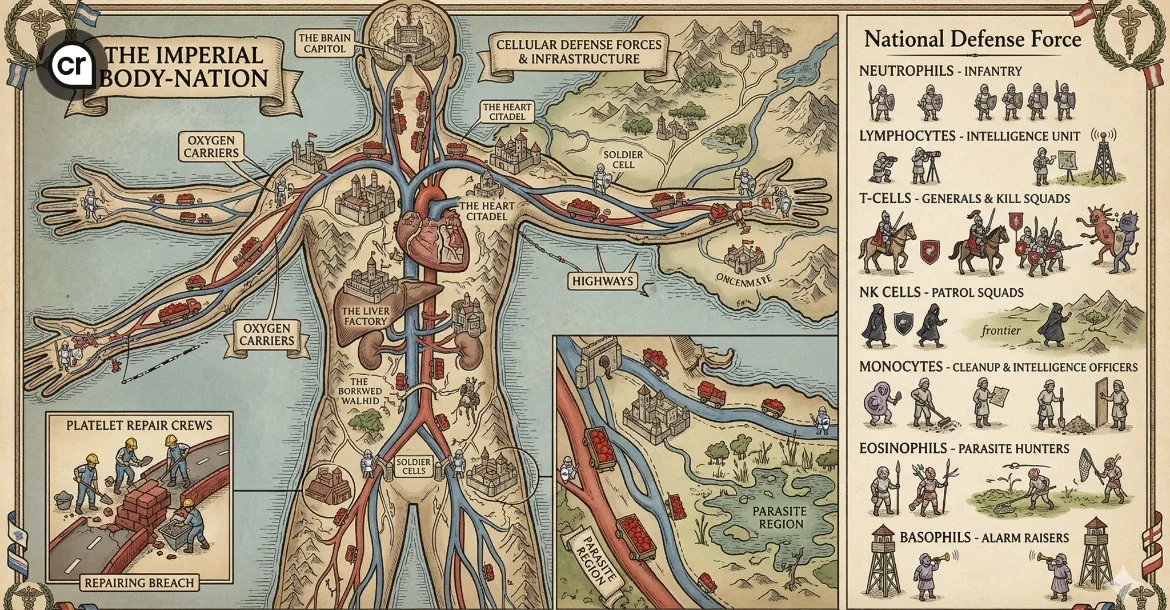
“There are 37 Trillion citizens living inside you. They have jobs, weapons, and a government. And they are at war.
Deep inside your bones, there is a factory that never shuts down.
It’s called bone marrow.
Every single second, it produces 2 to 3 million red blood cells.
At the centre of this factory lives one cell that can become anything the nation needs — a soldier, a transporter, a repair worker.
It’s called the stem cell.
Destroy the bone marrow — as leukaemia does — and the entire nation collapses.
The red blood cell is the delivery worker.
No nucleus. No agenda. Just one job — pick up oxygen from the lungs, deliver it to every corner of your body, bring carbon dioxide back.
Over and over. For 120 days. Then it retires and a new one takes its place.
You have 20 to 30 trillion of them right now.
When you’re anaemic, the delivery workers are short-staffed. The oxygen isn’t arriving.
The white blood cell is not one soldier.
It is an entire military.
Neutrophils — the infantry. First to arrive. Last to leave. That pus in a wound? Dead neutrophils. They fought so you didn’t have to feel it.
Lymphocytes — the intelligence unit. B cells manufacture custom missiles called antibodies, designed for one specific enemy. T cells are the kill squads and the generals. Natural Killer cells patrol without orders and execute without hesitation.
Monocytes — the cleanup crew and the intelligence officers. They eat the wreckage and write the after-action report.
Eosinophils — the parasite hunters.
Basophils — the alarm raisers.
Five divisions. One army. Always on duty.
Platelets are the emergency repair crew.
The moment a blood vessel breaks, they rush in, pile on top of each other, and form a plug. Then 13 clotting proteins activate — one triggering the next — weaving a mesh of fibrin over the plug like scaffolding.
And all of this moves through plasma.
55% of your blood volume. Mostly water — but carrying nutrients, hormones, antibodies, clotting factors, and waste.
The highway every citizen travels on.
The next time you see a bag of blood hanging in a hospital room — that is not fluid.
That is a nation of cells from another human being, entering a stranger’s body to save their life.
The next time someone asks you why blood donation matters — the answer is this:
You are sending workers, soldiers, and emergency responders to a nation in crisis.
One donation. Potentially three lives. Three different people in three different crises — red cells to one, platelets to another, plasma to a third.
I wrote a full breakdown of every cell, every function, and every normal value on my blog.
Because the least we can do — for a nation that has never taken a single day off — is know their names.
What did you learn about blood today that you didn’t know before?
Drop it below. I read every comment.”
Stay updated with Hemostasis Today.
-
Oct 21, 2026, 00:58Anees Ur Rahman: Completing a Two-Week Clinical Rotation at Haemophilia Treatment Centre Rawalpindi
-
Oct 21, 2026, 00:56Caitlyn Mooney: Pulmonary Embolism in Athletes, Recognition and Return to Sport
-
Oct 21, 2026, 00:54Hani Karrar: Pleased to Share Our Review on Emicizumab in Hemophilia A Management
-
Oct 21, 2026, 00:53Akshay Sharma: HSCT Leads to Sustained Improvements in Sickle Cell Cardiomyopathy for Up to 3 Years
-
Oct 21, 2026, 00:51Prateek Meena: The F. A. T. R. N. Mnemonic for Recognizing TTP
-
Oct 20, 2026, 23:51Registration Is Open for WFH CCS 2027 – World Federation of Hemophilia
-
Oct 20, 2026, 23:44Edward Lee Carter: AF in Nursing Homes – When Stroke Risk Scores Tell Only Part of the Story
-
Oct 20, 2026, 22:59Building Effective Patient Advocacy Through Collaboration Between Patients and Clinicians – EHC
-
Oct 20, 2026, 21:22Intezar Mehdi: When Prolonged Bleeding May Indicate an Underlying Bleeding Disorder