


William Wallace: How Vitamin B12 Is Being Absorbed?
William Wallace, Co-Founder and Chief ScientIfic Officer at Supplement Success Solutions, shared a post on LinkedIn:
“Vitamin B12 is absorbed through two pathways.
The first is intrinsic factor, a protein produced by parietal cells in the stomach.
If binds B12 in the small intestine and carries it across the gut wall via a receptor called cubilin in the distal ileum.
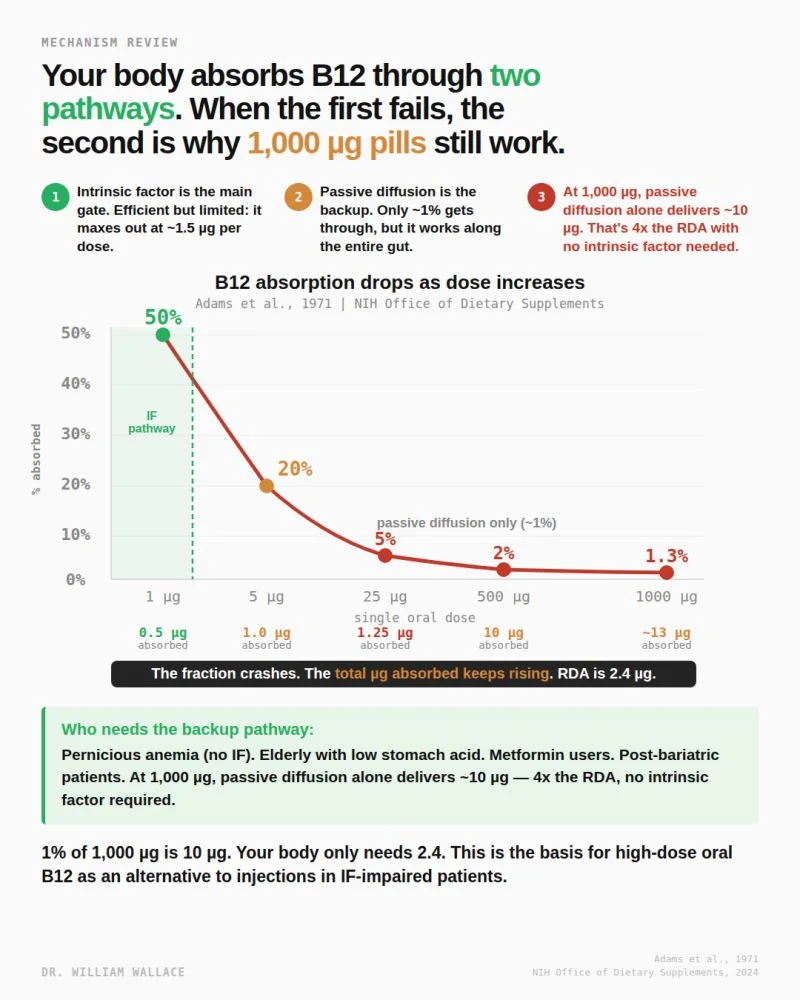
This pathway is efficient but has a hard ceiling: it saturates at roughly 1.5 µg per dose.
No matter how much B12 you swallow beyond that, If cannot carry any more.
The second pathway is passive dIffusion.
About 1 to 2% of any oral dose dIffuses across the intestinal lining without if, and this occurs along the entire length of the gut.
At dietary doses, this pathway is negligible.
At supplement doses, it becomes the primary route of absorption.
Adams et al. (1971, Scand J Gastroenterol) measured whole body retention of radiolabeled cyanocobalamin at dIfferent doses.
At 1 µg, roughly 50% was retained. At 5 µg, about 20%. At 25 µg, just over 5%.
The NIH Office of Dietary Supplements reports approximately 2% absorption at 500 µg and 1.3% at 1,000 µg.
The fraction drops dramatically.
But the total amount absorbed keeps rising.
At 1 µg you absorb about 0.5 µg.
At 1,000 µg you absorb roughly 13 µg total, of which approximately 10 µg comes from passive dIffusion alone.
The RDA is 2.4 µg.
Even the backup pathway, working at 1% efficiency, delivers more than four times your daily requirement from a single pill.
This is the basis for high-dose oral B12 as an alternative to injections in patients who lack intrinsic factor.
The NIH notes that high-dose oral supplementation ‘may be another treatment option’ for pernicious anemia, though injections remain standard first-line therapy and the available randomized controlled trials comparing the two approaches are considered limited in quality.
One important nuance: absorbing B12 into your bloodstream is only the first step.
After absorption, B12 must bind to a transport protein called transcobalamin to reach your cells.
This complex, holotranscobalamin, is the biologically active fraction.
It represents only about 20 to 30% of the total B12 circulating in your blood.
The remaining 70 to 80% rides on a separate protein called haptocorrin, which does not deliver B12 to most tissues.
This is why serum B12 can be misleading as a status marker.
A person can have a ‘normal’ total serum B12 level while their holotranscobalamin, the fraction that actually delivers B12 to cells, is low.
Methylmalonic acid is a more sensitive functional marker because it rises when cellular B12 is genuinely insufficient, regardless of what total serum B12 shows.
Absorption determines how much B12 enters your blood.
Transport determines how much reaches your cells.
Testing only total serum B12 measures neither of these processes accurately.”
More posts featuring William Wallace on Hemostasis Today.
-
Sep 30, 2026, 01:52Javed Anees: DADA2 – When a Young Stroke Is More Than a Stroke
-
Sep 30, 2026, 01:51How a Venous Thrombus Becomes Revascularized – ISTH
-
Sep 29, 2026, 22:45Victor Agunyego: Paracetamol – The Most Common Drug We Underestimate
-
Sep 29, 2026, 22:42Nova Sinclair: Advancing the Future of Hematology – Meet Our 2027 Organizing Committee
-
Sep 29, 2026, 22:41Lorenz Räber: Intracoronary Imaging in PCI – Why, When, How, and Which Modality?
-
Sep 29, 2026, 22:31Selma Turkovic: Pleased to Deliver the Opening Presentation at Kingston Hospital
-
Sep 29, 2026, 22:31Miguel Teran: Ultrasound and Simulation in Arterial Blood Sampling
-
Sep 29, 2026, 22:28Mohammad Refaei: Navigating Your Career in Hematology From Training to Practice
-
Sep 29, 2026, 22:27Matteo Foschi: 10 Clinical Pearls for Antithrombotic Therapy in Secondary Stroke Prevention