


Abdelrahman Omran: Blood Transfusion as a High-Risk Intervention in Acute Care
Abdelrahman Omran, Specialist Nurse in ICU, Emergency and OPD at Tanta Chest Hospital, Ministry of Health of Egypt, shared on LinkedIn:
”Blood Transfusion in Critical Care: Beyond the Basics
In high-acuity settings, a blood transfusion is more than replacing volume – it’s a complex, high-risk intervention that demands strict clinical vigilance.
When Do We Transfuse?
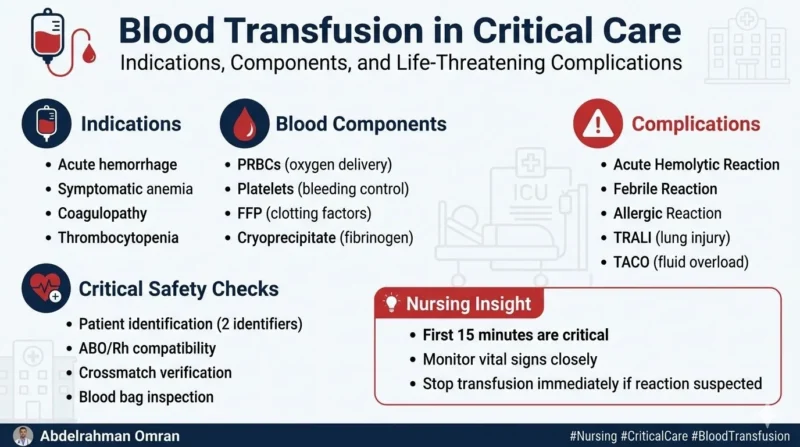
- Acute hemorrhage (trauma, surgery, postpartum)
- Symptomatic anemia (low Hb with clinical signs)
- Coagulopathy (liver disease, massive transfusion)
- Thrombocytopenia with active bleeding
Components Matter:
PRBCs – restore oxygen delivery
Platelets – reduce bleeding risk
FFP – replace clotting factors
Cryoprecipitate – fibrinogen support
Pre-Transfusion Priorities:
- Verify patient identity (2 identifiers)
- ABO/Rh compatibility + crossmatch
- Baseline vital signs
- Inspect unit (color, clots, leaks, expiry)
During Transfusion – What Can Go Wrong?
1. Acute Hemolytic Reaction
- Cause: ABO incompatibility
- Signs: fever, chills, back pain, hemoglobinuria
- Action: STOP immediately plus maintain IV with NS
2. Febrile Non-Hemolytic Reaction
Fever, chills (common but less severe)
3. Allergic Reaction
Rash, itching – may progress to anaphylaxis
4. TRALI (Transfusion-Related Acute Lung Injury)
- Acute hypoxia, non-cardiogenic pulmonary edema
- Usually within 6 hours
5. TACO (Circulatory Overload)
- Dyspnea, hypertension, pulmonary edema
- Especially in elderly or cardiac patients
Critical Nursing Insight:
Differentiating TRALI vs TACO is key:
• TRALI – normal CVP, no signs of fluid overload
• TACO – fluid overload, elevated BP, responds to diuretics
Monitoring Essentials:
- Stay with the patient during the first 15 minutes
- Recheck vitals (baseline → 15 min → ongoing)
- Never ignore subtle changes
Bottom Line:
Safe transfusion isn’t just about giving blood – it’s about anticipating complications before they become fatal.
Because in critical care… early recognition saves lives.”
Stay updated with Hemostasis Today.
-
Oct 27, 2026, 16:28Rose Agor: Celebrating Two New Publications in Haematology Research
-
Oct 27, 2026, 16:21Pregnancy and Thrombosis-What Clinicians Need to Know – World Thrombosis Day
-
Oct 27, 2026, 16:13Lesley Van Wyk: DIC vs TTP vs HUS – The Key Diagnostic Clues
-
Oct 27, 2026, 16:02Ahmad G. Alzahrani: AF and Vascular Risk Factors – Should We Add Antiplatelet Therapy?
-
Oct 27, 2026, 16:02Iron Deficiency and Thrombocytosis: How Iron Availability Shapes Hematopoietic Lineage Decisions
-
Oct 27, 2026, 15:46Christiane Berger-Schaffitzel: New PhD Project Explores Snake Venom and Haemostasis
-
Oct 27, 2026, 13:51Muhammed Hajmusa: ESMO 2026 Highlights the Challenge of Anticoagulation in ROS1-Positive Lung Cancer
-
Oct 27, 2026, 13:39Luca Galassi: Retrieved Venous Thrombi as a Tool for Predicting Post-Thrombotic Syndrome
-
Oct 27, 2026, 11:43Tareq Abadl: Hidden Interferences Behind Unexpected Laboratory Results