


Ifeanyichukwu Ifechidere: Developing Diagnostic Reasoning in Coagulation Testing
Ifeanyichukwu Ifechidere, Specialist Biomedical Scientist at Sheffield Teaching Hospitals NHS Foundation Trust, shared a post on LinkedIn:
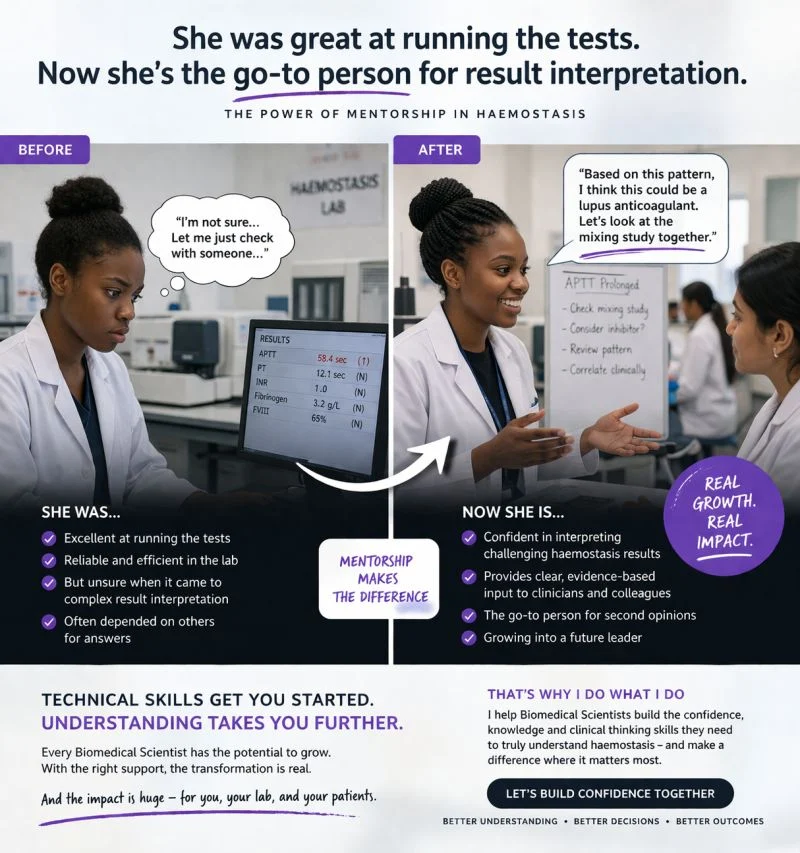
“She could run every test in the coag lab perfectly.
But the moment a result looked ‘off’ — she’d go quiet.
I remember the first time I worked with Priya.
Sharp. Organised.
Never made pre-analytical errors.
Her QC was immaculate.
But when a prolonged APTT landed on her screen?
She’d spin her chair around and say ‘Can you just check this one for me?’
Every. Single. Time.
And the thing is — nobody blamed her.
Because nobody had ever actually taught her how to think through it.
She’d been trained to run the lab.
Not to understand it.
There’s a difference.
A big one.
When we started working together, I didn’t give her a textbook.
I gave her a framework.
A way to look at a coag result and ask the right questions in the right order.
Is this pre-analytical?
Is this a single factor or multiple pathway issue?
Does the mixing study correct — and what does that actually mean?
What’s the clinical picture telling me that the result isn’t?
Week by week, something shifted.
She stopped spinning her chair around.
She started saying ‘I think this is a lupus anticoagulant — here’s my reasoning.’
She started defending her interpretation to clinicians on the phone.
Last month, her manager messaged me.
‘I don’t know what you did — but Priya is the person everyone goes to now when there’s a difficult result. She’s transformed.’
Priya didn’t become a different scientist.
She just finally got what she should have had from day one.
A structured way to think.
Here’s what I know after years in this field:
The coag lab is full of brilliant biomedical scientists who are one framework away from becoming the most confident person in the room.
They don’t need more experience.
They need the right thinking tools.
That’s exactly what I built Coag Simplified for.
A platform designed specifically for biomedical scientists who are done guessing — and ready to get it.
No overwhelming textbooks.
No generic CPD tick-boxes.
Just clear, structured coagulation fundamental ebook that actually sticks.
If you’re ready to become the Priya after — not the Priya before:
Subscribe now and get your copy to build your confidence in result interpretation.
And if this story reminded you of someone you work with — tag them.
They need to see this.”
Other posts featuring Ifeanyichukwu Ifechidere on Hemostasis Today.
-
Sep 18, 2026, 17:48Ronak H. Mistry: Updated ASH Guidelines Bring New Focus to Iron Deficiency
-
Sep 18, 2026, 17:32Hassan Kawtharany: New Ferritin Cutoffs for the Diagnosis of Iron Deficiency With or Without Anemia
-
Sep 18, 2026, 17:20Abhishek G P: GAVE as an Important Cause of Chronic Gastrointestinal Blood Loss
-
Sep 18, 2026, 17:08Irem Karaman Sebin: ASH 2026 Changes a Key Concept in Iron Deficiency
-
Sep 18, 2026, 16:51Adarsh Krishnan Sundara Rajan: Is VTE the Most Underdiagnosed Critical Threat in Modern Healthcare?
-
Sep 18, 2026, 16:19CRISPR and Hemophilia: The Next Frontier of In Vivo Gene Editing
-
Sep 18, 2026, 16:13Christian Irsara: PF4 Immunothrombosis Following Natural Adenovirus Infection
-
Sep 18, 2026, 16:10Leo Nicolai։ The Spleen Emerges as a Key Regulator of Thromboinflammation
-
Sep 18, 2026, 16:05Targeting Factor XI to Reduce Thrombosis Without Compromising Hemostasis – ISTH