


Abid Ur Rahman: Platelet Disorders and Laboratory Findings
Abid Ur Rahman, Laboratory Intern at Islamabad Diagnostic Centre, shared a post on LinkedIn:
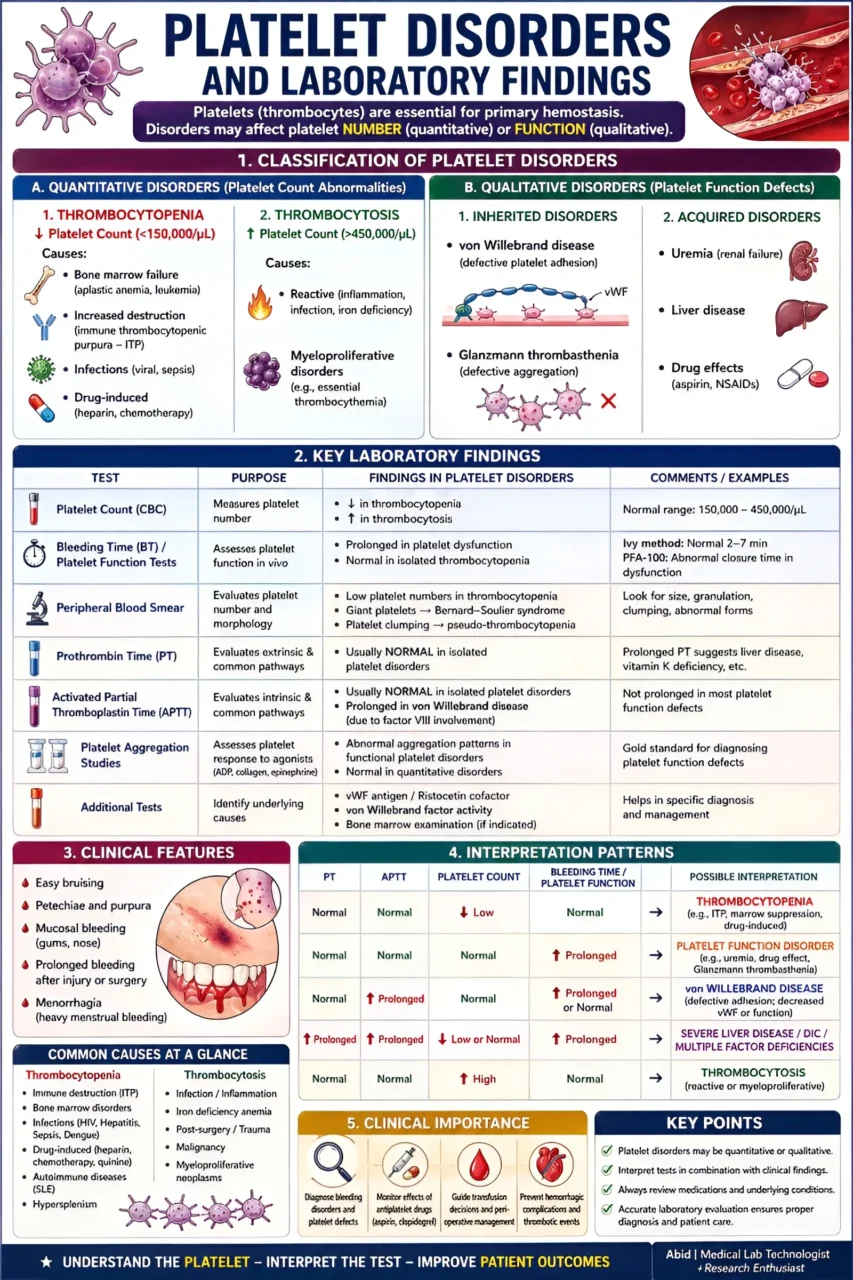
“Platelet Disorders and Laboratory Findings
Platelets (thrombocytes) are critical for primary hemostasis, forming the initial platelet plug at sites of vascular injury.
Disorders of platelets can involve quantitative abnormalities (number) or qualitative defects (function), leading to bleeding or, less commonly, thrombotic complications.
Classification of Platelet Disorders
Quantitative Disorders (Platelet Count Abnormalities)
Thrombocytopenia (Decreased Platelet Count <150,000/µL)
Causes:
- Bone marrow failure (aplastic anemia, leukemia)
- Increased destruction (immune thrombocytopenic purpura – ITP)
- Infections (viral, sepsis)
- Drug-induced (heparin, chemotherapy)
Thrombocytosis (Increased Platelet Count >450,000/µL)
Causes:
- Reactive (inflammation, infection, iron deficiency)
- Myeloproliferative disorders (e.g., essential thrombocythemia)
Qualitative Disorders (Platelet Function Defects)
Inherited Disorders
- von Willebrand disease (defective platelet adhesion)
- Glanzmann thrombasthenia (defective aggregation)
Acquired Disorders
- Uremia (renal failure)
- Liver disease
- Drug effects (aspirin, NSAIDs)
Key Laboratory Findings
Platelet Count (CBC)
- in thrombocytopenia
- in thrombocytosis
Bleeding Time (BT) / Platelet Function Tests
- Prolonged in platelet dysfunction
Peripheral Blood Smear
- Assess platelet number and morphology
- Giant platelets: Bernard-Soulier syndrome
- Platelet clumping: pseudo-thrombocytopenia
Prothrombin Time (PT)
- Usually normal in platelet disorders
Activated Partial Thromboplastin Time (APTT)
- Normal in isolated platelet disorders
- Prolonged in von Willebrand disease (due to factor VIII involvement)
Platelet Aggregation Studies
- Evaluate response to agonists (ADP, collagen)
- Abnormal in functional platelet disorders
Clinical Features
- Easy bruising
- Petechiae and purpura
- Mucosal bleeding (gums, nose)
- Prolonged bleeding after injury
Interpretation Patterns
- Low Platelets and Normal PT/APTT: Thrombocytopenia (e.g., ITP, marrow suppression)
- Normal Platelets and Prolonged Bleeding Time: Platelet function disorder
- Normal Platelets and Prolonged APTT: Consider von Willebrand disease
Clinical Importance
Platelet disorder evaluation helps:
- Diagnose bleeding disorders
- Differentiate quantitative vs qualitative defects
- Monitor drug effects (antiplatelet therapy)
- Guide treatment decisions and transfusion needs
Platelet testing bridges primary hemostasis and clinical bleeding assessment, making it essential for accurate diagnosis and patient care.”
Stay updated on all scientific advances with Hemostasis Today.
-
Sep 25, 2026, 09:49Haley Coleman: Volunteering to Support Hemophilia Awareness
-
Sep 25, 2026, 08:55Hitarth Mehta: BHMS Students Gain Practical Exposure to Haemophilia Diagnosis
-
Sep 25, 2026, 07:25Varun Capoor: How Therapeutic Apheresis and Transfusion Medicine Can Complement Clinical Management in SCD
-
Sep 25, 2026, 07:14Manshi Kesharwani: SAK-GQDs Modulate Thrombus Burden and Endothelial Function in Deep Vein Thrombosis
-
Sep 25, 2026, 06:20Farjah Hassan Algahtani: How Can We Better Identify Patients at Risk of Blood Clots after Metabolic and Bariatric Surgery?
-
Sep 25, 2026, 05:59Carla Lewis: Kids Conquering Sickle Disease Joins Nemours Children’s Hospital for 2nd Annual Awareness Event
-
Sep 25, 2026, 05:47Omid Seidizadeh: Evolutionary Constraint and Population Variation Across Coagulation Genes
-
Sep 25, 2026, 05:40Gerald Bertrand: Presenting UMi-NGS Non-Invasive Foetal HPA Genotyping at DGTI 2026
-
Sep 25, 2026, 05:33Urge Congress to support the Sickle Cell Disease Comprehensive Care Act – ASH