


Soumen Bhattacharyya: Hyperhomocysteinemia and Thrombosis – What Clinicians Should Know
Soumen Bhattacharyya, College Teacher in the Department of Physiology at RBC College for Women, shared a post on LinkedIn:
“Hyperhomocysteinemia and Thrombosis – What Clinicians Should Know
Hyperhomocysteinemia continues to sit in that interesting grey zone between biochemical abnormality and clinical significance.
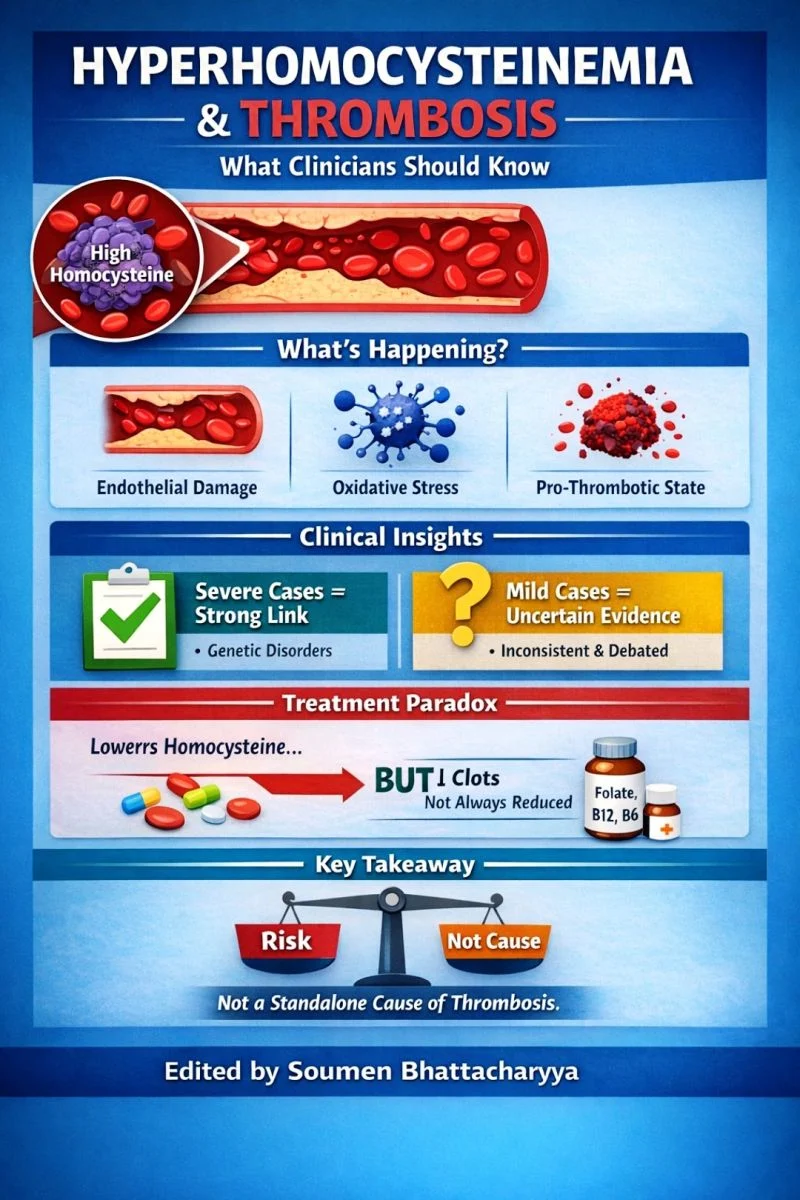
What’s happening?
Elevated homocysteine levels can:
- Damage vascular endothelium
- Increase oxidative stress
- Promote a pro-thrombotic state
Clinical relevance:
Strongly associated with thrombosis in severe elevations (e.g., genetic disorders)
In mild-to-moderate cases, the evidence is inconsistent and debated
Treatment paradox:
While folate, Vitamin B12, and B6 effectively reduce homocysteine levels…
This doesn’t consistently translate into reduced thrombotic events.
Takeaway for practice:
Hyperhomocysteinemia is best viewed as a modifiable risk marker rather than a standalone cause of thrombosis.
It reminds us of a broader principle in medicine:
Not everything we can measure needs to be aggressively treated in isolation.
Curious to hear from fellow clinicians – Do you routinely screen for homocysteine in thrombotic workups?”
Stay updated with Hemostasis Today.
-
Sep 25, 2026, 09:49Haley Coleman: Volunteering to Support Hemophilia Awareness
-
Sep 25, 2026, 08:55Hitarth Mehta: BHMS Students Gain Practical Exposure to Haemophilia Diagnosis
-
Sep 25, 2026, 07:25Varun Capoor: How Therapeutic Apheresis and Transfusion Medicine Can Complement Clinical Management in SCD
-
Sep 25, 2026, 07:14Manshi Kesharwani: SAK-GQDs Modulate Thrombus Burden and Endothelial Function in Deep Vein Thrombosis
-
Sep 25, 2026, 06:20Farjah Hassan Algahtani: How Can We Better Identify Patients at Risk of Blood Clots after Metabolic and Bariatric Surgery?
-
Sep 25, 2026, 05:59Carla Lewis: Kids Conquering Sickle Disease Joins Nemours Children’s Hospital for 2nd Annual Awareness Event
-
Sep 25, 2026, 05:47Omid Seidizadeh: Evolutionary Constraint and Population Variation Across Coagulation Genes
-
Sep 25, 2026, 05:40Gerald Bertrand: Presenting UMi-NGS Non-Invasive Foetal HPA Genotyping at DGTI 2026
-
Sep 25, 2026, 05:33Urge Congress to support the Sickle Cell Disease Comprehensive Care Act – ASH