

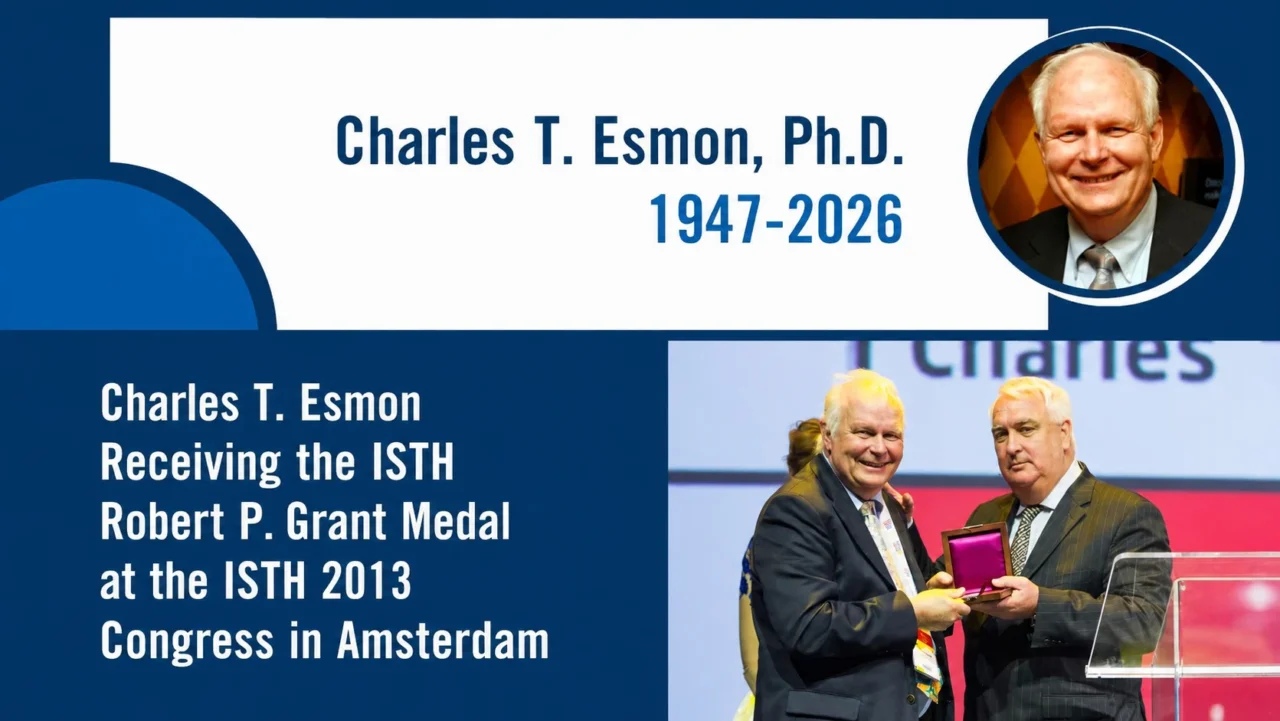
Honoring the Legacy of Charles T. Esmon in Hemostasis and Thrombosis – ISTH
International Society on Thrombosis and Haemostasis (ISTH) shared a post on LinkedIn:
“The ISTH staff, leadership and members extend their sincere condolences to the family of Charles ‘Chuck’ T. Esmon, Ph.D., a longtime ISTH member and influential leader within the field of thrombosis and hemostasis, who passed away on May 1, 2026.
Chuck and his wife Naomi joined the Oklahoma Medical Research Foundation in 1982, where they made many pioneering discoveries related to thrombosis and hemostasis.
Chuck is credited with identifying two proteins on the endothelial blood vessel lining: thrombomodulin and the endothelial cell protein C receptor.
His extensive research work often focused on the connection between blood clotting and inflammation.
To recognize his contributions, the ISTH honored Chuck with the ISTH Robert P. Grant Medal, the highest honor of the Society in 2013.
He had previously received the ISTH Distinguished Career Award in 1999 and the ISTH Investigator Recognition Award in 1983.”
Other posts about International Society on Thrombosis and Haemostasis on Hemostasis Today.
-
Nov 9, 2026, 09:29Veronica Sanchez: A Framework for Woman’s Health
-
Nov 8, 2026, 19:31Anna Kajaste-Rudnitski: Presenting AAV-Induced p53 Signalling in Human CNS Cells at ESGCT 26
-
Nov 8, 2026, 19:29David McIntosh: Cybersecurity Matters, but Blood Availability Remains the Bigger Challenge
-
Nov 8, 2026, 19:26Wenxue Ma: An Integrative Framework for Macrophage-Mediated Therapeutic Resistance in Cancer
-
Nov 8, 2026, 19:25Yildiz Yigit: Presenting a Polycythemia Vera Case at the MPN Subcommittee Session
-
Nov 8, 2026, 18:56Denis Oduor: Strengthening the Regulation and Delivery of Blood Transfusion and Transplantation Services
-
Nov 8, 2026, 18:28Raghavendra Rao: A Narrative Review on Chronic Venous Disease during Pregnancy
-
Nov 8, 2026, 17:57Dhiren Patel: PLD1-Derived Phospholipids Regulate NAD Kinase and ROS Production in Neutrophils
-
Nov 8, 2026, 17:48Andra T.: What Causes Antiphospholipid Syndrome? – Four Steps, not One Cause