


Krishna Kumar Dhakchinamoorthi: How AI-Powered Technologies Analyze Patient History to Detect and Predict DVT
Krishna Kumar Dhakchinamoorthi, Professor and Head at SNS Institutions, shared a post on LinkedIn:
“Artificial Intelligence (AI) is transforming the prevention, diagnosis, and management of Deep Vein Thrombosis (DVT) by enabling faster detection and smarter clinical decision-making.
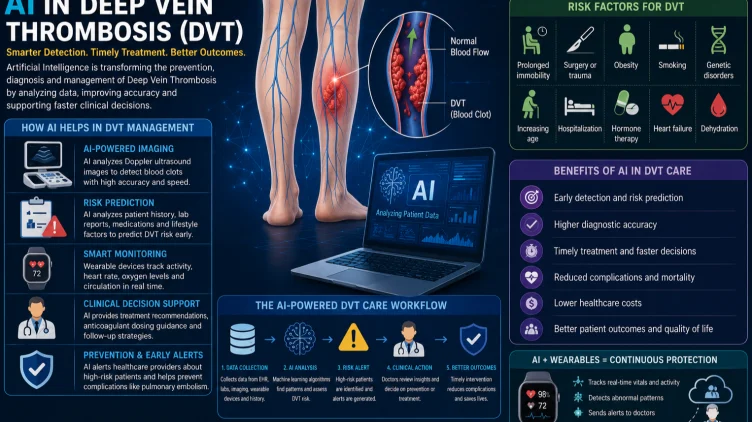
This infographic illustrates how AI-powered technologies analyze patient history, Doppler ultrasound images, laboratory reports, and vital signs to identify blood clots and predict DVT risk at an early stage.
It highlights the role of machine learning, wearable health monitoring, and clinical decision support systems in improving patient safety and treatment outcomes.
The infographic also emphasizes key benefits such as early diagnosis, accurate risk prediction, timely intervention, continuous monitoring, and personalized patient care.
Through advanced digital healthcare solutions, AI is helping healthcare professionals reduce complications, prevent pulmonary embolism, and improve overall vascular health management.”
Stay updated with Hemostasis Today.
-
Oct 17, 2026, 04:07Weihao Li: Global HEPATIC Registry Findings on Post-Transplant Arterial Thrombosis
-
Oct 17, 2026, 03:56Ghaith Abu-Zeinah: ASH Publishes 2026 Guidelines for Myelofibrosis Management in Blood Advances
-
Oct 17, 2026, 03:48Tristan Siokos: Why Vascular Occlusion Is More Than Just Clots – Breakdown of the 8 Pathways
-
Oct 17, 2026, 02:36Archil Jaliashvili: Oxygen Transport in Capillaries
-
Oct 17, 2026, 02:35Carly Newton: Understanding Access to Red Blood Cell Exchange for People Living With SCD
-
Oct 17, 2026, 02:34Raising Awareness of Blood Clots During and After Pregnancy – Thrombosis UK
-
Oct 17, 2026, 02:33Alaa Salamat: Our Research Accepted for Publication at ASH 2026
-
Oct 17, 2026, 02:32Mohammed Al Sharif: Discussing Factor XIII Testing and Its Clinical Significance
-
Oct 17, 2026, 02:31Joanna Popiolek-Kalisz: Talking about Novel Pharmacotherapy for Hypertension at CV Prevention and Intervention