


Jonathan Douxfils: Why Measuring NETosis Remains a Major Challenge in Translational Research
Jonathan Douxfils, Director of the Clinical Pharmacology and Toxicology Research Unit at University of Namur, Board Member of Belgian Society on Thrombosis and Haemostasis, shared a post on LinkedIn about a recent article he and his colleagues co-authored, published in Thrombosis Research, adding:
“I am pleased to share our recent publication in Thrombosis Research .
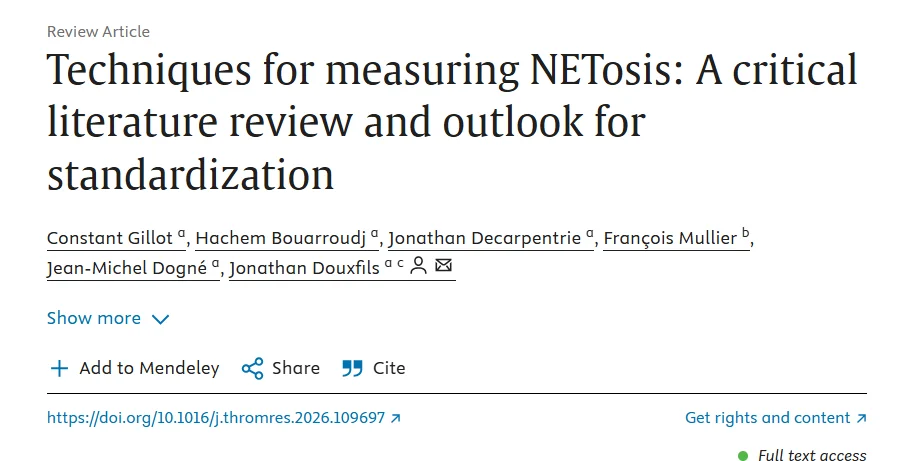
‘Techniques for measuring NETosis: A critical literature review and outlook for standardization’ by Constant Gillot, Hachem Zakaria Bouarroudj, Jonathan Decarpentrie, Francois Mullier, Jean-Michel Dogné and myself.
Neutrophil extracellular traps – or NETs – have become a major focus in immunothrombosis, inflammation, infection, autoimmunity, cancer and cardiovascular research.
However, despite the growing interest in NETosis as a potential biomarker and therapeutic target, one major issue remains insufficiently addressed: how do we reliably measure NETosis?
In this critical review, we systematically mapped the techniques used to detect and quantify NETs across 162 studies.
The findings are striking: the field remains highly fragmented, with substantial heterogeneity in the choice of biomarkers and analytical methods.
CfDNA was the most frequently used marker, followed by MPO, citrullinated histones and neutrophil elastase, while fluorometry, microscopy and ELISA were the most common analytical approaches.
Importantly, approximately 85–90% of protocols relied on non-validated, home-made assays, and no harmonized analytical framework currently exists.
Why does this matter?
Because NETosis is increasingly proposed as a clinically relevant biological process, but clinical translation cannot rely on poorly standardized methods.
A high level of cfDNA, MPO-DNA complexes or citrullinated histone H3 does not always mean the same thing across laboratories, matrices, diseases or experimental settings.
Without validated assays, commutable calibrators, robust pre-analytical control and transparent reporting, comparability remains limited and clinical implementation remains premature.
Our review therefore argues for a shift from descriptive enthusiasm to methodological and regulatory convergence.
Future NETosis research should move toward standardized, multimodal approaches combining structural markers such as cfDNA and H3Cit, enzymatic markers such as MPO and neutrophil elastase, and regulatory markers such as PAD4 or ROS, depending on the biological question and the intended use.
This work is important because NETs are not only fascinating biological structures; they may become clinically useful biomarkers or therapeutic targets.
But this will only be possible if the field develops the same level of analytical rigor that is expected for any biomarker intended to support clinical decision-making .
Many thanks to all co-authors for their contributions.
The article is freely available for 50 days.”
Title: Techniques for measuring NETosis: A critical literature review and outlook for standardization
Authors: Constant Gillot, Hachem Bouarroudj, Jonathan Decarpentrie, François Mullier, Jean-Michel Dogné, and Jonathan Douxfils
Other posts featuring Jonathan Douxfils on Hemostasis Today.
-
Oct 9, 2026, 15:27Mohamed Hegazi: Geostatistical Modelling Maps Global β-Thalassaemia Carrier Prevalence
-
Oct 9, 2026, 15:15Maha Othman: Uncovering the Consensus on TXA in TBI – Call for Collaboration on a Landmark Umbrella Review
-
Oct 9, 2026, 15:07Daniel D. Han: How Inhalation Product Exposure Impairs Cardiac and Platelet Recovery After MI
-
Oct 9, 2026, 14:58William Toole: How Ultrasound-Guided PRP Therapy Relieves Joint and Tendon Pain
-
Oct 9, 2026, 14:50Shayan Mohammadmoradi: In Corpus Christi for the 20th Midwest Platelet Conference
-
Oct 9, 2026, 14:37Tariq Tramboo: High Platelet Concentrate for Osteoarthritis Knee – Recent Meta-Analyses
-
Oct 9, 2026, 14:26Yousma Khan: Hematology Series – Beyond RBCs, WBCs and Platelets
-
Oct 9, 2026, 14:13Jesus Ardila Novoa: Why the WHO’s Historic Essential Medicines List Decision Is Just the Beginning
-
Oct 9, 2026, 14:07Chokri Ben Lamine: Pain After Allogeneic Stem Cell Transplantation in Sickle Cell Disease