


Bastu Odoka։ The World of Transfusion Medicine Keeps Evolving
Bastu Odoka, Transfusion Scientist at Effia-Nkwanta Regional Hospital, shared a post on LinkedIn:
”The world of transfusion medicine keeps evolving.
And sometimes, we have to be willing to learn, unlearn, and relearn.
For years, platelets have traditionally been stored at room temperature between 20 and 24 degrees Celsius under continuous agitation.
The belief was simple.
Cold temperatures shortened platelet survival, so refrigeration was avoided.
But newer understanding has changed how we look at this.
What really happens?
Cold temperatures activate platelets.
Because of this, refrigerated platelets are cleared from circulation more quickly after transfusion, usually within 24 to 48 hours, especially by the liver.
This shorter survival initially gave the impression that cold-stored platelets were simply being destroyed by cold temperatures.
But that may not tell the full story.
Even though cold-stored platelets do not stay long in circulation, they may still work very well where it matters most before being cleared by the system:
active bleeding.
In fact, refrigerated platelets may provide stronger early clot-forming activity because they are already in a more activated state.
So where does each type fit?
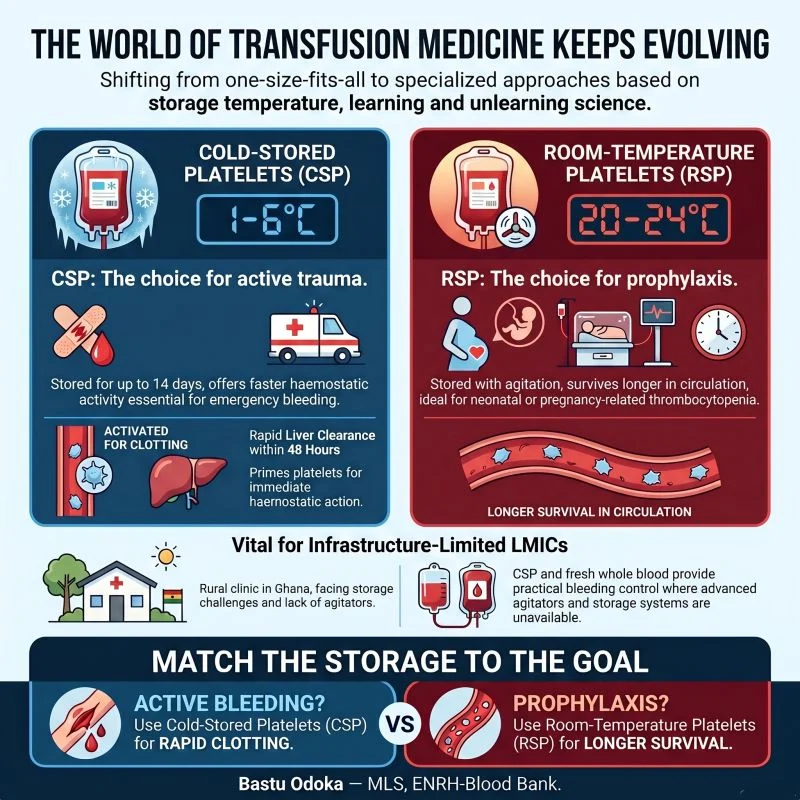
Cold-stored platelets stored at 1 to 6 degrees Celsius:
- Potentially useful in active bleeding and trauma.
- May provide faster early haemostatic activity.
- May allow longer storage for up to 14 days.
Room-temperature stored platelets stored at 20 to 24 degrees Celsius:
- Better when longer platelet survival is needed.
- Preferred for prophylactic support.
Examples include:
- Neonatal thrombocytopenia.
- Pregnancy-related thrombocytopenia.
- Malaria-related thrombocytopenia.
Why this is important for low- and middle-income countries.
This renewed interest in cold-stored platelets could be important for countries like Ghana.
Many centres still lack:
- Platelet preparation systems.
- Agitators.
- Advanced storage infrastructure.
Fresh whole blood is not the same as platelet concentrate, but it may provide haemostatic support because it still contains functional platelets and other clotting components early after collection.
That may partly explain why some clinicians feel bleeding control is better with fresh whole blood in certain emergency situations.
Key takeaway.
For active bleeding:
Rapid haemostasis may matter more, making cold-stored platelets potentially useful.
For prophylaxis:
Longer platelet survival matters more, making room-temperature stored platelets more suitable.”
Other posts featuring Bastu Odoka on Hemostasis Today.
-
Oct 10, 2026, 17:58Archo Farzana Batool: Exploring Medical Writing Through an Article on Iron Deficiency Anemia
-
Oct 10, 2026, 17:53Assessing Frailty in Adults With Hemophilia – JTH
-
Oct 10, 2026, 17:52Fatma Sadeghi: Reducing Maternal Health Inequalities Through Nursing Advocacy
-
Oct 10, 2026, 17:50Grzegorz Hensler: How Apheresis Transformed Blood Cell Separation and Collection
-
Oct 10, 2026, 17:47Hemant K Sharma: Japan’s Universal Artificial Blood Research – A Potential Breakthrough in Transfusion Medicine
-
Oct 10, 2026, 17:40John Strouse: Learning About Bleeding Disorders and Sickle Cell Disease at FWGBD
-
Oct 10, 2026, 17:34Mae Caime: Speaking at the Annual Women’s Retreat for the Hemophilia Community in Florida
-
Oct 10, 2026, 17:30Chokri Ben Lamine: PNH beyond the Textbook Triad
-
Oct 10, 2026, 17:29Ruah Alyamany: Thrombosis and Anticoagulation in Hematological Malignancies at SOHO KSA 2026