

Fatma Sadeghi: Reducing Maternal Health Inequalities Through Nursing Advocacy
Fatma Sadeghi, Udst at Registered Nursing, Nursing Administration, Nursing Research and Clinical Nursing, shared WACI Health‘s post on LinkedIn:
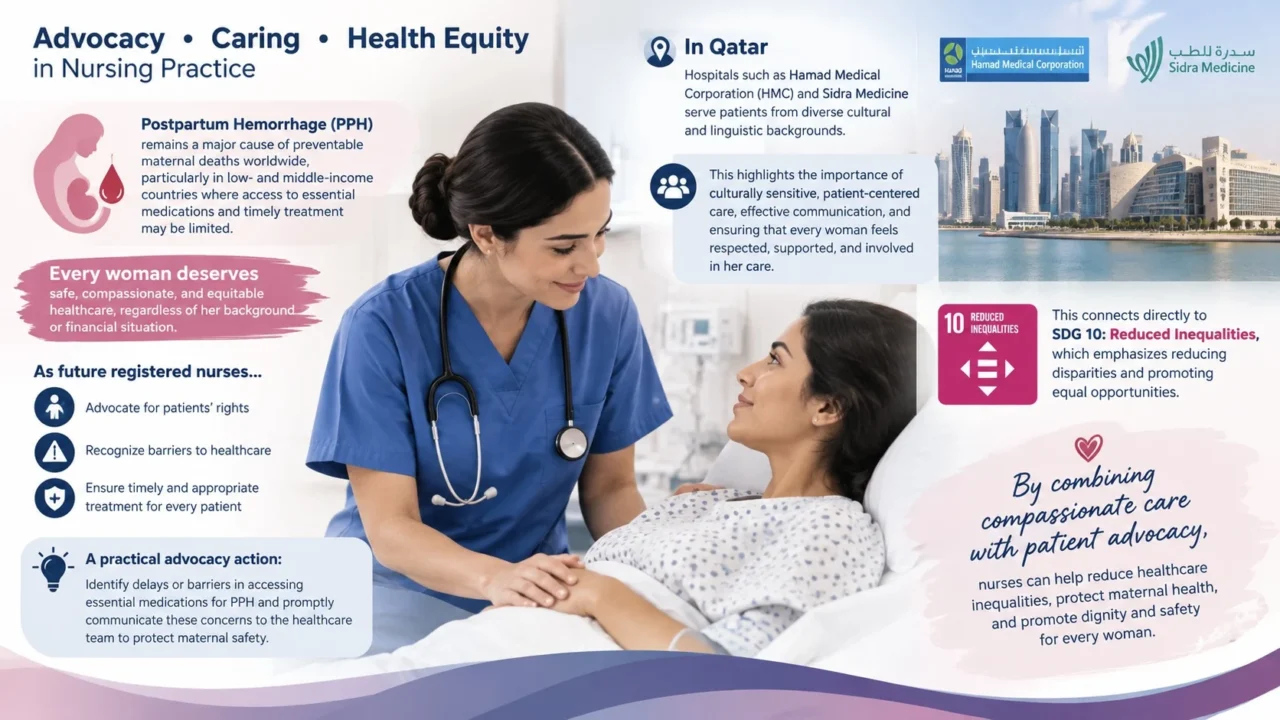
“This post highlights the importance of advocacy, caring, and health equity in nursing practice. Postpartum hemorrhage (PPH) remains a major cause of preventable maternal deaths worldwide, particularly in low- and middle-income countries where access to essential medications and timely treatment may be limited.
It reminds us that every woman deserves safe, compassionate, and equitable healthcare, regardless of her background or financial situation.
As future registered nurses, our responsibility goes beyond providing clinical care. We must advocate for patients’ rights, recognize barriers to healthcare, and ensure that every patient receives timely and appropriate treatment.
One practical advocacy action is identifying delays or barriers in accessing essential medications for PPH and promptly communicating these concerns to the healthcare team to protect maternal safety.
In Qatar, hospitals such as Hamad Medical Corporation (HMC) and Sidra Medicine serve patients from diverse cultural and linguistic backgrounds. This highlights the importance of culturally sensitive, patient-centered care, effective communication, and ensuring that every woman feels respected, supported, and involved in her care.
This connects directly to SDG 10: Reduced Inequalities, which emphasizes reducing disparities and promoting equal opportunities.
By combining compassionate care with patient advocacy, nurses can help reduce healthcare inequalities, protect maternal health, and promote dignity and safety for every woman.”
WACI Health shared a post on LinkedIn:
“Today, on World PPH Day, we are reminded that no woman should bleed to death giving life.
The medicines to prevent and treat postpartum haemorrhage (PPH), the leading cause of preventable maternal death in low- and middle-income countries, already exist. What decides whether a woman survives is whether those medicines are in the guidelines, funded, and accessible at the facility where she delivers.
Global experts and government leaders point to four things that turn recommendations into lives saved: sound policy, sustainable domestic financing, trained health workers, and evidence generated locally. Here is what that looks like in the work we do with partners across Africa.
Policy: Since 2019, alongside Concept Foundation (non-profit) and with the support of MSD for Mothers, we have engaged 14 African governments to adapt WHO recommendations on Heat-Stable Carbetocin (HSC) and Tranexamic Acid (TXA).
Ten countries (Uganda, South Sudan, Rwanda, Liberia, Ghana, Burkina Faso, Senegal, Sierra Leone, Côte d’Ivoire and Ethiopia) have updated their national guidelines and/or Essential Medicines Lists. We also worked with the East African Community and ECOWAS to carry those recommendations to the regional level.
Financing: Six countries have gone further, integrating these medicines into UHC benefit and procurement frameworks, because a medicine on a list only saves lives if it is paid for and procured.
Evidence: Women and communities should help shape the research that decides which innovations reach them. That is why WACI Health, alongside Concept Foundation, hosts the Community Advisory Board of the REACH Trial, which seeks to evaluate the safety and effectiveness of heat-stable carbetocin compared to oxytocin for the treatment of PPH.
Through the Community Advisory Board, civil society and community perspectives inform the PPH treatment research agenda, and the trial’s design, implementation and eventual scale-up.
When women’s experiences are built into the evidence from the start, the innovations that emerge are far more likely to reach the women who need them.
Access to quality-assured PPH medicines should not be left to those who can afford it; it should be universally available to every woman at childbirth. Ending preventable deaths from postpartum haemorrhage by 2030 is possible, and it depends on governments, funders, and partners treating it as a priority.”
Stay updated with Hemostasis Today.
-
Oct 10, 2026, 17:53Assessing Frailty in Adults With Hemophilia – JTH
-
Oct 10, 2026, 17:50Grzegorz Hensler: How Apheresis Transformed Blood Cell Separation and Collection
-
Oct 10, 2026, 17:47Hemant K Sharma: Japan’s Universal Artificial Blood Research – A Potential Breakthrough in Transfusion Medicine
-
Oct 10, 2026, 17:40John Strouse: Learning About Bleeding Disorders and Sickle Cell Disease at FWGBD
-
Oct 10, 2026, 17:34Mae Caime: Speaking at the Annual Women’s Retreat for the Hemophilia Community in Florida
-
Oct 10, 2026, 17:30Chokri Ben Lamine: PNH beyond the Textbook Triad
-
Oct 10, 2026, 17:29Ruah Alyamany: Thrombosis and Anticoagulation in Hematological Malignancies at SOHO KSA 2026
-
Oct 10, 2026, 17:28Juan José López Núñez: Bringing Patients and Families Together for World Thrombosis Day
-
Oct 10, 2026, 16:11David C. Madoff: HCC With Portal Vein Tumor Thrombosis East vs West