


Maitri Vaishnav: Anatomical Variability and Surgical Relevance of Corona Mortis
Maitri Vaishnav, Student at C.U. Shah College of Pharmacy, shared a post on LinkedIn:
“Corona Mortis
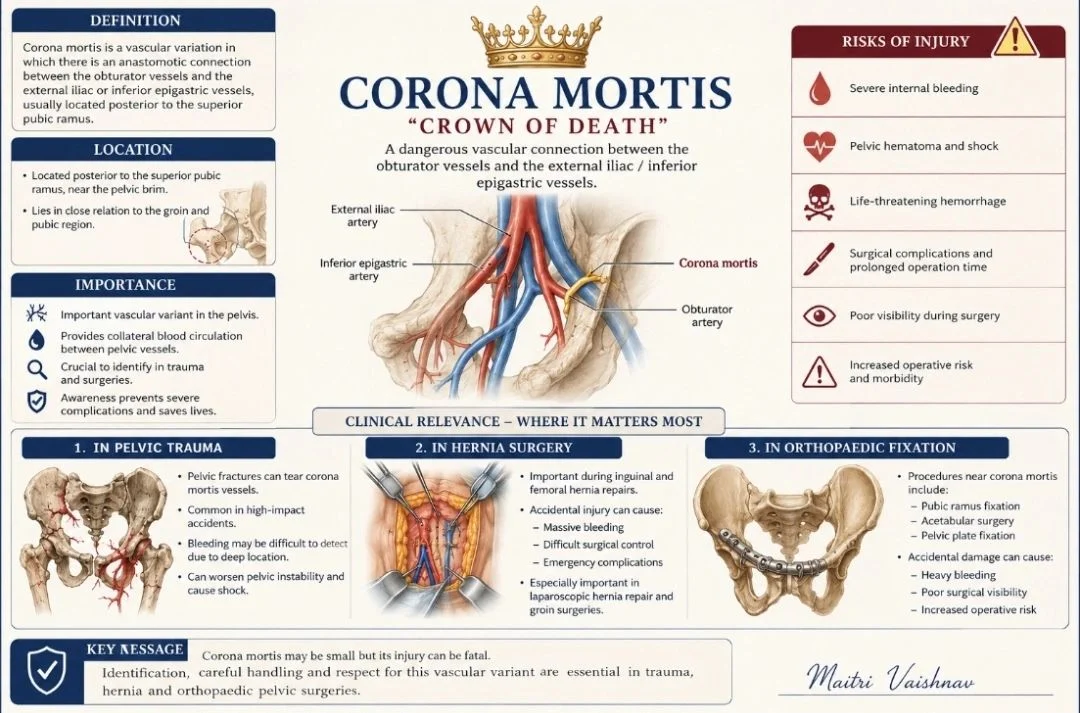
Corona mortis is a vascular connection (an abnormal or variable blood vessel link) between the obturator vessels and the external iliac or inferior epigastric vessels located behind the pubic bone in the pelvis.
The name means ‘Crown of Death’ because injury to this vessel can cause severe bleeding during trauma or surgery.
Location:
- Behind the superior pubic ramus
- Near the pelvic brim
- Around the groin and pubic region
Function
- Corona mortis acts as a vascular communication pathway between pelvic blood vessels.
- Helps provide collateral blood circulatio
- Connects blood supply between:
- Obturator artery/vein
- Inferior epigastric or external iliac vessels
Normally it may not cause problems, but it becomes important during surgery or trauma.
Corona mortis is considered highly sensitive and clinically important because it can bleed heavily if damaged.
Even a small injury can lead to:
- Rapid blood loss
- Hidden pelvic hemorrhage
Surgical complications
The vessel may:
- Be arterial or venous
- Vary in size and position in different people
Effects on the Body if Injured
- Severe internal bleeding
- Pelvic hematoma
- Low blood pressure
- Shock
- Increased surgical risk
- Possible life-threatening
Attachment With Pelvic Trauma
Pelvic fractures can tear the corona mortis vessels, especially during high-impact accidents such as road traffic injuries or falls from height.
Because these vessels are located deep inside the pelvis, bleeding may be difficult to detect early and can lead to severe internal hemorrhage.
Injury to the vessel may worsen pelvic instability, decrease blood pressure, and increase the risk of shock and life-threatening complications.
Attachment With Hernia Surgery
Corona mortis is clinically important during inguinal and femoral hernia repair surgeries.
Surgeons must carefully identify and protect these vessels because accidental injury can cause massive bleeding and difficult surgical control.
This vascular variation is especially significant during laparoscopic hernia repair and other groin surgeries where instruments are placed close to the pubic region.
Attachment With Orthopaedic Fixation
During orthopaedic procedures such as pubic ramus fixation, acetabular surgery, and pelvic plate fixation, surgical instruments and screws may pass near the corona mortis vessels.
Accidental damage can result in heavy bleeding, poor surgical visibility, prolonged operation time, and increased operative risk.
Therefore, proper anatomical knowledge and careful surgical planning are essential during pelvic fixation procedures.”
Stay updated with Hemostasis Today.
-
Oct 13, 2026, 02:01Nour Al-Mozain: Is It Really Anti-D? – Unraveling Auto-Anti-LW in the Transfusion Laboratory
-
Oct 13, 2026, 01:51Berenice Villegas: The Role of Morphologic Evaluation in Body Fluid Differential Analysis
-
Oct 13, 2026, 01:44Debadrita Ray: Evaluating vWF and VITRO Score for Detecting CSPH in cACLD Patients
-
Oct 13, 2026, 01:34Nagesh Ramesh: Donating Blood for International Plasma Awareness Week
-
Oct 12, 2026, 21:51Sam Botchey: Orthobiologics Are Advancing but the Evidence Must Keep Pace
-
Oct 12, 2026, 21:50Serum Vitamin D, Platelet Function, and Bleeding in Primary ITP – Platelets Journal
-
Oct 12, 2026, 21:30Nika Samadzadeh Tabrizi: Looking Forward to the PACeS Trial on Anticoagulation for POAF
-
Oct 12, 2026, 21:28Michael Megaly: Does Coronary Ectasia Affect Outcomes in Acute Coronary Syndromes?
-
Oct 12, 2026, 21:25Vitor Borin P. de Souza: Think Twice Before Anticoagulating an Isolated Subsegmental PE