


Paul Bolaji: ACTIVATE Study in Ghana Demonstrates Over 400% Increase in Stroke Thrombolysis
Paul Bolaji, Education Lead (Stroke Services) at Dorset County Hospital NHS Foundation Trust, shared on LinkedIn about a recent article by Priscilla Abrafi Opare-Addo et al, published in Journal of Stroke and Cerebrovascular Diseases, adding:
”Intentional. Innovative. Introspective.
A phenomenal piece of implementation research by Dr Priscilla Abrafi Opare-Addo and team from Ghana demonstrating that acute stroke reperfusion therapies can indeed be improved in Low- and Middle-Income Countries when context-specific barriers are intentionally addressed.
Their ACTIVATE study achieved more than a 400% increase in thrombolysis rates in a tertiary hospital through a multipronged implementation strategy focused on:
- Stroke awareness campaigns
- Protocolised stroke interventions
- Multidisciplinary stroke teamwork
- Financial mitigation strategies
- Streamlined acute stroke pathways
Importantly, this was not merely a clinical intervention study it was implementation science in action: identifying contextual bottlenecks, understanding local realities, and designing pragmatic solutions tailored to the environment.
What stands out is the powerful message that improving acute reperfusion therapy in LMICs is not impossible.
- The barriers are real
- Delayed presentation,
- Limited imaging access,
- Workforce constraints,
- Financial toxicity,
- Fragmented pathways
but they are not insurmountable when tackled systematically.
Kudos to Dr Priscilla Abrafi Opare-Addo and the entire multidisciplinary team.
The hard work, systems thinking, and persistence behind this achievement truly show that this the kind of context-fit innovation and implementation research that Africa and indeed the wider LMIC community needs more of.”
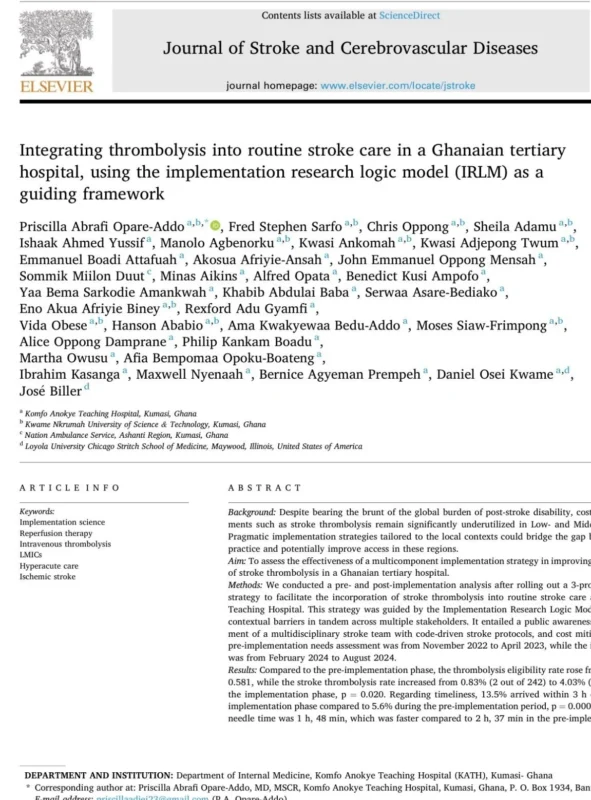
Title: Integrating thrombolysis into routine stroke care in a Ghanaian tertiary hospital, using the implementation research logic model (IRLM) as a guiding framework
Authors: Priscilla Abrafi Opare-Addo, Fred Stephen Sarfo, Chris Oppong, Sheila Adamu, Ishaak Ahmed Yussif, Manolo Agbenorku, Kwasi Ankomah, Kwasi Adjepong Twum, Emmanuel Boadi Attafuah, Akosua Afriyie-Ansah, John Emmanuel Oppong Mensah, Sommik Miilon Duut, Minas Aikins, Alfred Opata, Benedict Kusi Ampofo, Yaa Bema Sarkodie Amankwah, Khabib Abdulai Baba, Serwaa Asare-Bediako, Eno Akua Afriyie Biney, Rexford Adu Gyamfi, José Biller
Stay updated on all scientific advances with Hemostasis Today.
-
Oct 10, 2026, 17:58Archo Farzana Batool: Exploring Medical Writing Through an Article on Iron Deficiency Anemia
-
Oct 10, 2026, 17:53Assessing Frailty in Adults With Hemophilia – JTH
-
Oct 10, 2026, 17:52Fatma Sadeghi: Reducing Maternal Health Inequalities Through Nursing Advocacy
-
Oct 10, 2026, 17:50Grzegorz Hensler: How Apheresis Transformed Blood Cell Separation and Collection
-
Oct 10, 2026, 17:47Hemant K Sharma: Japan’s Universal Artificial Blood Research – A Potential Breakthrough in Transfusion Medicine
-
Oct 10, 2026, 17:40John Strouse: Learning About Bleeding Disorders and Sickle Cell Disease at FWGBD
-
Oct 10, 2026, 17:34Mae Caime: Speaking at the Annual Women’s Retreat for the Hemophilia Community in Florida
-
Oct 10, 2026, 17:30Chokri Ben Lamine: PNH beyond the Textbook Triad
-
Oct 10, 2026, 17:29Ruah Alyamany: Thrombosis and Anticoagulation in Hematological Malignancies at SOHO KSA 2026