


Nathan Connell: Connecting History with the Future of VWD Care
Nathan Connell, Clinical Chief of Hematology at Brigham and Women’s Faulkner Hospital, shared a post on Linkedln about a recent article he and his colleagues co-authored, published in Haemophilia, adding:
“In 2024, I traveled to Föglö in the Åland archipelago for the Seventh Aland Island Meeting on von Willebrand Disease.
I wrote then about the significance of returning to the place where Erik von Willebrand first described the disorder nearly a century ago.
It was a rare opportunity to connect the history of the field with the current work needed to improve diagnosis, treatment, and access for people living with VWD.
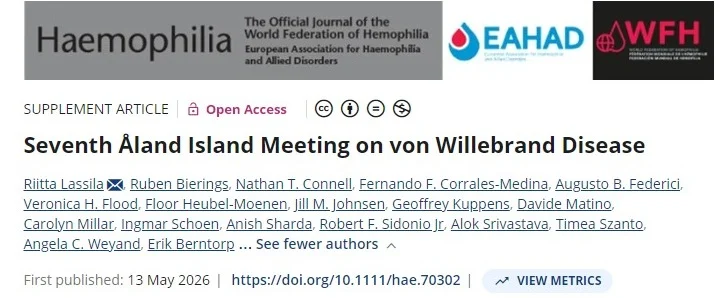
I am pleased to share that our meeting summary has now been published in Haemophilia Journal: ‘Seventh Åland Island Meeting on von Willebrand Disease.’
The manuscript captures several themes that remain central to the future of VWD care:
- VWD is common, heterogeneous, and still under-recognized, with diagnostic delays that continue to affect quality of life and treatment access.
- Bleeding assessment tools, newer VWF activity assays such as VWF and VWF, genotype-informed interpretation, and standardized diagnostic pathways are changing the diagnostic landscape.
- Women’s health remains a central priority, including heavy menstrual bleeding, pregnancy, postpartum hemorrhage, iron deficiency, and the need for stronger hematology–gynecology collaboration.
- Defining “severe VWD” more consistently is essential for clinical decision-making, prophylaxis access, reimbursement, and clinical trial design.
- Emerging data support prophylaxis for selected patients with clinically severe VWD, while personalized and pharmacokinetic-guided approaches require further study.
- The next phase of progress will depend on multidisciplinary collaboration among clinicians, laboratory scientists, geneticists, biologists, patient communities, and industry partners.
I was grateful to contribute the section on navigating the diagnostic landscape in VWD, including the persistent challenge of delayed diagnosis, the appropriate role of bleeding assessment tools, and the need to adapt guideline-based diagnostic algorithms to real-world and differently resourced settings.
Thank you to Octapharma for supporting this meeting and making it possible for us to gather in Aland for such a thoughtful and productive discussion.
Congratulations and thanks to my coauthors and colleagues.”
Title: Seventh Åland Island Meeting on von Willebrand Disease
Authors: Riitta Lassila, Ruben Bierings, Nathan T. Connell, Fernando F. Corrales-Medina, Augusto B. Federici, Veronica H. Flood, Floor Heubel-Moenen, Jill M. Johnsen, Geoffrey Kuppens, Davide Matino, Carolyn Millar, Ingmar Schoen, Anish Sharda, Robert F. Sidonio Jr, Alok Srivastava, Timea Szanto, Angela C. Weyand, Erik Berntorp
Other posts featuring Nathan Connell on Hemostasis Today.
-
Jun 2, 2026, 17:55Anna Rivera: Hemophilia Management – A Shift from Traditional IV Therapies to Novel Subcutaneous Agents
-
Jun 2, 2026, 17:53Zoya Surayya: My Thesis on Anticoagulation After Ischemic Stroke
-
Jun 2, 2026, 17:49Jeffrey Hall: A Pivotal Moment to Protect Rhode Island Wildlife from Anticoagulant Rodenticides
-
Jun 2, 2026, 17:38Arun V. J: The Most Racist Cell In The Human Body is The Red Blood Cell
-
Jun 2, 2026, 17:34Leonard Valentino: How We Protect Joints in People With Hemophilia
-
Jun 2, 2026, 17:26Puvaneswaran Akash: Emergency Management of Acute Myocardial Infarction
-
Jun 2, 2026, 15:28Kabilan K. L.: Management and Diagnosis of Acute Coronary Syndrome Types
-
Jun 2, 2026, 15:26Mital Jhaveri: What New Data Reveal About DOACs and Androgen Receptor Inhibitors?
-
Jun 2, 2026, 15:22Dhananjaya Kotebagilu Narayana Vamyanmane: High-Resolution Ultrasound Evaluation of Bowel Wall Ischemia