


Priya Prasad: In Massive Hemorrhage, Fibrinogen Is Often the First Clotting Factor to Fall
Priya Prasad, Senior Specialist at Caritas Hospital, shared a post on LinkedIn:
“When a patient is bleeding out, one link is too often forgotten.
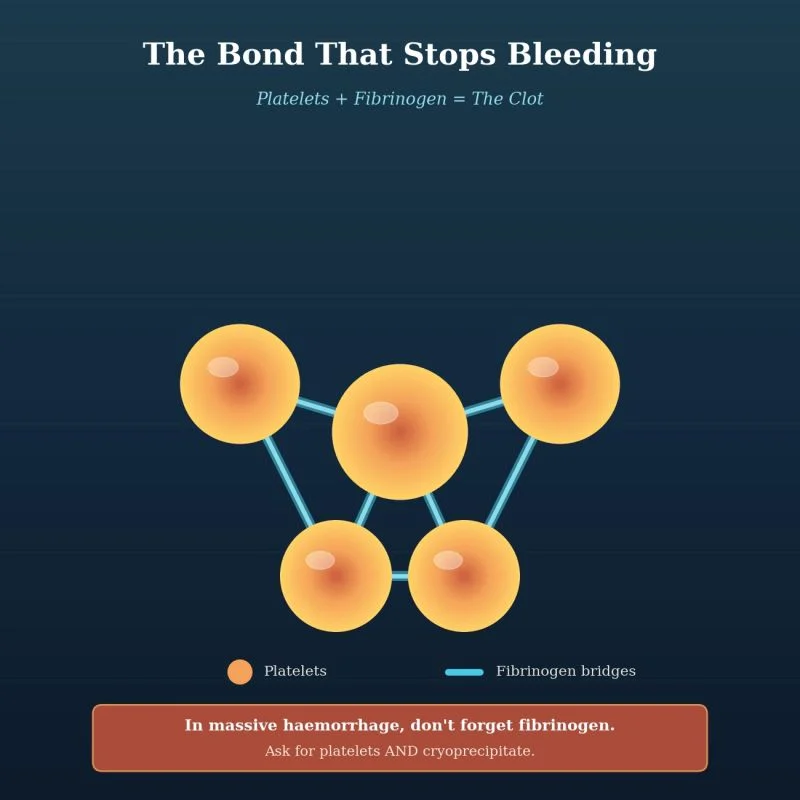
Platelets and fibrinogen work together.
The part that gets missed:
In massive haemorrhage, fibrinogen is often the first clotting factor to fall — sometimes before the platelet count even drops.
Focus only on platelets or the INR, and you can miss the very thing holding the clot together. Activated platelets can’t form a stable plug on their own!
Fibrinogen is the bridge that binds them, linking platelet to platelet through their GPIIb/IIIa receptors. Thrombin then converts that fibrinogen into fibrin – the mesh that locks the whole clot in place.
So don’t stop at platelets!
Ask for platelets and cryoprecipitate. Let that bond do what it’s designed to do — form a clot.”
More posts featuring Priya Prasad on Hemostasis Today.
-
Sep 17, 2026, 20:38Konstantinos Bistas: Reduced Circulating Tregs in Pediatric Chronic Neutropenia
-
Sep 17, 2026, 15:33Gopal Patidar: Honoured to Contribute to the ASFA 2026 Guidelines for Therapeutic Apheresis
-
Sep 17, 2026, 20:36Cosima C. Hoch: Developing a 3D Organotypic Co-Culture Model for Pleomorphic Adenoma
-
Sep 17, 2026, 20:19Riten Kumar: Boston Children’s Hospital Ranked No. 1 in Seven Pediatric Specialties
-
Sep 17, 2026, 20:17Katrina Snow: Whole Blood or Component Therapy – Which Would You Choose?
-
Sep 17, 2026, 16:30Daria Camilli: Empowering Bleeding Disorder Advocacy Through Health Economics
-
Sep 17, 2026, 16:17Mehran Ghasemzadeh: Platelet NK Cell Crosstalk in Advanced Coronary Artery Disease
-
Sep 17, 2026, 16:16Barbara Adams Krolak: Do GLP-1s Affect Blood Clot Risk?
-
Sep 17, 2026, 15:46Heghine Khachatryan: Clinical Context at the Core of Thrombosis and Thrombophilia Management